


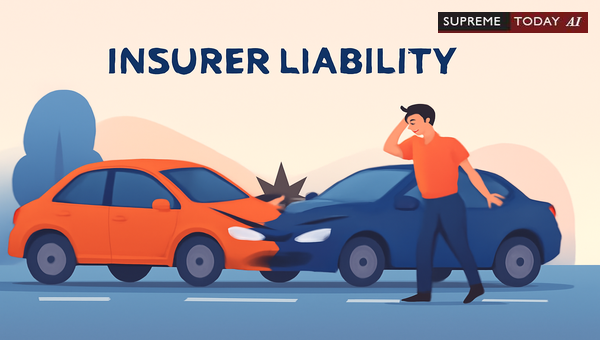
for Minor Drivers: SC Ruling AIR 2009 SC 24
Introduction
Motor vehicle accidents often raise complex questions about insurance liability, especially when the driver is a minor or lacks a valid license. A landmark judgment in United India Insurance Co. Ltd. v. Rakesh Kumar Arora and Ors. (AIR 2009 SC 24) addressed this head-on. The case centered on whether an insurance company can evade paying simply because of a , such as an underage or unlicensed driver.
If you've ever wondered: What does United India Insurance Company Limited Verses Rakesh Kumar Arora and Ors Air2009sc24 mean for accident victims and insurers? This blog breaks it down, drawing from the ruling and related precedents. We'll explore how courts protect claimants while holding insurers accountable—generally speaking, as laws can vary by facts.
Case Overview: The Facts and Dispute
In this pivotal case, an accident involved a minor driver without a valid license, leading to claims under the . The initially held the insurer liable, but the absolved it due to the breach. The intervened, restoring the 's order.
The Court emphasized that insurance policies for motor vehicles are typically Act only policies, designed to protect third parties. Mere allegations of breach don't suffice; the insurer must prove it. AIR 2009 SC 24.
Key Principle: Insurer's
The clarified a crucial point: a breach of policy conditions by the insured or driver does not automatically absolve the insurance company from liability. Instead:
- The insurer is duty-bound to satisfy the third-party claim first.
- It can then recover the amount from the insured (owner or driver) if the breach is established. AIR 2009 SC 24.
This approach prioritizes victim compensation. The Court stressed: The insurer must prove breach of policy conditions to avoid liability; otherwise, it remains liable to pay the claim. AIR 2009 SC 24.
Why This Matters
Under , insurers can't dodge responsibility lightly. This ruling aligns with public policy favoring quick payouts to accident victims, who shouldn't chase owners or drivers.
Driver's Age and Licensing: Not an Automatic Defense
The case highlighted a minor driver without a license. prohibit unlicensed or underage driving (under 18 in public places). Yet, the Court held:
- The driver's status is relevant but not conclusive.
- Insurer pays first, then recovers if breach proven. AIR 2009 SC 24.
Similar views echo in precedents. For instance, The Insurance Company must prove the owner's knowledge of the driver's unlicensed status to escape liability; mere allegations are insufficient. 2024 0 Supreme(Guj) 2022.
In another ruling, the court noted: the owner is only required to verify the driving skills of the driver, not the authenticity of the driving licence. 2024 0 Supreme(Guj) 2022. This shifts the burden squarely to the insurer.
Broader Precedents and Related Cases
The 's stance draws from and influences numerous decisions:
National Insurance Co. Ltd. v. Ram Parsad Kushwaha (AIR 2009 Patna 48): Owner liable for unlicensed driver, reinforcing insurer's initial payout duty. AIR 2009 SC 24.
In a case involving negligent parking, The court established that negligence in vehicular accidents must be clearly evidenced, and must be carefully assessed. 2023 0 Supreme(P&H) 1857. This underscores proof requirements across claims.
The Insurance Company can be exonerated from liability if the insured had handed over the vehicle for being driven by an unlicensed driver. 2014 0 Supreme(Del) 1240. But proof is key—willful breach needed. 2014 0 Supreme(Sikk) 62
Echoing the principle: a willful breach by the insured is required for the insurance company to avoid liability under the . 2014 0 Supreme(Sikk) 62.
Further, prohibits driving... by any person under the age of eighteen years. Yet, insurers bear the onus.
.
These cases, like referenced in 2024 0 Supreme(Guj) 2022, consistently hold that insurers can't rely on unproven breaches.
| Key Elements | Insurer's Obligation | Recovery Option ||--------------|---------------------|-----------------|| (e.g., Minor Driver) | Pay claim first | Recover from insured if proven || Sections 3,4,5 MV Act | Prohibits unlicensed driving | Insurer proves causation || Third-Party Protection | Statutory priority | Post-payment recovery |
and Decisions Restored
The set aside the 's exoneration, reinstating the 's award. The insurer was liable, with rights to recover from owner/driver upon proving breach. This typically ensures faster justice for claimants. AIR 2009 SC 24.
In related appeals, such as those dismissing insurer claims without proof, courts reiterate: Appeal of the Insurance Company dismissed due to failure to establish owner awareness. 2024 0 Supreme(Guj) 2022.
Practical Implications for Claimants, Owners, and Insurers
- Claimants: Benefit from insurer's primary liability—quicker payouts.
- Owners/Insured: Must ensure licensed drivers; face recovery if not.
- Insurers: Gather evidence early; mere charge-sheet allegations won't do. 2024 0 Supreme(Guj) 2022.
For example, in a fatal accident claim, the court found that the Insurance Company did not establish that the owner was aware of the driver's lack of a valid licence. 2024 0 Supreme(Guj) 2022.
Other sources highlight procedural nuances, like against owners or liberty to file fresh claims against drivers. 2018 0 Supreme(Gau) 1477,
.
Conclusion and Key Takeaways
United India Insurance v. Rakesh Kumar Arora (AIR 2009 SC 24) solidifies that insurers generally can't escape liability for policy breaches like minor or unlicensed drivers without proof. They pay first, recovering later if warranted. This claimant-friendly approach, supported by precedents, balances protection with accountability.
Key Takeaways:- Breach doesn't auto-exonerate; prove it caused the accident.- Focus on Sections 149 MV Act for defenses.- Owners verify skills, not just licenses.
Disclaimer: This is general information based on public judgments, not specific legal advice. Consult a qualified lawyer for your situation, as outcomes depend on facts.
Key Citation: United India Insurance Co. Ltd. v. Rakesh Kumar Arora, AIR 2009 SC 24.
Stay informed on evolving insurance law—share your thoughts below!
#InsuranceLiability #MotorAccidentClaims #SupremeCourtRuling












