


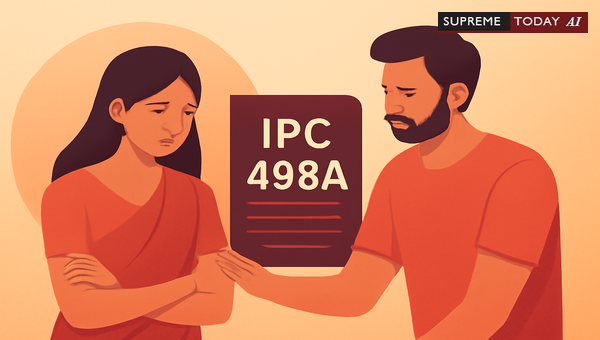
Does Apply to Live-In Relationships?
In today's evolving social landscape, live-in relationships are increasingly common in India. But what happens when disputes arise involving allegations of ? A frequent question is: whether attracts in cases? This provision of the (IPC) is designed to protect women from by husbands or their relatives. However, its application to non-marital cohabitation remains nuanced and fact-specific.
This blog post delves into key judicial interpretations, highlighting when may apply to live-in partners and when it does not. We'll draw from landmark cases to provide clarity, while emphasizing that this is general information—not legal advice. Consult a qualified lawyer for your specific situation.
Understanding
IPC penalizes a husband or his relatives for subjecting a woman to . includes:- Willful conduct likely to drive her to suicide or grave injury.- Harassment to coerce her into meeting unlawful demands for property or valuables.
The section explicitly targets husband or the relative of the husband. But courts have grappled with defining husband in modern contexts like live-in relationships. 1987 0 Supreme(AP) 532
When Does Apply to Live-In Relationships?
Courts have held that formal marriage isn't always required if the relationship mimics a marital one. In a pivotal case, the court observed that parties like husband and wife—sharing income, cohabiting, and holding themselves out as spouses—can trigger . The deceased's dying declaration referred to the accused as her husband, who allegedly set her ablaze after pouring kerosene. The court ruled:
Their relationship is that of husband and wife. We do not see any reason why S. 498-A, IPC cannot be applied to a case where a person inflicts such and harassment as to lead his mistress to commit suicide. 1987 0 Supreme(AP) 532
This establishes that —marked by domestic cohabitation, emotional bonds, and social recognition as spouses—may qualify. The legal principle extends protection beyond legal marriages to prevent in relationships resembling marriage. 1987 0 Supreme(AP) 532
Key factors courts consider:- Cohabitation duration and nature: Long-term shared living like spouses.- Mutual acknowledgment: Parties referring to each other as husband/wife.- evidence: Physical harm, harassment, or suicide inducement.
Contrasting Judicial Views: Not Always Applicable
Not all live-in scenarios attract . Several rulings emphasize a or strict adherence to statutory ingredients.
In one case, the court clarified: The would not attract the offence of , which can only be attracted in a valid and legal . 2025 Supreme(Online)(Kar) 33819 Yet, it also noted 's scope extends to relationships in nature of marriage, including , protecting women regardless of legal validity. 2025 Supreme(Online)(Kar) 33819
Another judgment stressed: From the perusal of Section 498-A of IPC, it is explicit that to attract the ingredients of this Section, a woman must be subjected to by her husband or his relative. Mere allegations without these elements warrant . 2025 Supreme(Online)(Tel) 54248
Extra-Marital or Casual Relationships
Extra-marital affairs or casual cohabitation often fall outside . Multiple courts have ruled:
, per se, or as such would not come within the ambit of Section 498 A IPC. It would be an illegal or immoral act, but other ingredients are to be brought home so that it would constitute a criminal offence. 2022 0 Supreme(Mad) 3403 2022 0 Supreme(All) 5 2020 0 Supreme(Guj) 284 2018 0 Supreme(Jhk) 1562 2018 0 Supreme(Mad) 3649
For instance:- In a matrimonial dispute involving alleged homosexuality and threats, proceedings were quashed due to insufficient evidence of driving suicide. 2022 0 Supreme(Mad) 3403- A dowry demand case without proven assault or injury led to acquittal, underscoring the need for specific elements. 2024 0 Supreme(Ker) 381- Bail was granted in an case linked to an extra-marital affair, as it didn't meet thresholds, let alone 498A. 2022 0 Supreme(All) 5
These cases highlight: Mental torture or abnormal behavior may qualify as , but proof is essential, and casual ties don't suffice.2020 0 Supreme(Guj) 284
Exceptions and Limitations
- Mere cohabitation: Short-term or non-committal typically doesn't qualify unless it exhibits marital characteristics.
- No proven: Demands alone without harassment or injury fail. 2024 0 Supreme(Ker) 381
- Void or deceitful marriages: Protection may still apply if relationship simulates marriage. 2025 Supreme(Online)(Kar) 33819
- Procedural issues: Duplicate proceedings or weak evidence lead to quashing. 2025 Supreme(Online)(Kar) 33819 2025 Supreme(Online)(Tel) 54248
Broader Implications for Live-In Couples
Live-in relationships offer no automatic legal marriage presumption under current law (unlike some countries). However, the Supreme Court has recognized live-in partners' rights in maintenance and inheritance via the . bridges gaps for but requires judicial scrutiny to avoid misuse.
Legal practitioners should evaluate:1. Relationship depth (cohabitation proof, shared life).2. specifics (medical reports, witness statements).3. Accused's status (akin to husband/relative).
1987 0 Supreme(AP) 532 2025 Supreme(Online)(Kar) 33819
Key Takeaways
- Yes, potentially: If live-in mimics marriage and is proven. 1987 0 Supreme(AP) 532
- No, typically: For casual, extra-marital, or unproven cases. 2022 0 Supreme(Mad) 3403 2025 Supreme(Online)(Kar) 33819
- Always gather robust evidence; courts prioritize facts over labels.
- Misuse risks: False cases can be quashed, but genuine victims deserve protection.
In conclusion, while may apply to live-in relationships resembling marriage, outcomes hinge on facts. This evolving area reflects India's balance between tradition and modernity. For personalized guidance, seek professional legal counsel.
Disclaimer: This post provides general insights based on judgments like 1987 0 Supreme(AP) 532, 2025 Supreme(Online)(Kar) 33819, 2025 Supreme(Online)(Tel) 54248, 2024 0 Supreme(Ker) 381, 2022 0 Supreme(Mad) 3403, 2022 0 Supreme(All) 5, 2020 0 Supreme(Guj) 284, 2018 0 Supreme(Jhk) 1562, and 2018 0 Supreme(Mad) 3649. Laws change, and individual cases vary. Not legal advice.
#IPC498A #LiveInRelationships #MatrimonialLaw












