


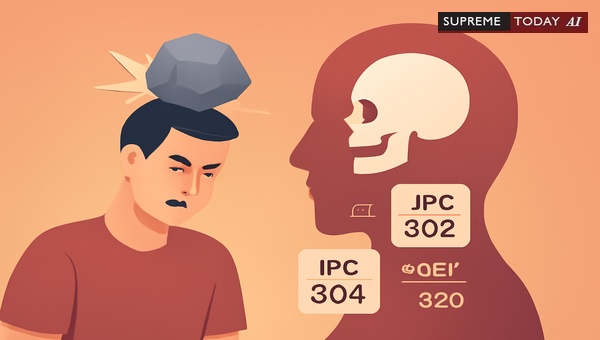
Hitting Someone on the Head with a Stone: Which IPC Sections Apply?
In heated altercations or sudden fights, acts of violence like hitting someone on the head with a stone can lead to severe legal consequences under the (IPC). The question often arises: Hitting Stone on Head which Section Attract? This seemingly simple act can trigger charges ranging from to , depending on intent, circumstances, and injury outcome. This blog post breaks down the relevant IPC provisions, key judicial insights, and factors courts consider, drawing from legal precedents. Note: This is general information, not legal advice. Consult a qualified lawyer for specific cases.
Understanding the Legal Framework
The IPC classifies offenses based on the nature of the act, the weapon used, the intent (), and the result (e.g., death or injury). A stone, while not a conventional weapon, can be deemed dangerous if used with force on a vulnerable area like the head. Courts evaluate:- Intent: Was it or impulsive?- Injury severity: Fatal, grievous, or simple?- Circumstances: , provocation, or deliberate attack?
These elements determine if the case falls under , , or hurt provisions.
Relevant IPC Sections for Hitting with a Stone on the Head
: Punishment for
This is the gravest charge, applicable when the act causes death with intent to kill or knowledge that it would likely cause death. Hitting the head with a stone, a vital area, often attracts this if injuries prove fatal.
For instance, cases show convictions under Section 302 where the accused intentionally caused fatal head injuries using a stone 2023 0 Supreme(Mad) 41 2013 0 Supreme(Bom) 944. In one scenario, you committed intentionally causing the death of your father... by hitting with a stone on his head indiscriminately 2018 0 Supreme(AP) 407. Similarly, His head hit on a huge stone, which caused his death highlights how such acts can lead to charges 2019 0 Supreme(UK) 457.
: Not Amounting to
If there's no clear intent to kill but death occurs due to , or in sudden fights, Section 304 applies (Part I for knowledge of death likelihood, Part II for rashness). This is common in impulsive stone attacks.
Courts have ruled: We are not satisfied that the appellant had the intention to cause death... But he caused the death of Babu by hitting with MO1 stone on the head 2019 0 Supreme(Ker) 1050. Another case notes, There is no element to attract an offence under section 302 of IPC. The immediate provocation of two groups resulted in a scuffle 2022 Supreme(Online)(KER) 36447 2022 Supreme(Online)(KER) 21364. If not but from , Section 304 fits 2001 0 Supreme(Raj) 919.
: Voluntarily Causing
When no death occurs but serious injuries result (e.g., fractures, disfigurement), this section applies for non-.
Relevant for stone-induced head injuries without fatality: 1960 0 Supreme(SC) 111 2021 0 Supreme(Jhk) 1056.
: by
Stones qualify as dangerous if heavy and used forcefully. Head strikes often lead here for grievous injuries.
Examples include: 2005 1 Supreme 215 2021 0 Supreme(Jhk) 216. Medical evidence of head fractures supports this 2022 Supreme(Online)(KER) 36447.
Key Factors Influencing the Charge
1. Intent and Circumstances
Intent is pivotal. attacks lean toward Section 302, while sudden quarrels favor Section 304. The intent behind the act and the circumstances surrounding it are crucial. If the act was committed in a without premeditation, it may fall under 2023 0 Supreme(Mad) 41 2001 0 Supreme(Raj) 919. Impulsive acts in rage often downgrade charges 2024 Supreme(Online)(Kar) 42887 2024 Supreme(Online)(KAR) 21063 2025 0 Supreme(Ker) 1897.
2. Nature of the Stone as a Weapon
A heavy stone used with force can be dangerous, attracting Section 326 2005 1 Supreme 215 2014 0 Supreme(AP) 244. However, it doesn't automatically mean ; depends on context 2025 0 Supreme(Ker) 1897.
3. Medical Evidence and Injury Nature
Head injuries to vital parts are severe. Medical reports indicating the nature of injuries (e.g., grievous or fatal) play a significant role 2013 0 Supreme(Bom) 944 2006 0 Supreme(Mad) 2366. Post-mortems showing fatal head trauma support Section 302 2016 0 Supreme(Kar) 205, where The head injuries as mentioned in post mortem are likely to occur when the victim was pushed and subsequent fall on the stone (with head hitting the stone).
Eyewitness accounts strengthen cases: She saw that Hamira while sitting on Prabhu was hitting his head with stone. On account of the head injury, blood was oozing out 2018 0 Supreme(Raj) 179.
Insights from Notable Cases
Legal documents reveal patterns:- Fatal Intentional Strikes: Convictions under 302 for indiscriminate head blows 2018 0 Supreme(AP) 407
2025 Supreme(Online)(Bom) 3941 2023 3 Supreme 508 2023 0 Supreme(Gau) 735.- Spontaneous Fights: Downgraded to 304 Part II or 326, e.g., scuffles with stones where no premeditation 2022 Supreme(Online)(KER) 36447 2022 Supreme(Online)(KER) 21364 2025 0 Supreme(Ker) 1897.- Non-Fatal : Sections 325/326 for fractures without death 1960 0 Supreme(SC) 111 2021 0 Supreme(Jhk) 1056.- Other offenses like 323/324 may apply initially 2021 Supreme(Online)(KER) 19710.
Courts emphasize: The use of a stone to hit the head can be considered an offence under if it causes death, especially when the injury is fatal and the act is intentional
. But in cases where injuries are inflicted impulsively... courts are less likely to attribute the offence to 2025 0 Supreme(Ker) 1897.
Conclusion and Key Takeaways
Hitting someone on the head with a stone typically attracts Sections 302, 304, 325, or 326 IPC, based on outcome and intent. Fatal intentional acts invoke 302; impulsive ones, 304 or lower. Always gather robust evidence like medical reports and witness statements.
Key Takeaways:- Assess Intent: Premeditation vs. provocation decides vs. .- Weapon Classification: Stones can be dangerous for 326.- Evidence is King: Medical and circumstantial proof sways courts.- Charge Strategy: Argue circumstances to mitigate from 302 to 304/326.
This analysis is for informational purposes only. Laws evolve, and outcomes vary by facts. Seek professional legal counsel.
References (select cases):2023 0 Supreme(Mad) 41 2013 0 Supreme(Bom) 944 2001 0 Supreme(Raj) 919 1960 0 Supreme(SC) 111 2021 0 Supreme(Jhk) 1056 2005 1 Supreme 215 2014 0 Supreme(AP) 244 2019 0 Supreme(Ker) 1050 2018 0 Supreme(AP) 407 2018 0 Supreme(Raj) 179 2016 0 Supreme(Kar) 205
#IPCLaw, #CriminalLawIndia, #GrievousHurt












