


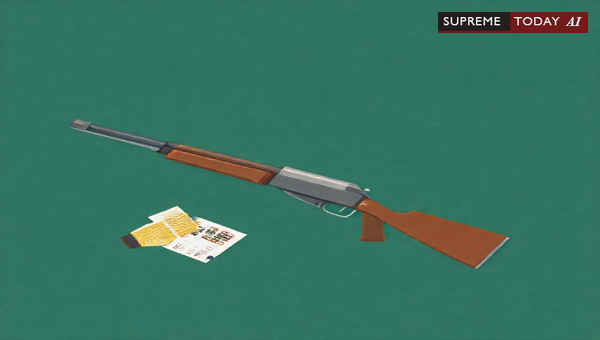
Whether a Rifle Falls Within the Definition of Under the
The classification of a rifle as a carries serious consequences in Indian criminal law. A conviction under — which prescribes the death penalty for using or in a manner resulting in death — hinges entirely on whether the weapon used answers the statutory description of a . This raises a recurring question in trials and appeals: is a rifle, by its very nature, a under the ?
The short answer, drawn from a consistent line of judicial decisions, is that a rifle is not automatically a . The classification depends on two distinct criteria, and courts have repeatedly set aside convictions where the prosecution failed to establish either.
The Statutory Test in Section 2(1)(i)
The definition of in targets firearms that are so designed or adapted that, if pressure is applied to the trigger, missiles continue to be discharged until pressure is removed or the magazine is emptied. This is the primary test for whether any firearm, including a rifle, qualifies as a . 2009 0 Supreme(P&H) 1010 and 2009 0 Supreme(Gau) 674
In practical terms, this definition captures automatic or self-loading weapons of that specific design. An AK-47 or similar that discharges missiles continuously until the magazine is emptied or the trigger pressure is released falls squarely within the Section 2(1)(i) definition and is a even without any specific notification. 2009 0 Supreme(Gau) 674
How Courts Have Treated Bolt-Action and Semi-Automatic Rifles
Courts have consistently held that a does not satisfy this definition. In the context of a 7.62 mm , a court explained that the weapon has to be bolted every time a shot is fired, so continued pressure on the trigger results in the discharge of only one missile, and no further missiles are discharged until the bolt is operated again. Such a rifle therefore cannot be described as a under Section 2(1)(i). 2009 0 Supreme(P&H) 1010
The same reasoning was applied to a .303 rifle, which was held not to be a because it is a bolt-action weapon requiring manual intervention between shots. 2014 0 Supreme(P&H) 1471 The bore or calibre of a rifle — whether .303, 7.62 mm, or otherwise — is not the deciding factor; the design of the firing mechanism is what matters. 2009 0 Supreme(P&H) 1010 and 2014 0 Supreme(P&H) 1471
Notably, categorises arms for licensing purposes but does not itself expand or alter the statutory definition of in Section 2(1)(i). 2009 0 Supreme(P&H) 1010 and 2000 0 Supreme(P&H) 212
The Role of
The second route to classification is found in , under which the Central Government may, by notification in the , specify any other arms — including non-automatic firearms — to be . A rifle that does not meet the automatic-discharge definition of Section 2(1)(i) may still be a if it has been specifically notified as such. However, in the absence of such a notification, a rifle that is not automatically discharging cannot be treated as prohibited. 2009 0 Supreme(Gau) 674 and 2000 0 Supreme(P&H) 212
Proof Requirements for Conviction Under Section 27(3)
Section 27(3) prescribes the death penalty for using any or in a manner that results in death. For this section to be attracted, the prosecution must establish that the weapon used was a . Where the weapon was a licensed rifle and the prosecution failed to prove it was either automatic within the meaning of Section 2(1)(i) or notified as prohibited, the conviction under Section 27(3) was set aside. The in emphasized that the conviction under Section 27 cannot be sustained unless the weapon used answers the description of a , and the mere fact that a weapon was used for an unlawful purpose is not enough. 2003 8 Supreme 499 and 2014 0 Supreme(P&H) 1471
In similar fashion, where arms were seized without any ammunition and it was not proved that the seized weapon was a , conviction under was not established, though conviction under was sustainable. 2014 0 Supreme(Pat) 901
Pramod Rai vs The State Of Bihar
This underlines the broader principle that conviction under Section 25 of the Arms Act cannot be sustained without expert or corroborative evidence regarding the nature of the recovered weapon. 2026 0 Supreme(All) 736 The prosecution should also prove by expert evidence that the injuries were caused by the weapon alleged. 2020 0 Supreme(SC) 637Distinguishing Licensed Possession from Prohibited Status
A rifle that is licensed and possessed under a valid arms licence is not ipso facto a . The Arms Act distinguishes between the regulatory regime for licensed firearms (Sections 3, 5, 13) and the prohibition on certain categories of arms (Sections 7, 27). The conviction under Section 27 requires a separate finding that the weapon falls within the prohibited category — a question of , not merely of licensing status. 2009 0 Supreme(Gau) 674 and 2000 0 Supreme(P&H) 212
It is also worth noting the licensing distinction between the two categories: while dealing with in any manner is totally prohibited unless specifically permitted by the Central Government under , applications for licences for are ordinarily to be allowed, whereas applications for are not ordinarily to be allowed. 2010 0 Supreme(Cal) 106 and 2020 0 Supreme(MP) 57
Practical Steps for Assessing a Rifle's Classification
When assessing whether a specific rifle is a , the following sequence generally applies:
- Determine the firing mechanism. Ask whether the rifle is designed or adapted to discharge missiles continuously on sustained trigger pressure (Section 2(1)(i)). If not, it is not a on that ground alone.
- Check for a . Verify whether a notification in the has specified that rifle as prohibited.
- Examine the evidentiary record. In Section 27(3) cases, independent and corroborative evidence — such as an expert ballistic report or arms expert opinion — is essential to establish that the weapon used was a . 2026 0 Supreme(All) 736 and 2020 0 Supreme(SC) 637
For licensing purposes, a member of a rifle club or rifle association licensed by the Central Government may use a .22 bore rifle or air rifle for target practice, but possession of more than two firearms is still restricted under unless the exception in is strictly complied with. 2024 0 Supreme(Guj) 115 and 2024 0 Supreme(Ker) 293 Courts have clarified that a member of a rifle club or association can only possess a third firearm for target practice with a licence under , and cannot possess it at all times. 2023 0 Supreme(Del) 4352
Key Takeaways
- A bolt-action or semi-automatic rifle that does not discharge missiles continuously on sustained trigger pressure is generally not a merely by virtue of its bore or design, unless it falls within a specific . 2009 0 Supreme(P&H) 1010
- Automatic weapons like the AK-47 are by definition, without needing any notification. 2009 0 Supreme(Gau) 674
- A conviction under Section 27(3) cannot rest on police testimony alone or the mere misuse of a licensed weapon; the prohibited character of the weapon must be independently proved. 2003 8 Supreme 499 and 2026 0 Supreme(All) 736
- The classification is a question of statutory definition, not of licensing status or Schedule I categorisation. 2000 0 Supreme(P&H) 212
This article provides general legal information based on judicial decisions and does not constitute legal advice for any specific case; the outcome in any particular matter will depend on its facts and the evidence on record.
#ArmsAct1959 #ProhibitedArms #CriminalLaw #ArmsLicence #Section27









