Searching Case Laws & Precedent on Legal Query.....!
Analysing the retrieved Case Laws
Scanned Judgements…!



Searching Case Laws & Precedent on Legal Query.....!
Analysing the retrieved Case Laws
Scanned Judgements…!
Definition of Dangerous Weapon - A writing pen can be considered a dangerous weapon if it is used in a manner likely to cause harm or death. Courts have recognized that even seemingly innocuous objects, like a pen or a pen-knife, can qualify as dangerous weapons if they are used as instruments of violence or are inherently capable of causing injury ["2024 Supreme(US)(ca3) 206"], ["2025 Supreme(US)(ca1) 2"].
Perception and Use in Context - The legal interpretation of a dangerous weapon includes objects that appear to be dangerous or are possessed with intent to cause harm. For example, a pen drive or a pen-knife used in a threatening or assaultive manner can be classified as a dangerous weapon based on its use or appearance ["2023 Supreme(US)(ca11) 71"], ["2025 Supreme(US)(ca1) 2"].
Legal Standards for Dangerous Weapons - Courts consider whether an object is inherently dangerous or perceived as dangerous, and whether it is used in a threatening or assaultive context. A pen, if used to inflict injury or with intent to threaten, may qualify as a dangerous weapon under this standard ["2024 Supreme(US)(ca3) 206"], ["2024 Supreme(US)(ca4) 53"].
Examples and Cases - Cases involving small weapons like pens or pen-knives have resulted in convictions for assault with a dangerous weapon, especially when used to cause injury or threaten violence. The nature of the weapon, such as a pen-knife, has been sufficient to establish the element of a dangerous weapon in criminal proceedings ["1956 0 Supreme(Ker) 155"], ["2024 Supreme(US)(ca4) 53"].
Conclusion - While a writing pen is generally not considered a dangerous weapon in everyday use, it can be classified as such in legal contexts if used in a threatening or violent manner, or if it is inherently capable of causing harm. The determination depends on the specific circumstances and manner of use ["2024 Supreme(US)(ca3) 206"], ["2024 Supreme(US)(ca4) 53"].
References:- ["2024 Supreme(US)(ca3) 206"]- ["2023 Supreme(US)(ca8) 421"]- ["2024 Supreme(US)(ca4) 53"]- ["1956 0 Supreme(Ker) 155"]- ["2023 Supreme(US)(ca11) 71"]
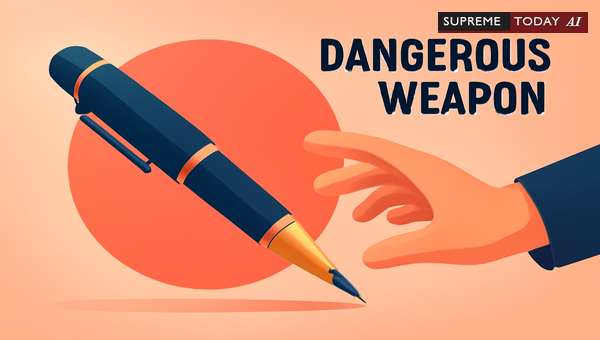
Imagine you're in a tense situation, and someone brandishes a pen—could that everyday writing tool land you in serious legal trouble as a ''? The question, is a writing pen a ?, often arises in criminal cases involving assaults, robberies, or public safety concerns. Under Indian law, the answer is generally no, but it hinges on specific factors like the object's nature, modification, and manner of use. This blog dives deep into legal principles, court precedents, and key considerations to clarify this nuanced issue.
Note: This article provides general information based on judicial interpretations and is not legal advice. Consult a qualified lawyer for case-specific guidance.
The (IPC) doesn't offer a rigid list of dangerous weapons. Instead, courts assess instruments based on their inherent characteristics and potential to cause death or . As outlined in legal documents, the necessary ingredients of a '' are: first, that it should be a weapon and capable of being used as such; and second, that it must be inherently lethal and if used in the intended manner is likely to result in death.
Similarly, classification is fact-specific, factoring in size, sharpness, and lethality. 2008 8 Supreme 366 Common household items rarely qualify unless wielded in a deadly fashion. This principle prevents over-criminalization of innocuous objects.
Courts emphasize that mere possession doesn't suffice; intent and capability matter.
Indian courts have consistently ruled that everyday items aren't inherently dangerous. In , the held that a knife qualifies as deadly if capable of fatal injury and used accordingly, but clarified: a knife may be of different types and it was not appropriate to consider only a particular type or size of knife as a . 2025 0 Supreme(Del) 622
This logic extends to pens. In , courts relied on Phool Kumar, noting the words ‘’ are of common use and do not require any interpretation. 2025 0 Supreme(Del) 622 No ruling categorizes a standard pen as deadly, as it lacks .
A pivotal observation comes directly: However, a pen is not a and merely carrying the said writing instrument, at the time of committing or , would not constitute an offence punishable under Section 398 of the IPC. 2020 0 Supreme(Del) 874 Even if a pen could theoretically cause harm, it must be inherently lethal—a bar a typical ballpoint pen doesn't meet.
Courts apply similar scrutiny to items like iron rods, sticks, and wooden objects:
In a criminal revision challenging charges under , an iron rod's status as dangerous was deemed a disputed question of fact for trial, based on circumstances—not inherent nature. The court noted: whether the weapon of offence was a or a has to be considered in the light of the facts and circumstances of each case and no generalization can be done. 2022 0 Supreme(MP) 988
For wooden sticks in an assault: The wooden stick can be categorized as a , but only tied to specific injuries, leading to conviction under , not higher sections. 2022 0 Supreme(Bom) 866
Firewood in a property dispute: Conviction altered from Section 326 to 324 IPC, as medical evidence showed simple hurt. 2016 0 Supreme(Mad) 3330
A rice pounder (M.O.1) was called dangerous because it could cause death if used, but pens lack such consensus. 2012 0 Supreme(Kar) 1126
These cases reinforce: context rules. A pen, designed for writing, mirrors non-lethal items unless modified (e.g., into a pen knife).
Exceptions exist:- Modification: A concealed blade or sharpened tip could reclassify it.- Manner of Use: If jabbed at vital areas causing grievous injury, it might support charges under , but not automatically as 'deadly.'- Intent: In robberies, mere possession doesn't trigger Section 398. 2020 0 Supreme(Del) 874
High courts stress: the classification depends on the specific facts and circumstances, including how the object is used, not solely on its appearance or general perception. 2008 8 Supreme 366
US cases (e.g., VICAR assault definitions) highlight similar debates but are non-binding in India, focusing instead on enumerated offenses. 2024 Supreme(US)(ca4) 193
Merely carrying a pen—even in heated disputes—typically doesn't attract weapon-related provisions.
2020 0 Supreme(Del) 874
In summary, while creative use might harm, Indian courts protect against deeming everyday tools as weapons. Stay informed, and for personalized advice, reach out to a legal expert.
References:-
, 2008 8 Supreme 366, 2025 0 Supreme(Del) 622, 2020 0 Supreme(Del) 874, 2022 0 Supreme(MP) 988, 2022 0 Supreme(Bom) 866, 2016 0 Supreme(Mad) 3330, 2012 0 Supreme(Kar) 1126 #DangerousWeapon, #IndianLaw, #IPCRulings



The Commission’s writing of the commentary, and our examination of it as needed, is not designed as an exercise in futility. The District Court correctly applied the dangerous- weapon enhancement to Chandler because of his use of a replica firearm. ... Dangerous Weapon, Black’s Law Dictionary (5th ed. 1979). ... weapon[,]” the Commission amended the commentary to say, “[w]here an object that appeared to be a dangerous weapon was brandished, d....
The relevant enhancement applies "[i]f a dangerous weapon (including a firearm) was possessed." See USSG § 2D1.1(b)(1). Application Note 11(A) to that section provides that the definitions of "dangerous weapon" and "firearm" are found in the commentary to USSG § 1B1.1. ... Finally, the definition of "firearm" contained in Application Note 1(H) explicitly states that BB guns are "a dangerous weapon but not a firearm." ... The district court determined that the BB gun was a #HL_....
Keene, 955 F.3d 391 (4th Cir. 2020), that for every charge of VICAR assault with a dangerous weapon the government must prove as an element the enumerated federal offense of “assault with a dangerous weapon.” 87 F.4th at 274. ... prove as an element the enumerated federal offense of assault with a dangerous weapon. 87 F.4th at 274. ... weapon.’” ... USCA4 Appeal: 22-6285 Doc: 47 Filed: 02/20/2024 Pg: 2 of 18 .......
Like § 2114(a) and § 111(b), every VICAR assault with a dangerous weapon requires (1) an assault and (2) the presence of a dangerous weapon in its commission. See 18 U.S.C. § 1959(a). ... Our precedents establish that VICAR assault with a dangerous weapon satisfies this standard. ... We must decide whether VICAR assault with a dangerous weapon is still one of them. Because we find that VICAR assault with ....
As established above, federal assault with a dangerous weapon easily qualifies as a crime of violence. ... Like § 2114(a) and § 111(b), every VICAR assault with a dangerous weapon requires (1) an assault and (2) the presence of a dangerous weapon in its commission. See 18 U.S.C. § 1959(a). ... We must decide whether VICAR assault with a dangerous weapon is still one of them. Because we find that VICAR assault with ....
Penal Code, s. 449-Being armed with dangerous weapon with intent to commit an unlawful act-Charge. ... When a person is charged under section 449 of the Penal Code with being armed with a dangerous weapon with intent to commit an unlawful act, the charge should allege what unlawful act he was intending to commit. ... There are two offences in that section, namely, the one being in possession of house-breaking implements without lawful excuse, and the other of being armed with a dangerous or o....

weapon. ... weapon'. ... It is alleged that all this time they were requiring the de facto complainant to hand over the pen drive. Thereafter the de facto complainant was taken to another place in a car. ... The prosecution also suggests the motive of assault as, to procure a pen drive from the de facto complainant. Of course, this is a matrimonial dispute between the parties. ... Similarly, the de facto complainant also possessed a pen drive, which claimed to contain certain information about the 1st ....

State decided on 13.2.2014 passed in Criminal Appeal No.414/2013, it is submitted by the counsel for the applicants that whether the weapon of offence was a deadly weapon or a dangerous weapon has to be considered in the light of the facts and circumstances of each case and no generalization can be done ... Under these circumstances, an iron rod cannot be said to be a dangerous weapon. 4. Per contra, the revision is vehemently opposed by the counsel for the State. ... The only contenti....
Tennes- see’s law prohibited selling, loaning, giving, or delivering “to any minor a pistol, bowie-knife, dirk, Arkansas tooth-pick, hunter’s knife, or like dangerous weapon, except a gun for hunting or weapon for defence in traveling,” TENN. ... Cooper eds. 1858) (making it unlawful to sell, loan, or give, “to any minor a pistol, bowie-knife, dirk, Arkansas tooth-pick, hunter’s knife, or like dangerous #HL....
Tennes- see’s law prohibited selling, loaning, giving, or delivering “to any minor a pistol, bowie-knife, dirk, Arkansas tooth-pick, hunter’s knife, or like dangerous weapon, except a gun for hunting or weapon for defence in traveling,” TENN. ... Cooper eds. 1858) (making it unlawful to sell, loan, or give, “to any minor a pistol, bowie-knife, dirk, Arkansas tooth-pick, hunter’s knife, or like dangerous #HL....

The wooden stick can be categorized as a dangerous weapon. The evidence on record does not permit us to attribute any intention or knowledge to the accused Nos.2, 3 and 4 to cause the death of PW-7-Deepak Meghanwar. The prosecution has proved that the injuries on the person of the PW-7-Deepak Meghanwar were caused by the wooden stick. Considering the nature of injuries caused by these accused Nos.2, 3 and 4 to the PW-7-Deepak Meghanwar and the nature of the weapon namely; sticks, the offence made out against these accused would be under Section 324 r/w Section 34 of the Ind....

However, a pen is not a deadly weapon and merely carrying the said writing instrument, at the time of committing robbery or dacoity, would not constitute an offence punishable under Section 398 of the IPC. Thus, the necessary ingredients of a ''deadly weapon'' are: first, that it should be a weapon and capable of being used as such; and second, that it must be inherently lethal and if used in the intended manner is likely to result in death. Even an innocuous writing instrument such as a pen, if used in a particular manner, may result in fatality.

That apart, size, width, length and other details of M.O.1 has not been furnished by the prosecution. Thus, there is dearth of material to hold whether M.O.1 is a dangerous weapon.

A weapon like MO1 is a dangerous weapon since it could cause death if used. Therefore, merely on the basis of the answer listed in the cross-examination of PW8, the user of MO1 cannot be doubted.

Weapon used for the commission of offence is a dangerous weapon. Nature of weapon used and injuries caused manifests intention of the accused to cause fatal injuries. In such facts and circumstances, conviction of the appellant is modified as Section 304/Part (I) IPC.


An indispensable Tool for Legal Professionals, Endorsed by Various High Court and Judicial Officers
Please visit our Training & Support
Center or Contact Us for assistance

Scan Me!
India’s Legal research and Law Firm App, Download now!


For Daily Legal Updates, Join us on :



 Back to top


