


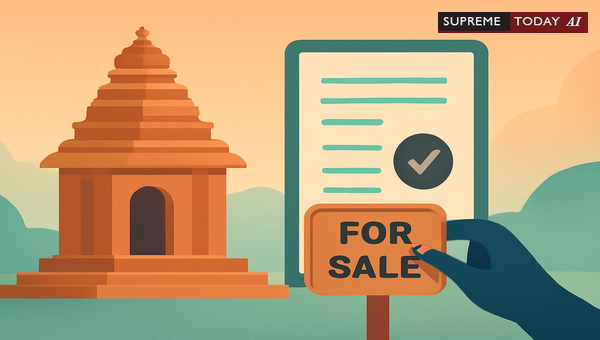
Can Be Sold? Legal Guide
In the realm of , holds a sacred status, often sparking questions among trustees, , and potential buyers: Can be sold? This seemingly straightforward query dives into complex layers of Hindu law, court oversight, and the vested in the deity itself. Whether you're a shebait managing temple lands or someone eyeing such properties, understanding these restrictions is crucial to avoid legal pitfalls.
This guide breaks down the legal framework, key restrictions, exceptions, and insights from landmark cases. Note that this is general information based on established precedents and should not replace professional legal advice tailored to your situation.
What is ?
refers to immovable assets formally dedicated for the worship or service of a Hindu deity. Once dedicated, it transitions from private ownership to a , governed primarily by Hindu religious and charitable endowments laws. 1969 0 Supreme(Cal) 206
The establishment requires clear intent and formal dedication, distinguishing it from personal holdings. Courts have historically been cautious in expanding this definition, requiring substantive proof for any additional claims. 1969 0 Supreme(Cal) 206
Legal Framework Governing Sales
Under Hindu law, debattar properties are not freely like ordinary real estate. explicitly states: no immoveable property or government securities belonging to the Debattar estate can be sold or leased for more than five years without the express permission of the . 1969 0 Supreme(Cal) 206
This underscores a core principle: the sale of typically requires prior court approval. The has upheld schemes mandating such oversight to safeguard the endowment's purpose. 1969 0 Supreme(Cal) 206
Ownership Vested in the Deity
A pivotal aspect is the nature of ownership. The deity is the legal owner, with (managers or trustees) acting as custodians. lack personal authority to sell; any transaction must align with the trust's religious objectives and secure . 1989 0 Supreme(Cal) 263
Attempting a unilateral sale invites challenges, as courts prioritize the deity's perpetual interests over temporary managerial needs.
Key Restrictions on Sale
- Court Approval Mandatory: No sale is valid without explicit permission from the competent court, such as the District Judge. This prevents misuse and ensures proceeds benefit the endowment. 1969 0 Supreme(Cal) 206
- Prohibition on Personal Sales: cannot treat the property as their own. Ownership vests in the deity, limiting trustees to administrative roles. 1989 0 Supreme(Cal) 263
- Leasing Limits: Even leases beyond five years need approval, maintaining control over long-term encumbrances. 1969 0 Supreme(Cal) 206
Historical judicial trends reinforce these barriers, declining to broaden debattar claims without rigorous evidence. 1969 0 Supreme(Cal) 206
Exceptions and Limitations
While outright sales face steep hurdles, nuances exist:
- Subordinate Interests: cannot be sold, but subordinate rights—like rent-receiving interests—may be created or retained. In one case, Ram Rakhal Ghose divested while keeping a . 1954 0 Supreme(Cal) 11
- Tax Considerations: Debattar properties enjoy no blanket tax exemption, potentially influencing management decisions. 1950 0 Supreme(Cal) 204
For development, may pursue construction with partners, but delays can lead to compensation claims, as seen where developers failed to complete multi-storied buildings on debattar land, causing rental losses. 2022 Supreme(Online)(NCDRC) 1006
Insights from Related Cases
Court precedents across trusts and endowments highlight consistent themes of judicial discretion:
- Trust Property Auctions: In a trust sale petition, the court permitted sale via public auction to the highest bidder (Rs. 5.02 crores), condoning minor delays and directing execution of the sale deed. This illustrates courts' willingness to approve sales under strict supervision when beneficial to the trust. 2013 0 Supreme(Mad) 3631
- Religious Property Disputes: Claims of partition or sale of temple-adjacent lands demand stringent proof. One appellate court reversed a finding, upholding joint ownership for religious use based on comprehensive evidence review. 2025 Supreme(Online)(Mad) 66725
- Partition and Prior Sales: In property suits, prior sales of shares don't extinguish others' rights without final decrees. Courts emphasize settled titles before allowing transfers. 2023 0 Supreme(AP) 801
Conversely, premature sales are quashed:
- Partnership or trust assets cannot be sold before account settlements. Orders for eviction or sale were set aside pending audits. 2010 0 Supreme(Mad) 5115 2010 0 Supreme(Mad) 110
These cases affirm: even for non-debattar trusts, sales hinge on necessity, fairness, and court nod—principles amplified for debattar estates.
Practical Recommendations
Navigating debattar sales demands caution:
- File for Court Approval: Petition the District Judge or relevant authority early, detailing necessity (e.g., temple maintenance). 1969 0 Supreme(Cal) 206
- Document Thoroughly: Substantiate dedication, ownership, and benefits to the deity to preempt disputes. 1989 0 Supreme(Cal) 263
- Consult Specialists: Engage lawyers versed in Hindu endowment and property law for petitions and compliance.
- Explore Alternatives: Consider with safeguards, but ensure timelines to avoid liability. 2022 Supreme(Online)(NCDRC) 1006
Conclusion and Key Takeaways
In summary, generally cannot be sold without express court permission, protecting its sacred purpose. must act as stewards, not owners, with judicial oversight ensuring alignment with religious intent. 1969 0 Supreme(Cal) 206 1989 0 Supreme(Cal) 263
Key Takeaways:- Always seek approval—unapproved sales risk invalidation.- Deity owns the property—personal gains are impermissible.- Exceptions are narrow—focus on subordinate rights or proven necessity.- Learn from cases—courts balance preservation with practical needs.
For or stakeholders, proactive legal steps preserve legacies while complying with law. This overview draws from precedents like 1969 0 Supreme(Cal) 206 1954 0 Supreme(Cal) 11 1950 0 Supreme(Cal) 204 1989 0 Supreme(Cal) 263, but consult experts for your case.
Disclaimer: This article provides general insights and is not legal advice. Laws evolve; verify with qualified professionals.
#DebattarProperty, #HinduLaw, #PropertyLawIndia












