


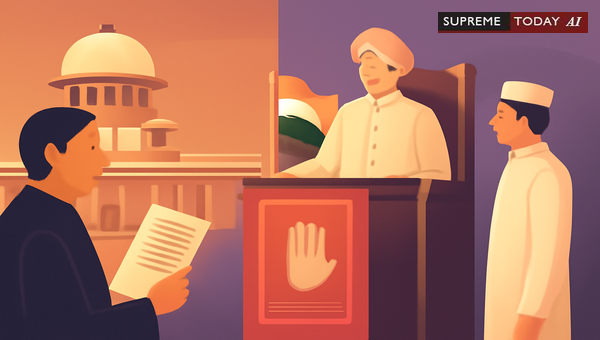
Recent Judgments on President and Governor: Key Insights
In the dynamic landscape of Indian constitutional law, the roles of the President and Governors often come under judicial scrutiny, especially regarding their discretionary powers. A pressing query arises: Recent Sc Judgement on President and Governer. This question reflects growing interest in how the is interpreting and limiting these high offices' authority. Recent rulings emphasize that while these positions hold significant influence, their actions must align with constitutional mandates and .
This blog post delves into the legal principles, landmark cases, and evolving doctrines shaping these powers. Drawing from precedents, we'll explore the balance between executive discretion and judicial oversight. Note: This is general information and not specific legal advice; consult a qualified lawyer for personalized guidance.
Constitutional Framework: Sources of Authority
The powers of the President and Governors stem primarily from and 310 of the Indian Constitution. Article 309 empowers the appropriate legislature to regulate recruitment and conditions of service for persons serving the Union or a State. establishes the 'pleasure doctrine,' stating that every person in the civil service holds office during the pleasure of the President or Governor, subject to exceptions like . 1973 0 Supreme(SC) 261
As clarified in key judgments, emphasizes that office is held during the pleasure of the President or Governor, with exceptions such as , which provides protections against arbitrary dismissal, except as expressly provided by the Constitution. 1973 0 Supreme(SC) 261
This framework ensures stability in public administration but is not a blank check for executive action.
The : Broad Yet Bounded
The grants the President and Governors wide discretion in matters like appointments, dismissals, and removals. However, recent judgments reaffirm its limitations. This power must be exercised within constitutional bounds, particularly under , which safeguards civil servants against removal without inquiry for misconduct or inefficiency. 1973 0 Supreme(SC) 261
The grants the President and Governors significant discretion in dismissing or removing officials, but this power is subject to constitutional safeguards, especially under . 1973 0 Supreme(SC) 261 Courts have stressed that while broad, this doctrine demands and adherence to principles.
In practice, this means no arbitrary actions. For instance, dismissals require proper inquiry and fact verification, preventing caprice under the guise of pleasure.
: A Critical Safeguard
The plays a pivotal role in checking potential overreach. Actions invoking the pleasure doctrine are subject to if they violate or procedural norms. The has emphasized that actions taken under the guise of exercising the pleasure doctrine must adhere to principles of and , including proper inquiry and verification of facts before dismissal or removal. 2010 0 Supreme(All) 3795
The Vimla case exemplifies this: arbitrary deprivation of statutory rights, such as financial or administrative functions, can be invalidated if lacking justification or procedure. 2010 0 Supreme(All) 3795 This underscores the judiciary's vigilance against unjustified executive moves.
Comparative insights from other jurisdictions, like U.S. cases on presidential removal authority, highlight similar tensions. For example, recent discussions affirm the breadth of removal powers but note they are not absolute, echoing Indian principles of accountability. 2025 Supreme(US)(cadc) 139
Spotlight on Recent Case Law
Several recent judgments illuminate these principles:
- Jharkhand Case: Rules on pension and gratuity cannot be arbitrarily applied to withhold benefits unless explicitly allowed. This stresses statutory adherence and procedural rigor. 2013 0 Supreme(All) 2842
- Detention Case: Detention orders demand proper verification and independent inquiry, showcasing scrutiny over discretionary executive powers. 2000 0 Supreme(Guj) 196
Additionally, proceedings involving the Governor reinforce procedural mandates in administrative actions.
In one instance, the court addressed respondent references to the Governor, emphasizing compliance in official capacities.
These cases collectively affirm: executive discretion must be evidence-based and process-oriented.
Broader Implications from Allied Judgments
While focused on constitutional roles, parallels emerge in other domains. For instance, in governance-related disputes like those involving federation presidents, courts have struck down illegal appointments lacking democratic process, directing recovery of undue benefits. 2023 0 Supreme(Del) 5568 This mirrors the scrutiny on high offices, where unauthorized or arbitrary exercises of power are curtailed.
In employment contexts, requires , not mere impressions, aligning with pleasure doctrine limits. 2019 1 Supreme 23 is attracted only in case of . Cannot be invoked on basis of impressions. Such rulings bolster procedural protections across executive actions.
Key Takeaways and Recommendations
Recent judgments reinforce core principles:- Powers under and 310 are expansive but tethered to safeguards.- The pleasure doctrine demands inquiry, verification, and fairness; arbitrariness invites judicial intervention.- Courts vigilantly protect statutory rights, pensions, liberty, and employment from capricious decisions.
Practical Recommendations (general guidance):- Document all bases for dismissals or removals thoroughly.- Conduct inquiries compliant with .- Heed precedents to avoid challenges under .
In summary, Recent judgments reinforce that while the President and Governors possess broad powers under Articles 310 and 309, these powers are subject to constitutional limitations, , and . The is not unfettered. 1973 0 Supreme(SC) 261 2010 0 Supreme(All) 3795
The judiciary's role ensures these constitutional pillars serve justice, not unchecked authority. Stay informed on evolving case law, as it shapes India's administrative ethos.
This analysis draws from publicly available judgments and is for informational purposes only. Legal outcomes depend on specific facts; professional advice is recommended.
#SCJudgments, #PresidentPowers, #GovernorPowers















