


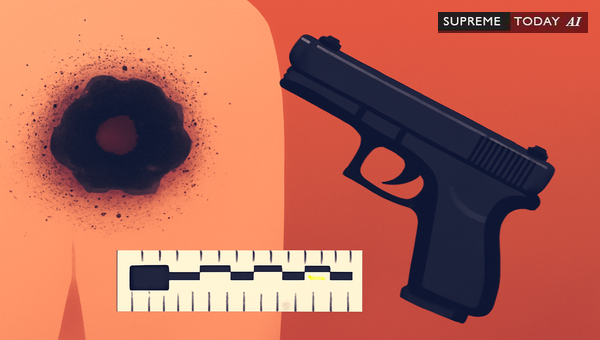
Blackening in Gunshot Injuries: Supreme & High Court Rulings
In criminal cases involving firearms, forensic evidence plays a pivotal role in determining the circumstances of a shooting. One critical indicator is the presence or absence of blackening and tattooing around gunshot wounds, which helps establish the distance from which the shot was fired. But what do Indian courts, particularly the and , say about this? A common query from legal practitioners and investigators is: Show some Judgements of as Well as High Court on the Issue of Present of Blackening in Gunshot Injuries.
This blog post delves into judicial interpretations, key precedents, and forensic nuances, drawing from landmark rulings. While blackening typically signals close-range firing, courts caution against over-reliance on it due to influencing factors. Note: This is general information based on precedents and not specific legal advice. Consult a qualified lawyer for case-specific guidance.
Understanding Blackening and Tattooing in Gunshot Wounds
Blackening refers to the deposition of smoke and unburnt powder particles on the skin or clothing around the , caused by the of a firearm. Tattooing occurs when unburnt powder grains embed into the skin, creating small punctate marks. These signs are generally present in close-range shots (up to 2-3 feet) but fade with distance 2003 8 Supreme 7 2024 0 Supreme(All) 700.
The has clarified: Blackening is caused by smoke deposit. Smoke particles are light. They do not travel far. Therefore, smoke deposit, i.e., blackening is limited to a small range2003 8 Supreme 7. Similarly, a High Court noted: Blackening is found, if a firearm like a shotgun is discharged from a distance of not more than three feet2024 0 Supreme(All) 700.
However, courts emphasize that absence of blackening does not conclusively prove a distant shot, as factors like clothing, rain, or weapon type can alter appearances 2003 8 Supreme 7 2024 0 Supreme(All) 700.
Judgments on Blackening
The has consistently recognized blackening as a of proximity. In one key ruling, it held that Blackening and tattooing prove definitely that the shot was fired from very close quarters, in which case an assertion by the suspected person that the deceased fired the shot himself, cannot be disproved if the weapon used was a pistol or revolver2003 8 Supreme 7.
Another observation underscores limitations: the absence of powder residue no distinction can be made between one distance shot and another, as far as distance is concerned2024 0 Supreme(All) 700. The Court in stressed that close-range wounds typically show blackening and tattooing, absent in that case to infer distance 2023 Supreme(Online)(MP) 27254.
In , the apex court established that entry wounds from close-range single pellet shots are circular or oval with tattooing present, reinforcing the standard for forensic analysis 2023 Supreme(Online)(MP) 27254. Courts also note variances: variance of the with the , in all cases, should not lead to the conclusion, inevitably to reject the 1999 1 Supreme 201.
High Court Rulings and Case Examples
across India have applied these principles in diverse scenarios, often integrating medical reports with .
Cases with Absence of Blackening
- In 2024 Supreme(Online)(ALL) 719, a gunshot wound on the skull (0.3 cm x 0.2 cm, brain cavity deep) showed No Blackening and Tattooing present, suggesting distant firing.
repeatedly noted No blackening, no tattooing, was present... Margins inverted, no blackening, no tattooing and no scorching was present, leading courts to infer non-close range without interference.
- 2025 Supreme(SRI)(CA) 250 () found no blackening or burns, concluding the shot from 3-15 feet.
Cases with Presence of Blackening
- 2022 Supreme(Online)(All) 29704 described wounds with blackening present around entry points, like a 2cm x 1cm firearm wound, indicating close range.
and
/
confirmed size ¼ x ¼ x deep to skin, blackening present, supporting prosecution narratives of proximity
.
- 2023 Supreme(Online)(MP) 27254 highlighted tattooing around entry wounds as typical for close shots.
, like Madhya Pradesh in 2024 Supreme(Online)(MP) 41983, evaluate such evidence alongside eyewitnesses, dismissing isolated reliance.
Judicial Approach: Presence vs. Absence and Limitations
| Indicator | Implication | Key Factors Influencing ||-----------|-------------|-------------------------|| Presence of Blackening/Tattooing | Close range (≤2-3 ft) 2003 8 Supreme 7 | Shotgun/pistol, dry conditions 2024 0 Supreme(All) 700 | | Absence | Likely distant shot | Clothing, rain (Wetting of the skin or clothes by rain reduces the scorching range2024 0 Supreme(All) 700), high-power rifle (up to 1 ft) 2024 0 Supreme(All) 700 |
Courts advocate a holistic evaluation: the absence of blackening or tattooing is not conclusive proof that the shot was fired from a distance and efforts should be made to find the truth1999 1 Supreme 201. In 2022 Supreme(Online)(MP) 5187, the referenced to reject rigid rules like , prioritizing overall evidence.
Practical Implications for Investigations and Trials
- Forensic Experts: Must detail conditions affecting residues, e.g., Blackening with a high power rifle can occur up to about one ft2024 0 Supreme(All) 700.
- Prosecutors/Defense: Corroborate with wound trajectory, ballistics, and witness statements.
- Judges: Consider totality, as in 2024 Supreme(Online)(MP) 41983 where trial courts weighed oral and documentary evidence.
Recommendations from precedents:1. Interpret blackening alongside other forensics 2003 8 Supreme 7.2. Account for environmental variables 2024 0 Supreme(All) 700.3. Avoid conclusive inferences from absence alone 1999 1 Supreme 201.
Conclusion and Key Takeaways
Indian judiciary, through and High Court judgments, views blackening and tattooing as vital yet non-dispositive clues in gunshot cases. Presence strongly suggests close-range firing, while absence points to distance—but always tempered by context. Precedents like those in 2003 8 Supreme 7, 2024 0 Supreme(All) 700, and others (e.g., 2024 Supreme(Online)(ALL) 719, 2023 Supreme(Online)(MP) 27254) guide fair trials by balancing science and circumstances.
Key Takeaways:- Blackening/tattooing = close range (typically ≤3 ft) 2003 8 Supreme 7 2024 0 Supreme(All) 700.- Absence suggests distance but check confounders.- Courts prioritize comprehensive evidence over isolated forensics 1999 1 Supreme 201.
For deeper insights, review full judgments. Stay informed on evolving forensic law!
References
- 2003 8 Supreme 7: Supreme/High Court on blackening as close-range indicator.
- 2024 0 Supreme(All) 700: Conditions and limitations of blackening.
- 1999 1 Supreme 201: Handling variances.
- 2024 Supreme(Online)(ALL) 719,
, 2023 Supreme(Online)(MP) 27254, 2025 Supreme(SRI)(CA) 250, 2022 Supreme(Online)(All) 29704,
,
: Case-specific observations on presence/absence.

















