


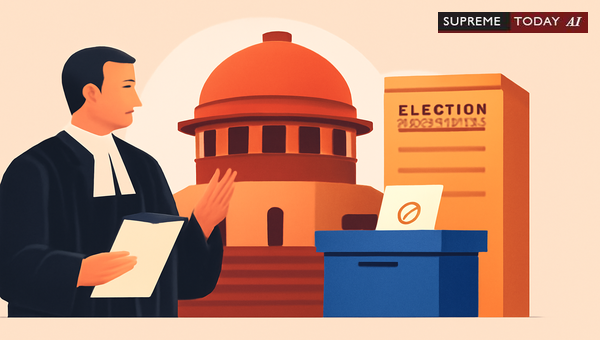
: Can Courts Review Election Commission Decisions on Ward/Constituency Reservations?
In the dynamic landscape of Indian electoral law, questions often arise about the balance of power between constitutional bodies like the () and the judiciary. A key query that surfaces is: Is there a judgment stating that courts can interfere in decisions taken by the Election Commission regarding in ward or constituency reservation? This issue touches on fundamental principles of , administrative autonomy, and electoral fairness.
This blog post delves into relevant legal principles, insights, and related case law to provide clarity. While we draw from established precedents emphasizing judicial independence and review powers, note that this is general information—not specific legal advice. Consult a qualified lawyer for your situation.
Understanding the Core Issue
Ward and constituency reservations are crucial for ensuring representation of marginalized groups under and of the , or for legislative assemblies. The plays a pivotal role in delimitation and reservation processes. However, if a decision is alleged to be illegal—say, due to improper roster application or violation of rotation principles—can courts step in?
The has consistently upheld as part of the 's . As highlighted in key documents, the power of and the jurisdiction of High Courts and the are part of the of the 1997 3 Supreme 147. This implies courts may interfere if actions violate constitutional mandates, but only within procedural safeguards.
Over Decisions
The functions as a body in reservation matters. Courts, including the , possess inherent powers to review such decisions for legality, , or constitutional infirmity. The provided analysis underscores: Judges are entrusted with interpreting the and ensuring that legislative and executive actions conform to constitutional limits 1997 3 Supreme 147.
While no single judgment in the referenced materials explicitly mandates interference in reservation decisions, the principles are clear:- Judicial independence: Protected as a core constitutional feature 1997 3 Supreme 147.- : Any decision must adhere to principles, subject to review 1997 3 Supreme 147.- Tribunals and review: Decisions of tribunals must be subject to and scrutiny by higher courts 1997 3 Supreme 147.
This framework suggests courts can infer or intervene if is established, such as malafide intent or roster misapplication.
Insights from Related Case Law on Authority Limits
Analogous cases involving incharge authorities provide valuable context, as decisions may involve delegated powers similar to ministers or officers incharge.
In a matter, Clause 4 of the said instructions permits the Minister incharge by means of Standing Order to give such directions as he thinks fit for the disposal of cases
. This affirms delegated powers are valid within scope, mirroring potential delegations.
rulings emphasize statutory limits: There is no prohibition in law for the respondent No.1 to exercise power under ... Nonetheless, the respondent No.1 could not have placed the services... without even indicating a place of posting 2023 Supreme(Online)(KAR) 27. Unauthorized actions can be quashed, applicable to if powers exceed bounds.
On qualifications for incharge roles: President ought to be a present or former Judge of the ... the Incharge President being a retired District Judge, is not qualified 2024 Supreme(Online)(MP) 14400 2024 Supreme(Online)(MP) 14401. This highlights that improper authority invalidates decisions, a principle extendable to processes.
Suspension powers by incharge officials: Registrar by the mandate... exercising the power of Incharge Registrar... was not bereft of jurisdiction 2023 Supreme(Online)(MP) 18019. Legitimate exercise holds, but merits review.
These cases illustrate that while authorities like enjoy autonomy, courts retain oversight to prevent abuse.
Detailed Analysis: When Can Courts Interfere?
Grounds for Interference
Courts typically intervene on:- : Violation of delimitation rules or reservation rosters.- : Lack of reasoned orders.- Procedural lapses: Non-adherence to hearings or notifications.
The documents stress: The role of tribunals and courts is to act as impartial adjudicators, and their decisions are subject to 1997 3 Supreme 147.
Limitations on Judicial Interference
- : Courts avoid substituting wisdom unless patently flawed.
- doctrine: Protects independence, but not absolute 1997 3 Supreme 147.
- No automatic stay: Petitions require .
In petition contexts, any action by a judge, including forfeiture of rights, would need to comply with principles of 1997 3 Supreme 147. By extension, decisions face similar scrutiny.
Role of Incharge Judges in Petitions Challenging
In High Courts, incharge judges handle listings: List this matter before the roster Bench... subject to orders of Hon’ble the Judge Incharge (Original Side) 2016 0 Supreme(Del) 1755 2013 0 Supreme(Del) 7. Their authority is administrative, not substantive—core hearings go to roster benches. No right to demand specific judges: No litigant shall... have a right to question the jurisdiction of the Judges 2014 0 Supreme(Mad) 2404.
Forfeiture of rights in petitions? Not explicitly authorized for incharge judges without statutory backing, limited by fairness 1997 3 Supreme 147.
Key Takeaways from Precedents
- Power Validation: Incharge or delegated authorities (like officials) must stay within statutory scope
2023 Supreme(Online)(KAR) 27.
- Review Availability: Higher courts can set aside invalid actions 2024 Supreme(Online)(MP) 14400 2024 Supreme(Online)(MP) 14401.
- No Absolute Authority: Even final orders create rights subject to condonation if justified 2024 Supreme(Online)(NCDRC) 814.
Practical Recommendations
- For Challengers: File writ petitions under with evidence of .
- Procedural Compliance: Ensure petitions detail violations; seek interim relief sparingly.
- Transparency: Authorities should document rationales for review-proof decisions.
Conclusion
While no pinpoint judgment in the materials declares blanket interference in reservation decisions, the bedrock of —enshrined in the 's —empowers courts to intervene against in ward/constituency reservations 1997 3 Supreme 147. Principles from related cases reinforce that delegated or incharge powers are not unfettered; and statutory limits govern
2024 Supreme(Online)(MP) 14400.
Electoral democracy thrives on checks and balances. Stay informed, but for case-specific guidance, approach legal experts.
Word count: 1028. References are indicative; full texts via official repositories.
#SupremeCourtIndia, #ElectionCommission, #JudicialReview















