


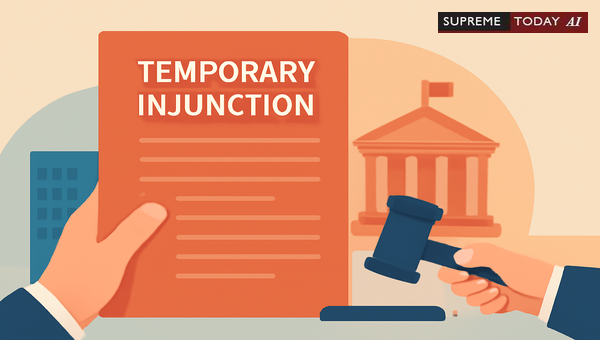
When Courts Reject Injunctions Against State Authorities
Imagine you've built a structure on land without proper approvals, and now state authorities issue a . You rush to court seeking a to halt the action. Will the court side with you? Often, the answer is no. exercise caution when it comes to granting against government bodies, prioritizing legality over temporary stays.
This blog delves into the legal question: Injunction against State Authorities. We'll examine the principles governing the rejection of temporary injunctions (T.I.), drawing from key judgments and related cases. Note that this is general information based on legal precedents and not specific legal advice—consult a qualified lawyer for your situation.
Key Legal Principles for Temporary Injunctions
Courts grant or refuse temporary injunctions under , based on three core factors:- : Strong initial evidence in favor of the applicant.- : Which side suffers more if relief is denied or granted.- : Harm that cannot be compensated by damages. 2009 6 Supreme 584
When the action is against state authorities—such as enforcing demolition of —courts are particularly restrained. The courts generally uphold the rejection of against government entities when the material evidence indicates the structures or actions are unauthorized or when the order for removal or demolition is final and based on proper procedures. 2009 6 Supreme 584
This approach prevents perpetuating illegality. For instance, in cases under the , courts vacate injunctions if structures lack sanctioned plans or were extended without approval. 2009 6 Supreme 584
Detailed Analysis: Why Courts Reject T.I. Against Government
Judicial Discretion and Caution Against State Actions
Judges wield discretion but must adhere to settled principles. against government is not routine, especially for unauthorized constructions. Courts are cautious in granting against government actions, especially when such actions are based on lawful procedures and final orders for demolition or removal are passed. 2009 6 Supreme 584
A related case under the , illustrates this. The petitioner, allotted space for a scooter stand, sought an injunction against eviction after tenders were invited. The court upheld eviction, finding possession unauthorized, and confirmed the trial court's rejection of the injunction. 2019 0 Supreme(Bom) 15
Similarly, in eviction disputes under the , courts dismissed challenges to eviction orders where property was vested with entities like since 1962, rejecting the appellant's claims. 2018 0 Supreme(UK) 52
's Supervisory Role Under Article 136
The intervenes under only in exceptional cases: Interference by under Article 136... is permitted only when the lower courts act arbitrarily, , or , or ignore settled principles of law. 2009 6 Supreme 584
The generally refrains from interfering with discretionary orders of courts below unless there is arbitrariness, perversity, or violation of principles of law. 2009 6 Supreme 584 This supervisory jurisdiction ensures discretion stays within bounds, backed by material evidence.
In procedural compliance matters, the emphasizes non-interference in administrative actions post proper procedures, aligning with rejections against state bodies. 2023 0 Supreme(SC) 152
Landmark Cases on Rejection
- : Courts reject T.I. when demolition orders follow due process, as seen in municipal cases without approved plans. 2009 6 Supreme 584
- Eviction from Government Premises: In a Nagpur case, despite prior allotments, fresh tenders led to eviction; injunction denied as possession was unauthorized. 2019 0 Supreme(Bom) 15
- Property Disputes: Under , suits for possession restoration failed if beyond limitation, interpreting 'dispossessed' strictly—control loss triggers the clock, not later acts like breaking locks. 2022 0 Supreme(Bom) 1202
These examples underscore that courts prioritize public interest and legality over private claims against state enforcement.
Exceptions: When Injunctions May Be Granted
Relief isn't impossible. Courts may grant T.I. if:- There's a genuine threat of irreparable loss and the structure/action is authorized. 2009 6 Supreme 584- Lower court orders are , lacking material support. 2009 6 Supreme 584- Fundamental rights or constitutional violations are at stake, with strong prima facie evidence. 2009 6 Supreme 584
For example, in tenancy disputes, injunctions restored where possession was undisputed and dispossession lacked due process—nobody can be dispossessed... save and except by . 2023 0 Supreme(Cal) 781
In construction-related suits, granted injunctions against further building, later allowing plaint amendments to address ongoing issues, emphasizing necessity over technicalities.
However, even in IP cases like trademarks, rejections occur if no prima facie similarity exists, reinforcing consistent application of principles. 2018 0 Supreme(Raj) 112
Recommendations for Litigants and Courts
- Evaluate Thoroughly: Courts should assess , structure legality, and finality before . 2009 6 Supreme 584
- Uphold Legality: Avoid injunctions for clearly with valid orders. 2009 6 Supreme 584
- Higher Court Restraint: Interfere only on arbitrariness or legal violations. 2009 6 Supreme 584
Litigants: Gather strong evidence of authorization and irreparable harm early. Authorities: Ensure procedural compliance to strengthen positions.
Key Takeaways
- Courts typically reject temporary injunctions against state authorities for unauthorized actions to prevent illegality. 2009 6 Supreme 584
- Core tests—, , —must be met. 2009 6 Supreme 584
- steps in under Article 136 sparingly, only for perversity. 2009 6 Supreme 584
- Exceptions exist for legal structures or lower orders, but public interest prevails.
Understanding these nuances can guide expectations in disputes involving government enforcement. Always seek professional legal counsel tailored to your facts.
References:1. 2009 6 Supreme 584: Core principles on T.I. rejection against government.2. 2023 0 Supreme(SC) 152: Non-interference in procedural administrative actions.3. Other cases: 2019 0 Supreme(Bom) 15, 2018 0 Supreme(UK) 52, 2023 0 Supreme(Cal) 781,
, 2022 0 Supreme(Bom) 1202, 2018 0 Supreme(Raj) 112. #InjunctionLaw, #StateAuthorities, #IndianJudiciary












