SupremeToday Landscape Ad

AI Overview

AI Overview...

Analysis and Conclusion:In Kerala, statutory regulations mandate that bars be located at least 200 metres from schools, and schools should be established within specific walking distances (1 km for primary, 3 km for middle school). Courts have upheld these norms, emphasizing the state's obligation to enforce them. Violations regarding proximity often lead to rejection of licensing or construction applications. Overall, maintaining prescribed distances is crucial for compliance, safety, and the protection of children's interests.

Kerala Bar-School Distance: Legal Measurement Rules

Kerala Bar-School Distance: Legal Measurement Rules Explained

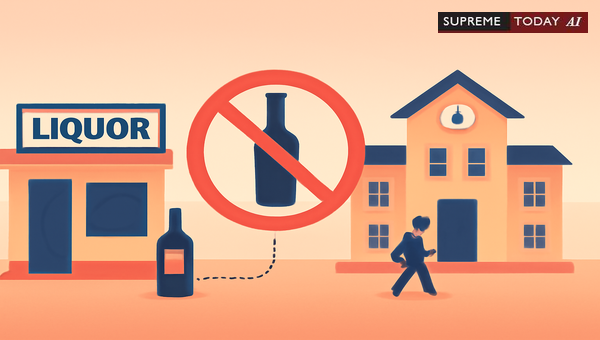
In Kerala, where liquor licensing is tightly regulated to protect public interests, one common dispute arises around the distance between bars (or liquor shops) and schools. A frequent question is: What is the legal distance between a bar and a school in Kerala, and how is it measured? This issue often surfaces in license applications, renewals, or challenges by local residents concerned about proximity to educational institutions.

Understanding these rules is crucial for bar owners, toddy shop operators, licensing authorities, and even school managements. Violations can lead to license refusals, relocations, or court battles. This guide breaks down the legal framework, judicial interpretations, and practical tips, drawing from Kerala High Court rulings and statutory rules. Note: This is general information based on precedents and not specific legal advice—consult a lawyer for your case.

The Core Legal Requirement: Minimum Distance Norms

Kerala's Foreign Liquor Rules (particularly Rule 13(3)) mandate that bars and liquor outlets must be at least 200 meters from schools or places of worship. Similar norms apply to toddy shops under the Kerala Abkari Shops Disposal Rules. For instance, in one case, a bar license was upheld because the distance from its existing gate to Salvation School was 235 meters, satisfying the norm K.T.Manoj Kumar, S/O.K.P.Thankappan vs Excise Commissioner, Commissionerate Of Excise - Kerala.

However, the prescribed distance isn't the only battleground—the method of measurement is equally critical. Courts have clarified that failing this can invalidate licenses, even if the straight-line distance appears compliant K.T.Manoj Kumar, S/O.K.P.Thankappan vs Excise Commissioner, Commissionerate Of Excise - Kerala.

How Distance is Measured: Gate-to-Gate Along Public Paths

The main legal finding from Kerala courts is clear: Distance is measured from gate to gate along the shortest pathway or route generally used by the public, not as the crow flies (straight-line) Subash Soman VS State of Kerala - 2019 0 Supreme(Ker) 263Residents of Village Magra-Punjala VS State of Rajasthan - 2006 0 Supreme(Raj) 1953. This reflects the actual accessible route pedestrians would take, prioritizing public safety and accessibility.

Key Measurement Principles

In Vijaya Kumar v. State of Kerala, the court stressed: the measurement must be from the main or nearest gate along the shortest public route, not just the building entranceResidents of Village Magra-Punjala VS State of Rajasthan - 2006 0 Supreme(Raj) 1953. This prevents evasion tactics like placing outlets at remote corners.

Judicial Clarifications and Evolving Standards

Early interpretations sometimes allowed straight-line distances, but amendments and rulings standardized the public pathway method. The Note to Rule 13 explicitly states the basis is the 'shortest pathway/lane/street/road generally used by the public, measured from gate to gate'Biju Joseph VS Chacko - 1992 0 Supreme(Ker) 193.

Courts reinforce this for public health and social reasons, ensuring liquor outlets don't tempt students via easy access. If the public-route distance falls below 200 meters, licenses are typically refused or shops relocated Biju Joseph VS Chacko - 1992 0 Supreme(Ker) 193Residents of Village Magra-Punjala VS State of Rajasthan - 2006 0 Supreme(Raj) 1953.

Notable Case Examples

Related Regulations: School Establishment Distances

Conversely, Kerala’s Right of Children to Free and Compulsory Education Rules, 2011 require schools to be within walking distances of neighborhoods: 1 km for classes 1-5 and 3 km for classes 6-8St Mary's English Medium School, rep by the manager fr. Betson thukkuparambil, S/o. T.K. Antony vs State Of Kerala, Represented By The Secretary, General Education Department, Government Secretariat - KeralaBalachandran VS State of Kerala - Kerala. Courts mandate state compliance, rejecting setups beyond these limits St Mary's English Medium School, rep by the manager fr. Betson thukkuparambil, S/o. T.K. Antony vs State Of Kerala, Represented By The Secretary, General Education Department, Government Secretariat - Kerala. 'Neighbourhood' includes walkable areas near elementary schools Manager, Ithihadul Islam Aided Lower Primary School, Cheroor VS State of Kerala, Represented By Its Secretary to Government, General Education Department - 2018 Supreme(Ker) 334 - 2018 0 Supreme(Ker) 334.

This interplay means bars can't exploit school relocations—if a school moves closer post-licensing, licensees may need to relocate, though opportunities for hearings exist Biju Joseph VS Chacko - 1992 0 Supreme(Ker) 193.

Exceptions, Limitations, and Practical Challenges

Disputes often hinge on facts like Google Maps vs. ground reality—e.g., one case disputed a 800m claim as actually 2.9 km School Managing Committee Of Amaramunda Govt. Primary School, Amaramunda VS State Of Odisha - 2021 Supreme(Ori) 516 - 2021 0 Supreme(Ori) 516. Courts favor independent surveys.

Recommendations for Compliance

To avoid pitfalls:- Measure Correctly: Use nearest gates and shortest public routes—hire surveyors early.- Document Thoroughly: For licenses, submit verified maps and photos of paths K.T.Manoj Kumar, S/O.K.P.Thankappan vs Excise Commissioner, Commissionerate Of Excise - Kerala.- Seek Court Commissioners: In disputes, request neutral verifications.- Policy Advocacy: Push for clearer guidelines in licensing to standardize processes.

Authorities should enforce uniformly, as courts stress state obligation in distance norms Balachandran VS State of Kerala - Kerala.

Conclusion and Key Takeaways

In summary, Kerala's rule for distance between bars and schools is gate-to-gate along the shortest public pathway—at least 200 meters—not straight-line. This protects children while allowing fair business, backed by precedents like Subash Soman VS State of Kerala - 2019 0 Supreme(Ker) 263, Residents of Village Magra-Punjala VS State of Rajasthan - 2006 0 Supreme(Raj) 1953, and Biju Joseph VS Chacko - 1992 0 Supreme(Ker) 193.

Key Takeaways:- Prioritize public routes over hypotheticals.- Expect scrutiny in licensing—non-compliance risks denial.- Schools must stay accessible; bars, distant.

Stay compliant to sidestep litigation. For tailored advice, engage legal experts familiar with Abkari laws.

References:1. Subash Soman VS State of Kerala - 2019 0 Supreme(Ker) 263: Gate-to-gate public pathways.2. Residents of Village Magra-Punjala VS State of Rajasthan - 2006 0 Supreme(Raj) 1953: Nearest gate, public routes.3. Biju Joseph VS Chacko - 1992 0 Supreme(Ker) 193: Shortest public pathway clarification.4. P. G. Murugesan VS The Assistant Commissioner (Excise), Coimbatore - 1998 0 Supreme(Mad) 1348: Multiple gates consideration.5. K.T.Manoj Kumar, S/O.K.P.Thankappan vs Excise Commissioner, Commissionerate Of Excise - Kerala: 200m norm examples.

#KeralaLiquorLaws, #BarSchoolDistance, #KeralaLegalRules
Chat Download
Chat Print
Chat R ALL
Landmark
Strategy
Argument
Risk
Chat Voice Bottom Icon
Chat Sent Bottom Icon
SupremeToday Portrait Ad
logo-black

An indispensable Tool for Legal Professionals, Endorsed by Various High Court and Judicial Officers

Please visit our Training & Support
Center or Contact Us for assistance

qr

Scan Me!

India’s Legal research and Law Firm App, Download now!

For Daily Legal Updates, Join us on :

whatsapp-icon telegram-icon
whatsapp-icon Back to top