


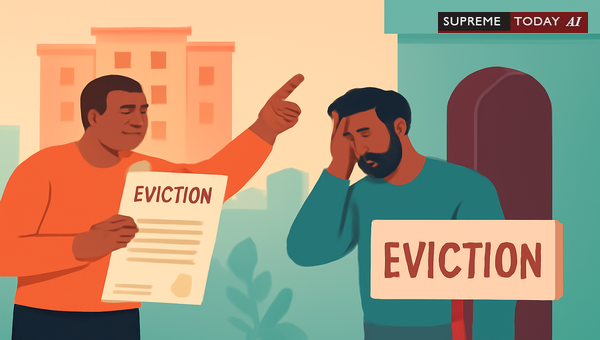
Can Landlord Evict Tenant for in India?
In the bustling rental markets of India, disputes between landlords and tenants over unpaid rent—commonly known as —are all too common. Imagine a scenario: a tenant falls behind on payments, and the frustrated landlord decides to change the locks or throw out belongings. But can a landlord evict a tenant on arrears of rent just like that? The short answer, based on established Indian legal precedents, is no—not without following strict .
This blog post dives deep into the legal framework governing landlord-tenant relationships in India, emphasizing that forcible evictions are prohibited. We'll explore key court rulings, statutory principles, and practical recommendations, drawing from authoritative judgments. Note: This is general information and not specific legal advice. Consult a qualified lawyer for your situation.
The Core Legal Principle: No Forcible Evictions Allowed
Under the Indian judiciary system, a landlord cannot forcibly evict a tenant without following the due legal process. Eviction must be carried out through lawful procedures, such as obtaining an from a competent court or authority, and not by or force. 2015 3 Supreme 683 1987 0 Supreme(SC) 143 2004 2 Supreme 765
Courts have consistently held that eviction must be effected only through lawful proceedings, including obtaining an and executing it lawfully. The use of force or illegal methods to evict a tenant is illegal and can be challenged in courts, which can declare such actions unlawful. 2015 3 Supreme 683 1987 0 Supreme(SC) 143 2004 2 Supreme 765
For instance, the has explicitly stated that a landlord cannot evict a tenant by taking the law into his own hands, as doing so violates legal procedures and may lead to criminal or . In , it was clarified that a landlord may not use force to eject a tenant and must instead seek eviction through lawful proceedings. 2004 2 Supreme 765
Landmark Court Decisions on
Multiple rulings reinforce that eviction for requires proper legal channels:
- The law in India was that a landlord cannot use force to evict a tenant and must obtain an order of eviction from a competent court.2015 3 Supreme 683
- In , the held that a landlord cannot forcibly dispossess a tenant; eviction must be through lawful process.2004 2 Supreme 765
- Courts have intervened in cases where landlords attempted , declaring such actions illegal and protecting tenants' rights. 1987 0 Supreme(SC) 143
These principles stem from the protection of tenancy rights under various state-specific and general civil laws like the .
Real-World Examples from Recent Cases
Recent high court decisions echo this stance. In one case, a landlord issued a legal notice for rent recovery and vacation but was reminded that the landlord is trying to evict the tenant which she can to do after following of law.
Another instance involved a tenant facing attempts after demands for arrears: He claimed that an attempt was made to forcibly evict him, necessitating him to file a suit to protect possession. The landlord had issued a notice dated for arrears and fair rent, but courts upheld the need for judicial process.
2021 Supreme(Online)(MAD) 29234
In a , a tenant alleged police involvement in coercion: now she wanted to evict the petitioner forcibly. Hence, using her husband's contact in the police department... The court clarified no force was to be used in landlord-tenant disputes.
Even police inaction on complaints of was addressed: The said Loganathan is attempting to forcibly evict him from the property... The police are obligated to investigate complaints and proceed with matters in accordance with law. The court directed inquiry, stressing civil disputes shouldn't involve force. 2022 Supreme(Online)(Mad) 82821
A ruling stated: cannot evict him forcibly except by way of such proceedings as may be available in the eye of law... he cannot evict him except by drawing such proceedings for not payment of rent and liability to pay arrears of rent.
These cases illustrate a uniform judicial intolerance for evictions, even when are involved.
Prohibition of Eviction Tactics
eviction—such as lock changes, utility cutoffs, or physical removal—is strictly illegal. Courts have struck down such actions, emphasizing: eviction can only be carried out after obtaining a decree and executing it lawfully.2015 3 Supreme 683 1987 0 Supreme(SC) 143
Landlords must file an eviction suit under applicable rent laws (e.g., state Rent Acts) citing grounds like default in rent payment. Only after a decree can execution follow via court bailiffs, not private force.
Exceptions: Limited and Procedural
Exceptions are rare and apply mainly to trespassers or encroachers, where state authorities may evict via —not landlords acting unilaterally. Even then, authorized officers must follow procedures.2000 1 Supreme 10 2013 0 Supreme(SC) 1101
For genuine tenants, no shortcuts exist, regardless of arrears quantum.
Steps for Lawful Eviction on
If you're a landlord dealing with :1. Serve Legal Notice: Demand payment and/or vacation, specifying arrears.2. File Eviction Suit: Approach the or with evidence of tenancy and default.3. Obtain Decree: Prove grounds under law (e.g., 15-30 days default notice unmet).4. Execute Decree: Use court processes for possession.
Tenants facing threats:- Seek Injunction: File for .- Approach Police/Courts: Report illegal attempts.- Counter-Claim: Challenge arrears if disputed.
Additional Insights from Judicial Trends
Eviction suits often involve . In one, a defendant sought to evict via Title Suit No. 212 of 2013... praying therein to evict. Courts prioritize procedure.
Police must investigate complaints without bias, as in cases directing cause enquiry and if the landlord and tenant dispute is found, not to interfere with the civil dispute.2022 Supreme(Online)(Mad) 82821
Key Takeaways and Recommendations
- is illegal and invites penalties, restoration orders, and damages. 2015 3 Supreme 683 1987 0 Supreme(SC) 143 2004 2 Supreme 765
- Always pursue court orders for eviction, even with substantial arrears.
- Tenants: Document everything and seek immediate relief.
- Landlords: Patience pays—illegal shortcuts lead to prolonged litigation.
In conclusion, while justify eviction grounds, the process remains judicially guarded to prevent abuse. Indian law balances property rights with tenant protections, ensuring fairness. Stay informed, follow the law, and consult professionals for tailored guidance.
References:1. 2015 3 Supreme 683: Prohibition on .2. 1987 0 Supreme(SC) 143: Need for lawful proceedings.3. 2004 2 Supreme 765: on .4. Additional cases:
,
, etc. #TenantRights, #LandlordEviction, #IndianRentalLaw












