


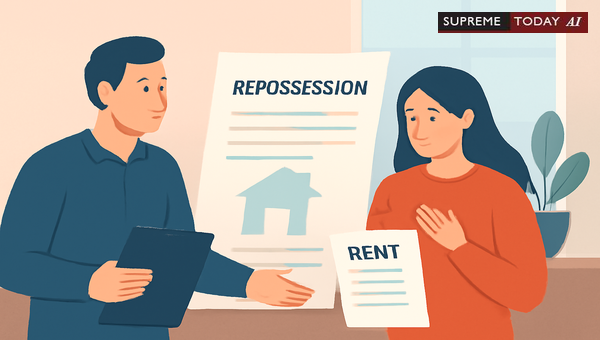
No ? Why Tenants Can't File Repossession Suits
In the complex world of rental disputes, one fundamental rule stands out: a tenant cannot file a suit for repossession if there is no established . This principle protects property owners and ensures courts only handle legitimate tenancy matters. But what does this mean in practice? How do courts determine if such a relationship exists, and what happens when it's disputed?
If you're a tenant facing eviction or a landlord seeking to reclaim property, understanding this core legal requirement is crucial. This post breaks down key court rulings, evidence standards, and jurisdictional nuances, drawing from established case law. Note: This is general information, not specific legal advice. Consult a qualified attorney for your situation.
The Core Legal Principle: Relationship as Prerequisite
Courts have consistently held that the existence of a is a prerequisite for any claims related to eviction or repossession. Without it, suits are typically dismissed. The question at hand—Tenant can Not File Suit for Repossession if there is no Tenant Landlord Relationship—captures this essence perfectly.
Payment of rent and acknowledgment of the landlord's title are critical in establishing this relationship. For instance, in one case, the tenant's payment of rent and acknowledgment of the landlord's title confirmed the 1970 0 Supreme(Raj) 232. This evidence transforms a mere occupancy into a legally recognized tenancy.
Court Findings: Dismissal Without Proof
When the relationship isn't proven, courts act decisively. In a notable ruling, the court dismissed an eviction suit because the was not established, emphasizing that claims regarding the relationship must be substantiated with evidence 2021 0 Supreme(Raj) 329.
Furthermore, disputes over the relationship must be resolved before eviction actions proceed. If a tenant denies the existence of this relationship, the court retains to address it 2021 8 Supreme 125. This prevents premature evictions and upholds .
Civil courts play a pivotal role here. They maintain over such disputes, even when exclusive is conferred on for eviction matters. As held, if a tenant genuinely disputes the existence of a , the can the matter 2021 8 Supreme 125.
Expanding on : Insights from Related Cases
This principle isn't isolated. Other precedents reinforce that denying the relationship from the outset preserves access. For example, under the , if the relationship is denied from very beginning, of is not barred 2019 0 Supreme(P&H) 1578. The court clarified: party has a right to file a civil suit and establish before the that the proceedings before were without as there was no relationship of landlord and tenant 2019 0 Supreme(P&H) 1578.
A word of caution from the bench: Courts of limited aren't powerless, but their orders on relationship existence aren't final. On question whether there existed relationship of landlord and tenant, order passed by the cannot be held to be final 2019 0 Supreme(P&H) 1578. This allows parallel civil challenges, ensuring fairness.
In another context, the requirement for a registered lease isn't always universal. Under the , Requirement of New Act that there should be a registered instrument of lease in order to enable creation of a landlord tenant relationship cannot be said to be universal in its application 2022 0 Supreme(Mad) 145. Landlords may need to resort to general law like the if no written agreement exists 2022 0 Supreme(Mad) 145.
Cases where the relationship is undisputed highlight the contrast. For instance, in a Madhya Pradesh eviction suit, Relationship of landlord and tenant is not in dispute 2019 0 Supreme(Chh) 633, allowing courts to focus on grounds like default or bona fide need. Similarly, under Jharkhand's eviction laws, admitted tenancy streamlined proceedings 2018 0 Supreme(Jhk) 1469.
Even agreements to sell don't automatically end tenancies: the relationship of landlord and tenant does not come to an end even if by mere execution of agreement to sell 2017 0 Supreme(P&H) 372. And disputes over ownership or tenancy can be rectified at trial, with courts wielding inherent powers: A court has the inherent power to rectify an error committed at an earlier stage of the proceedings 2015 0 Supreme(Cal) 304.
Evidence and Practical Steps
To succeed in repossession or eviction claims:- Prove the relationship with rent receipts, agreements, or acknowledgments.- Anticipate disputes: Tenants may challenge via civil suit, invoking .
For tenants:- Deny the relationship early if unsupported.- Seek intervention for jurisdictional challenges.
Recommendations include:- Ensuring claims are backed by clear evidence of the .- Challenging landlord claims by disputing the relationship if applicable.- Considering an for conflicting claims, as suggested in relevant cases 1989 0 Supreme(Raj) 902.
Summary of Key Findings
- A tenant (or landlord) cannot initiate a without a clear .
- Courts demand evidence like rent payments and title acknowledgment 1970 0 Supreme(Raj) 232.
- Civil courts retain for disputes, overriding limited eviction forums 2021 8 Supreme 125 2019 0 Supreme(P&H) 1578.
- Written agreements aren't always mandatory; general laws apply where needed 2022 0 Supreme(Mad) 145.
- Once established, focus shifts to eviction grounds like default or need 2019 0 Supreme(Chh) 633.
Conclusion: Prioritize Proof in Rental Disputes
The is the foundation of repossession and . Without it, suits falter, and civil courts step in to resolve foundational disputes. These principles, upheld across jurisdictions—from to high courts—underscore the need for solid evidence and strategic filings.
Key Takeaways:- Always substantiate the tenancy relationship before litigating.- Dispute it promptly in if absent.- Technicalities yield to justice, but preparation is key 2015 0 Supreme(Cal) 304.
Stay informed, document everything, and seek professional guidance. Rental laws evolve, but this bedrock rule endures.
(Word count: ~950. Sources cited are for illustrative purposes; full judgments should be reviewed.)
#LandlordTenantLaw, #EvictionRights, #RentalDisputes












