


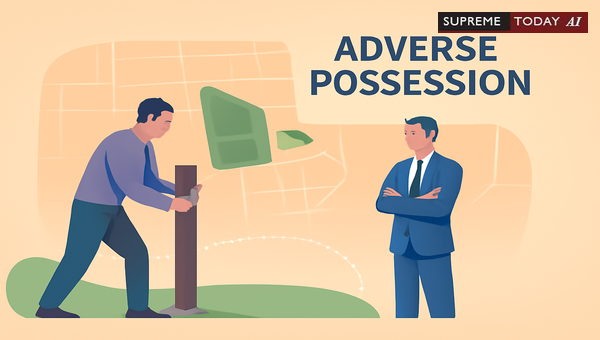
Is Landowner Knowledge Needed for ?
Imagine discovering unused land next to your property and using it openly for decades—fencing it, farming it, or building on it. Could you claim ownership through ? A common question arises: Whether Land Owner Knowledge is Necessary to Claim of Land. Many wonder if the true owner must be aware of your use for your claim to stick.
This blog dives into the nuances of , drawing from legal precedents on possession requirements, owner involvement, and related property processes like layout map sanctions. We'll clarify the role of landowner knowledge (or lack thereof), integrate insights from key cases, and provide practical takeaways. Note: This is general information, not legal advice. Consult a qualified attorney for your specific situation.
What is ?
allows someone to claim legal title to land after occupying it for a under certain conditions. Typically, the possession must be:
- : Visible and obvious, not hidden.
- Continuous: Uninterrupted for the required time (e.g., 12-30 years depending on jurisdiction).
- : Without the owner's permission.
- Exclusive: Treating the land as your own.
- Actual: Physically using the property.
These elements ensure fairness—giving owners a chance to assert rights while rewarding productive use of abandoned land.
Does Landowner Knowledge Matter?
Generally, by the landowner is not required for an claim. Courts emphasize through possession. If your use is so apparent that the owner should know (e.g., a visible fence or building), that's sufficient. Permission or acquiescence defeats the claim, but mere awareness without objection doesn't automatically stop it.
Key precedents highlight that trumps paper records. For instance:
- The learned counsel for the petitioner argued that there should be actual take over of possession and the take over of possession in record is not the of the surplus lands. But the records reveal that it is only possession in papers. 2021 0 Supreme(Mad) 3131 2009 0 Supreme(Mad) 3056
This underscores that courts prioritize actual, physical control over formal documents. If the landowner isn't involved (e.g., not signing receipts), independent evidence like witness signatures or panchanamas may establish possession: If the land owner is not a party to the Land Delivery Receipt, the take over should be established by getting signature from independent witnesses, preparing , etc. 2021 0 Supreme(Mad) 3131
In urban land ceiling cases, non-compliance with notice and possession takeover rules led to , allowing claimants to retain property as absolute owners based on physical use, electricity bills, and constructions. 2021 0 Supreme(Mad) 3131
Owner's Involvement in Related Property Processes
While often proceeds without owner input, other land processes demand explicit landowner participation—offering contrast and lessons.
Necessity of Land Owner's Signature on Layout Map for Sanction
When seeking approval for development, the land owner's involvement is crucial. Legal documents stress:
Land Owner's Responsibility: The legal documents indicate that it is the responsibility of the land owner to comply with statutory conditions when seeking . This includes executing necessary deeds, such as a for land earmarked for public use, which implies that the land owner’s involvement is crucial in the sanctioning process. 2002 0 Supreme(Mad) 497 2002 0 Supreme(Mad) 552
Signature Requirement: While the documents do not explicitly state that the land owner’s signature is mandatory on the layout map itself, the implication is that the land owner’s submission of the layout plan to the competent authority is essential. The layout plan must be submitted by the owner, suggesting that their endorsement (signature) is likely required for the submission to be valid. 2013 0 Supreme(Jhk) 1147
Legal Precedents: The Apex Court notes owners hold public-purpose land in trust for the benefit of society, mandating compliance. 2010 0 Supreme(Mad) 55
In practice, lacking owner endorsement can lead to rejection. However, alternatives like a suffice as ownership proof without a : The is a valid ownership document for sanctioning a building map, and rejection based on the absence of a is arbitrary and illegal. 2024 0 Supreme(All) 1706
Lessons from Sanction Disputes
Sanctioned maps must be honored despite zoning changes if approvals predated new plans: A sanctioned map must be honored despite changes in zoning regulations, provided earlier approvals were validly obtained before the enactment of new planning frameworks. 2025 0 Supreme(All) 2877
Unauthorized constructions require sanctioned plans, regardless of owner permission: It is just like owner permitting construction by the tenant or any other person on his land but ultimately the construction has to be in accordance with the sanctioned plan. 2020 0 Supreme(All) 1496
These cases show that while thrives on non-involvement, formal processes like map sanctions hinge on owner signatures and compliance.
Evidence Strategies for Claims
To succeed without relying on owner knowledge:
- Document : Photos, tax payments, utility bills, neighbor affidavits.
- Prove Open Use: Fences, crops, structures visible to all.
- Track Time: Maintain records spanning the .
- Avoid Permission: No leases or agreements with owner.
Courts dismiss claims with suppressed facts or non-, as in town planning schemes where laid-out road land vests automatically. 2022 0 Supreme(Guj) 1581
Potential Pitfalls and Defenses
Owners can defend by:- within limitation periods.- Proving permission or interruption.
Claimants fail if possession is in papers only without actual control. 2009 0 Supreme(Mad) 3056
In ceiling repeal contexts, buyers gained title via possession evidence despite prior proceedings. 2021 0 Supreme(Mad) 3131
Conclusion and Key Takeaways
Landowner knowledge is not strictly necessary for if possession is open, notorious, and meets other criteria—constructive notice suffices. However, robust evidence of physical control is vital, as courts distinguish it from mere records. 2021 0 Supreme(Mad) 3131 2009 0 Supreme(Mad) 3056
In contrast, layout sanctions demand owner signatures and compliance. 2013 0 Supreme(Jhk) 1147 2002 0 Supreme(Mad) 497 2002 0 Supreme(Mad) 552 2010 0 Supreme(Mad) 55
Key Takeaways:- Focus on visible, continuous use for adverse claims.- Secure signatures and deeds for development approvals.- Review local laws (e.g., , ).- Always seek professional legal counsel—outcomes vary by jurisdiction and facts.
References: 2013 0 Supreme(Jhk) 1147 2002 0 Supreme(Mad) 497 2002 0 Supreme(Mad) 552 2010 0 Supreme(Mad) 55 2021 0 Supreme(Mad) 3131 2009 0 Supreme(Mad) 3056 2024 0 Supreme(All) 1706 2025 0 Supreme(All) 2877 2022 0 Supreme(Guj) 1581 2020 0 Supreme(All) 1496
Stay informed on property rights to protect or assert your interests effectively.
#AdversePossession, #PropertyLaw, #LandClaims












