


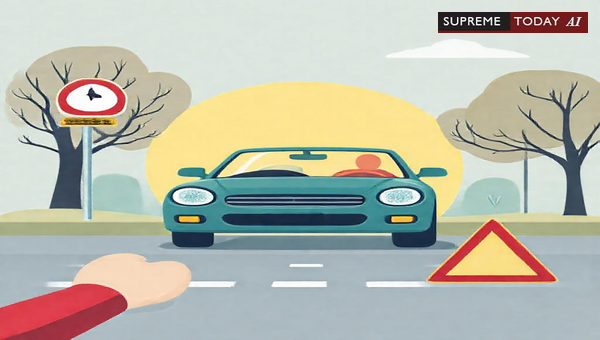
When a Driver Holds Only a Learner's Licence With a Qualified Person Beside Them, Who Pays the Victim?
Road accidents often raise a deceptively simple question that puts claimants, vehicle owners, and insurers on opposite sides of a . Suppose a person driving a vehicle holds only a learner's licence but has a qualified, fully licensed driver seated beside them. If an accident occurs, is the insurance company liable to pay compensation, or can it walk away by arguing the driver was not ?
This question matters because insurers routinely try to on licensing grounds. The settled position of Indian courts, however, generally favours the claimant.
A Under the
The foundational ruling on this point comes from the in , where the Court held that a learner's licence is itself a licence within the meaning of the , and a person holding one is entitled to drive 2004 1 Supreme 243. The Court went further and observed that even if an insurance contract contains a condition purporting to exclude vehicles driven by learner's licence holders, such a condition would run counter to of the Act and cannot save the insurer 2004 1 Supreme 243.
Subsequent High Court decisions have consistently reaffirmed this principle. Courts have held that a learner's licence is a valid driving licence, and defences such as no driving licence, fake driving licence, or learner licence are generally not available to the insurance company unless a statutory breach is actually proved
Oriental Insurance Company Ltd. VS Sheela Meghwal - Consumer (2025)
. In one such matter, the Tribunal's award of compensation for severe injuries was upheld precisely because a policy exclusion aimed at learner's licence holders was found ineffective 2024 0 Supreme(Mad) 2725.Does the Presence of a Qualified Driver Beside the Learner Matter?
Interestingly, the answer is generally yes — but not in the way insurers hope. When a learner drives accompanied by a qualified licence holder, the conditions attached to the learner's licence are typically being observed, which strengthens the claimant's case even further.
However, even where the accompaniment requirement is missing, courts have often declined to exonerate the insurer outright. Some decisions have taken a stricter view under of the , holding that a learner driving without an accompanying instructor holding an effective driving licence cannot be treated as , and in such cases the insurer may be directed to pay compensation first but recover it from the insured owner 2021 0 Supreme(Ker) 1031 and 2023 0 Supreme(Mad) 922. On the other hand, other rulings have held that the mere absence of a qualified instructor does not itself amount to a breach of the insurance policy, and the insurer remains liable to compensate the claimants 2025 0 Supreme(Bom) 1980.
The practical takeaway: in most scenarios involving a learner's licence, the victim receives compensation — the real contest is usually between the insurer and the owner over who ultimately bears the burden.
The Insurer Must Prove a
Mere absence, invalidity, or disqualification of a driving licence is not, by itself, a defence available to the insurer against the insured or third parties 2004 1 Supreme 243. To escape liability, the insurance company must establish:
- That the owner knowingly permitted an unlicensed or disqualified driver to use the vehicle;
- That the owner was negligent and failed to exercise reasonable care in ensuring the driver was ;
- That the breach was so fundamental that it contributed to the cause of the accident 2004 1 Supreme 243.
A negative verification report from the transport office or an inability to trace licensing records is insufficient to discharge this burden 2026 Supreme(Online)(HP) 2736. Procedurally, Tribunals must also give insurers a fair opportunity to lead evidence on such defences before rejecting them 2013 0 Supreme(J&K) 553.
Standard of Proof:
Motor accident claims are civil proceedings, so the applicable standard is the , not proof beyond reasonable doubt. Claimant testimony supported by an unchallenged FIR can constitute prima facie proof 2026 Supreme(Online)(HP) 2736. Appellate courts retain the duty to ensure the awarded amount amounts to , even without formal cross-objections 2026 Supreme(Online)(HP) 2736.
Pay First, Recover Later: Protection for Third Parties
Where a licensing breach is made out, courts frequently still protect the victim by directing the insurer to satisfy the decree at the first instance, with a right to recover the amount from the owner or driver2004 1 Supreme 284 and 2025 0 Supreme(Kar) 929. This mechanism ensures third-party claimants are not defeated by technical breaches they had no role in creating.
Two limiting scenarios deserve mention. First, a learner's licence that had expired before the accident may permit the insurer to raise a defence under certain older policy formulations 1987 0 Supreme(Mad) 275. Second, the position differs for transport vehicles: a person holding only a non-transport licence cannot lawfully drive a transport vehicle, and insurers may escape liability entirely in that situation
New India Assurance VS Birender Mishra
. Notably, in one consumer dispute, a valid, unexpired learner's licence with no exclusion clause in the policy was held sufficient to hold the insurer liable for the vehicle damage claimNATIONAL INSURANCE CO. LTD. VS RAMESH KUMAR
.Key Takeaways
- A learner's licence is generally a valid licence for motor accident compensation purposes under the .
- Driving with a qualified licence holder in the passenger seat strengthens compliance with learner's licence conditions and rarely gives the insurer an escape route.
- The insurer bears the burden of proving a willful, of policy conditions by the insured, judged on a .
- Even where a breach is proved, the insurer typically pays compensation first and may recover it from the vehicle owner.
- Expired learner's licences and transport vehicle misuse are narrower situations where insurers may find greater success in repudiating claims.
Accident victims holding or affected by a learner's licence driver's status should therefore not assume the claim is lost. Since outcomes can vary with the facts and the specific policy wording, anyone dealing with such a dispute may wish to consult a qualified advocate for advice tailored to their case.
#MotorAccidentClaims #LearnersLicence #InsuranceLiability #MotorVehiclesAct #CompensationClaims









