


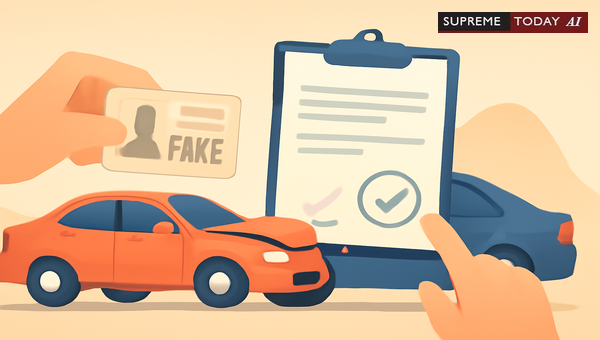
Insurance Liable for Compensation Without Valid Driving License?
Imagine this: A car accident occurs, injuring innocent third parties. The driver doesn't have a valid license. Does the insurance company get off the hook? Many assume yes, but say otherwise—generally, the insurer remains liable unless they prove the license was invalid or fake. This post dives into the legal nuances under the , answering the burning question: Insurance Company is Liable to Pay Compensation Even if a Person Do Not Have Valid Driving License?
We'll break down key judgments, the , exceptions, and practical tips. Whether you're a vehicle owner, accident victim, or insurer, understanding this can save time, money, and stress.
Main Legal Finding: Insurer's Liability Persists Without Proof
Typically, if the insurance company fails to prove the driver lacked a valid license at the accident time, they must pay . The core principle? The lies on the insurance company2004 1 Supreme 243.
Courts have consistently held: The that the driver had no licence was open to the insurer which it had failed to discharge 2004 2 Supreme 205. Mere claims or a driver's assertion aren't enough—insurers need solid evidence.
Key points include:- Burden on insurer: They must demonstrate invalidity or fakeness 2004 1 Supreme 243.- Insufficient evidence: Producing a learner’s license or unverified claims doesn't absolve liability if unproven fake 2004 1 Supreme 243 2008 2 Supreme 144.- Owner's limited duty: Vehicle owners aren't detectives; a seemingly genuine license suffices 2004 1 Supreme 243 2008 2 Supreme 144.- Outcome of failure: No proof means full third-party payout 2004 1 Supreme 243.
The : Insurer's Heavy Lift
Under , insurers bear the onus. If the insurer does not adduce evidence to prove the license was invalid or fake, it cannot avoid liability 2004 1 Supreme 243.
In one case, the Insurance Company failed to adduce any evidence to prove that the driving license (Ex.R1) was either fake or invalid for some reason 2016 5 Supreme 224. Result? Insurer pays.
This aligns with broader precedents. For instance, even if a driver's license appears fake, insurers may still pay third parties and recover from owners via the '' principle 2007 0 Supreme(Pat) 553. The court noted: if it is found that the driver had no valid licence even then the Insurance Company is liable to pay compensation so far third party is concerned 2007 0 Supreme(Pat) 553.
Driver's Produced License: Face Value Matters
When a driver shows a license that on the face of it looks genuine, the owner is not expected to find out whether the licence has in fact been issued by a competent authority or not 2004 1 Supreme 243. Owners check appearance and competence—that's it.
Renewals don't legitimize fakes: A fake licence cannot get its forgery outfit stripped off merely on account of some officer renewing the same with or without knowing it to be forged 2004 1 Supreme 243.
Judicial Precedents: Courts Enforce Insurer Accountability
Multiple rulings reinforce this:- Insurers must prove '' to dodge liability, especially sans valid license proof 2020 0 Supreme(Mad) 2466. Here, issues included: Whether, the Insurance Company is liable to pay the third party claimants when the Driver of the insured offending vehicle does not have a valid driving licence? The court applied pay-and-recovery where needed.- In passenger/employee cases, third-party status matters, but license validity follows the proof rule 2009 0 Supreme(Guj) 660.- Even with fake licenses, the insurance company could still be liable to pay compensation to the third party, and the proper remedy... would be to realize the amount from the owner 2007 0 Supreme(Pat) 553.
These echo views, prioritizing victim protection.
Learner's Licenses: Valid Unless Proven Otherwise
A learner’s license counts: A learner’s licence is, thus, also a licence within the meaning of the provisions of the said Act 2004 1 Supreme 243. Insurers can't escape without disproving it.
Exceptions and Limitations: When Insurers Escape
Insurers avoid liability only by proving fakeness/invalidity. No shortcuts:- Owner's 'reasonable care' (visual check) protects them.- Appeals require deposits under —insurers/owners can't evade 2005 0 Supreme(All) 895 2005 0 Supreme(All) 900. When insurance Company is liable the liability of the principal person who is required to pay cannot be less than that of Insurance Company 2005 0 Supreme(All) 900.
Breach must be 'fundamental,' not minor 2020 0 Supreme(Mad) 2466.
Practical Recommendations for Stakeholders
- Insurers: Investigate rigorously—prove fakeness or pay up. Use 'pay and recover' strategically.
- Vehicle Owners: Document license checks; employ competent drivers. Keep records.
- Claimants: Push insurers on proof burden; cite precedents for leverage.
- Courts/Tribunals: Scrutinize evidence before shifting liability.
Key Takeaways and Conclusion
Generally, insurers pay third-party claims despite invalid licenses unless they discharge the proof burden. This victim-centric approach under the balances protection with accountability.
From genuine-looking licenses to learner’s permits, courts prioritize evidence over suspicion. Integrated cases show consistency—even in appeals or employee claims, proof rules.
This is general information based on judgments, not specific legal advice. Consult a lawyer for your case. Stay safe on roads, verify licenses, and know your rights.
References:- 2004 1 Supreme 243: Core on burden and fake proofs.- 2008 2 Supreme 144: Genuine appearance sufficiency.- Others as cited inline.
#MotorInsurance #DrivingLicenseClaims #AccidentCompensation















