Searching Case Laws & Precedent on Legal Query.....!
Analysing the retrieved Case Laws
Scanned Judgements…!



Searching Case Laws & Precedent on Legal Query.....!
Analysing the retrieved Case Laws
Scanned Judgements…!
The sources do not suggest that a son automatically becomes liable for service tax dues in the father's name unless he is carrying on the business or has been legally designated as responsible for the tax obligations ["2025 0 Supreme(Kar) 1987"].
Analysis and Conclusion:
References:- ["2026 0 Supreme(Ori) 56"]- ["2024 Supreme(Online)(Mad) 72349"]- ["2025 Supreme(Online)(Kar) 37161"]- ["2025 0 Supreme(Kar) 1987"]
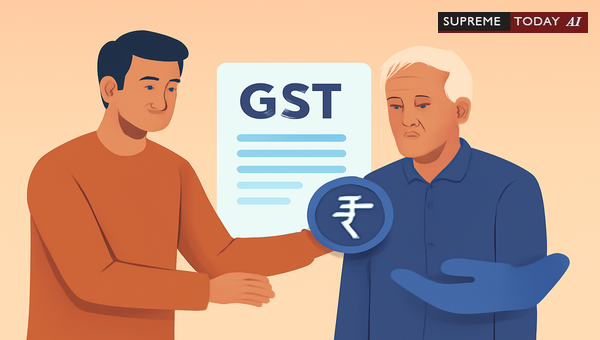
Losing a parent is challenging enough without the added burden of unexpected tax demands. Imagine receiving a GST notice for service tax owed by your late father—does the responsibility fall on you as the son? This is a common concern for in India, especially under the regime, where service tax liabilities from pre-GST eras can linger.
In this post, we dive into the legal nuances: is the son liable to pay service tax in GST which was due in the name of the late father? We'll break down the principles, court views, and practical steps, drawing from key legal documents. Note: This is general information, not specific legal advice. Consult a tax professional for your situation.
Generally, the liability to pay GST on service tax due in the name of a deceased person does not automatically transfer to the son or legal heir2022 0 Supreme(SC) 479. The law specifies that the person liable is the or the responsible party, limited to the assets of the deceased that reach the heir 2022 0 Supreme(SC) 479. Personal liability doesn't arise unless explicitly assigned by law or accepted by the heir.
The liability to pay the tax is the or the person responsible for the payment, and such liability is limited to assets of the deceased that come into the hands of the legal heir or representative 2022 0 Supreme(SC) 479.
These principles stem from GST laws, akin to Sections 159 and 2(29), emphasizing asset-bound responsibility 2022 0 Supreme(SC) 479.
GST law ties liability to the actual , not just the billed party. The definition of 'recipient' under GST laws emphasizes that only one recipient per supply is recognized, and the liability is tied to the actual recipient 2022 0 Supreme(SC) 479. This prevents heirs from inheriting tax debts unrelated to inherited assets.
In practice, if your father was the service recipient, his estate bears the load—not you personally.
Heirs' exposure is capped: The liability to pay tax, including service tax, is limited to assets inherited or in the possession of the legal heir, and does not automatically extend to the heir personally 2022 0 Supreme(SC) 479. Proceedings against a deceased can continue against heirs only if they hold assets and are properly recognized.
This mirrors broader tax recovery rules, where personal assets remain protected absent specific provisions.
Notices to a deceased? Often a procedural lapse, fixable under : Notices issued to a deceased person are that can be cured under Section 292B of the GST law 2022 0 Supreme(SC) 479. This doesn't auto-impose liability on heirs without further steps.
The in reinforced this: procedural errors are curable but don't create personal heir liability without participation or recognition 2022 0 Supreme(SC) 479.
Under , sons have a '' to pay father's debts (not immoral/illegal). But does this cover taxes?
One view limits it: It does not stand to reason that while the son is liable to pay the debts of the father so incurred, he is not due in respect of the profits of that trade... The doctrine of of the sons of a Hindu to discharge the pecuniary liability of their father which is not tainted by illegality or immorality does not extend to the liability of the father for payment of tax 1970 0 Supreme(AP) 5.
However, courts have sometimes extended it to tax arrears. In a case involving income-tax dues from a father's separate business pre-partition, the court held recovery possible from sons post-partition under : The arrears of income-tax due by the petitioners' father... can be recovered from the son after the partition under the doctrine of 1970 0 Supreme(AP) 5. The ratio: It is obligatory on the son that he should pay taxes which are legitimately due to the State by his father 1970 0 Supreme(AP) 5.
Contrast with GST: While income-tax precedents exist, GST focuses on service recipient liability and asset limits, potentially narrowing heir exposure 2022 0 Supreme(SC) 479.
Watch for these scenarios:
Other contexts, like lease agreements, show tenants liable for GST on maintenance, but that's contractual—not heir-related 2022 0 Supreme(SC) 1062. Similarly, GTAs include free diesel in service value for GST, highlighting recipient focus 2023 0 Supreme(Chh) 647.
Tax authorities should issue heir-specific notices rather than relying on defects 2022 0 Supreme(SC) 479.
Typically, a son isn't personally liable for his late father's service tax under GST—it's tied to the recipient and deceased's assets 2022 0 Supreme(SC) 479. may apply in some tax contexts 1970 0 Supreme(AP) 5, but GST's framework offers protection.
Key Takeaways:- Liability doesn't auto-transfer to heirs.- Limited to inherited assets.- Respond to notices proactively.- Consult experts for case-specifics.
Stay informed on GST evolutions, as seen in works contracts or e-commerce 2025 0 Supreme(Kar) 1955 2023 0 Supreme(Chh) 647. For families, proactive estate planning avoids these pitfalls.
References: Primary analysis from 2022 0 Supreme(SC) 479; insights 1970 0 Supreme(AP) 5. Always cross-check with current laws.
#GSTLiability,#LegalHeirsTax,#ServiceTaxHeirs


, such electronic commerce operator shall appoint a person in the taxable territory for the purpose of paying tax and such person shall be liable to pay tax. ... This is the essence of GST, and this is why GST is not simply VAT plus service tax but an improvement over the previous system of VAT and disjointed service tax.” 47. ... As per Section 15(2)(b) any amount of supply is liable to #HL_START....

Petitioners contend that 1-7-2017 when the Goods and Services Tax (GST) Act came into effect/force, the works contract was treated as "deemed service" and the Petitioners were liable to pay GST at 18% from 1-7-2017 to 21-8-2017 and at 12% from 22-8-2017 onwards. ... ) or regular VAT assessment scheme (for short 'the VAT scheme') under the Karnataka Value Added Tax Act, 2003 (for short 'the KVAT Act') are required and made liable to pay#HL_E....

Said section employs the expression "person liable to pay the service tax". ... Section 65(7) of the Act, 1994 defines the term "assessee" to mean "a person liable to pay the service tax and includes his agent". 8.4. In the case at hand service provider, namely Atal Bihari Senapati, is the person liable to pay the service tax. ... 8.20.One of the legal heirs of....
Petitioners contend that 1-7-2017 when the Goods and Services Tax (GST) Act came into effect/force, the works contract was treated as "deemed service" and the Petitioners were liable to pay GST at 18% from 1-7-2017 to 21-8-2017 and at 12% from 22-8-2017 onwards. ... Under the Finance Act 1994, service tax had been exempted in respect of the Works Conntract rendered to Government and statutory agencies and therefore, there was no Service#H....

be liable to pay, out of the estate of the deceased, to the extent to which the estate is capable of meeting the charge, the tax, interest or penalty due from such person under this Act, whether such tax, interest or penalty has been determined before his death but has remained unpaid or is determined ... legal representative or any other person, such legal representative or other person, shall be liable to pay tax, interest or penalty due....

However, after taking into account the due credit made by the petitioner and after considering reply made by the petitioner, the assessment order was passed finally on 05.03.2020, quantifying the total service tax liability at Rs.17,80,821/-. ... The learned counsel appearing for the petitioner by referring the communication said to have been sent by the Superintendent of GST & Central Excise, Neyveli Range 1, submitted that the petitioner paid the service tax. ... While quantifying t....

Since the appellant had availed the cash discount from the vendors and on the net of the amount had discharged the Central Excise duty liability, it cannot be said that they are again liable to pay service tax under the category of Banking and other Financial Services, as it would amount to double taxation ... I Service Tax Miscellaneous Application No. 87278 of 2025 (on behalf of the appellant) In Service Tax Appeal No. 86019 of 2018 AND ....
6.4 Since the appellants were individually liable to pay service tax and eligible for the exemption under general exemption Notification 6/2005-S.T., dated 1-3-2005 during the period 2007-08 and 2008-09, no service tax was payable during the said period. ... The appellants were, therefore, not liable to pay service tax on the amounts received by them during these two years by virtue of Notification No. 6/2005-S.T.....

It does of stand to reason that while the son is liable to pay the debts of the father so incurred, he is not liable to pay the tax due in respect of the profits of that trade, or debts incurred by the father for the purpose of the payment of those taxes. ... that the son is liable to pay the fathers debt. ... The son has not to pay a fine or t....

or any other person, such legal representative or other person, shall be liable to pay tax, interest or penalty due from such person under this Act; and (b) if the business carried on by the person is discontinued, whether before or after his death, his legal representative shall be liable to pay, out ... Undeniably, in a case where the person is liable to pay tax, interest and/or penalty, has expired and the business is carried on ....

Under the Lease Agreement, over and above the above amount, the tenant is also liable to pay the maintenance charges as well as the service tax. The tenant, though paid the rent and the other maintenance charges, however, did not deposit/pay the GST. Therefore, the original plaintiff – landlord filed an application before the learned Trial Court under Section 13(6) of the Act, 1961 and prayed to strike off the defence of the appellant - defendant - tenant. On coming into force of the GST, the tenant is liable to pay the GST instead of service tax.

Applicability of service tax on production charges is a different plea intertwined with determination of factual position of whether there is an incidence of service in the activity of production or if the nature of service could be held as a composite supply. Although service tax has been subsumed in it, GST is nevertheless a new tax. In fact, the decision of the Delhi Authority for Advance Ruling,[ Advance Ruling No. 02/DAAR/2018 dated 28th March, 2018 (in Application No. 02/DAAR/2017 dated 29th December, 2017).] The court also does not find any merit in the contention of....

However in respect of the license fee, the Railway is liable to pay service tax to the GST by collecting from the contractors on the license fee. However, exemption would be applicable only in respect of the services provided by the contractors to the customers/end users and in such cases, the contractors are not liable to pay taxes directly to the GST Department. As far as the exempted services under the provisions of the Act, are concerned provided by the contractors to the customers/end users, in such an event, the contractors are not liable to pay tax to the GST Departm....

1 and 4 submits that even if there is any change in the tax structure, the Petitioner would not be entitled to receive the original tax benefits as provided under the Incentive Scheme of 1993 and whatever benefits that might be conferred upon the Petitioner would be made available only in terms of Government Resolution recently issued on 12th June 2018 and also the other instructions that have been issued so far or would be issued from time to time. He points out that under the new tax structure which has a centralized system of Sales Tax under the name General Sales Tax (for short....

7. Mr. Dharmadhikari, the learned AGP for Respondent Nos.1 & 4 submits that even if there is any change in the tax structure, the Petitioner would not be entitled to receive the original tax benefits as provided under the Incentive Scheme of 1993 and whatever benefits that might be conferred upon the Petitioner would be made available only in terms of Government Resolution recently issued on 12th June 2018 and also the other instructions that have been issued so far or would be issued from time to time. He points out that under the new tax structure which has a centralized system o....


An indispensable Tool for Legal Professionals, Endorsed by Various High Court and Judicial Officers
Please visit our Training & Support
Center or Contact Us for assistance

Scan Me!
India’s Legal research and Law Firm App, Download now!


For Daily Legal Updates, Join us on :



 Back to top


