Searching Case Laws & Precedent on Legal Query.....!
Analysing the retrieved Case Laws
Scanned Judgements…!



Searching Case Laws & Precedent on Legal Query.....!
Analysing the retrieved Case Laws
Scanned Judgements…!
THE NEW INDIA ASSURANCE CO. Vs M.SHANTHI,
, the bus driver was held primarily negligent for rash driving, with responsibility fixed at 30% on the bus driver and 70% on the van driver after considering the circumstances ["reference"].Analysis and Conclusion:In incidents involving a vehicle hitting a heavy vehicle from behind, liability primarily rests on the driver of the heavy vehicle if rash or negligent driving is established. Proper safety measures, signaling, and adherence to traffic rules can mitigate liability. When accidents involve parked heavy vehicles, negligence is typically attributed to the parked vehicle if safety precautions are not observed. Liability may extend to the owner and insurer of the heavy vehicle, especially when negligence is proven. In cases of death, courts consider contributory negligence and the circumstances of the accident to determine compensation liability. Overall, heavy vehicle drivers and owners bear significant responsibility for ensuring safety to prevent rear-end collisions and related accidents.
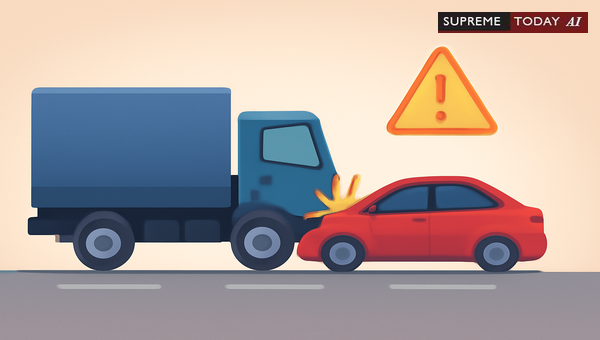
Rear-end collisions are among the most common road accidents, especially involving heavy vehicles like lorries. Imagine driving behind a lorry when traffic slows—suddenly, your vehicle collides with its rear. A pressing question arises: Hitting Behind Lorry Heavy Vehicle Lorry only Liable? In other words, is the lorry driver solely responsible when hit from behind? This blog explores the legal principles, primarily under Indian traffic laws, revealing that liability typically falls on the rear vehicle unless proven otherwise. We'll break down key rules, case law, and exceptions to help you understand your rights and responsibilities.
Note: This is general information based on legal precedents and not specific legal advice. Consult a qualified lawyer for your case.
In rear-end collisions where a vehicle strikes the rear of a heavy vehicle like a lorry—especially if the lorry is stationary or slow-moving—the driver of the following vehicle generally bears liability. This stems from the fundamental duty to maintain a safe distance. As outlined in the , Rule 23 mandates: the driver of a motor vehicle moving behind another vehicle shall keep at a sufficient distance from that other vehicle to avoid collision if the vehicle in front suddenly slows down or stops. 2016 0 Supreme(Ker) 864
This on the rear driver is reinforced in case law. Courts hold that failure to keep a safe distance constitutes negligence, placing the burden on the rear driver to prove otherwise. For instance, in a discussed decision involving Nishan Singh, the court emphasized that the driver who hits the vehicle in front from behind is usually negligent unless he can prove otherwise. 2025 Supreme(KER) 1043
Judicial decisions consistently uphold this principle. In one case, a vehicle hit the rear of another, and the court attributed negligence to the rear driver for not maintaining distance. 2025 Supreme(KER) 1043 The 's stance in similar matters, like Nishan Singh, solidifies that the rear driver must with evidence of due caution.
Other precedents echo this. For example, in a high court matter, the entire negligence lay with the bus driver who drove the vehicle in a and dashed against the van from behind.
,
Here, after hitting the van, the bus struck a tree, underscoring the rear vehicle's speed and lack of control as key factors.Contrastingly, cases where lorries are the rear vehicle shift liability accordingly. But when lorries are hit from behind, the focus remains on the following driver's adherence to safe distance rules.
Police documentation plays a pivotal role. Reports typically note if the rear vehicle failed to keep sufficient distance, directly invoking Rule 23. 2016 0 Supreme(Ker) 864 In one such report, the accident occurred because the following vehicle hit a stationary or slow-moving lorry ahead, confirming the rear driver's negligence. 2016 0 Supreme(Ker) 864
Under the , these violations contribute to compensation claims. Tribunals assess evidence like witness statements, vehicle inspections, and skid marks to —often 100% on the rear driver in straightforward rear-shunts.
While the default favors the rear driver being liable, exceptions exist if they can prove:- The lorry stopped abruptly without warning (e.g., mechanical failure or brake lights malfunction).- Road conditions or signals misled the rear driver.- The lorry was parked illegally or without indicators.
However, such proofs are challenging. Documents rarely detail these exceptions, placing the onus on the rear driver. 2025 Supreme(KER) 1043 In insurance disputes, factors like invalid licenses complicate matters but don't alter core collision liability. For instance, courts have ruled insurers not liable if lorry drivers lacked heavy goods vehicle endorsements, but this affects compensation recovery, not fault determination. 2017 0 Supreme(AP) 482
Broader case law provides context:- In claims involving lorries as the crime vehicle, tribunals fixed liability on owners/insurers when lorries caused accidents, but these often involved lorries hitting from front or side—not rear-end scenarios. 2024 Supreme(Online)(TEL) 18450- A case acquitted an accused lorry driver for dangerous driving due to prosecution gaps, highlighting the need for solid evidence on causation.
- Compensation appeals under Article 226 confirmed lorry liability only when drivers were at fault, reducing awards if victims contributed. But in pure rear-hits, rear remains primary.
These illustrate that while lorries (heavy vehicles) face scrutiny for size-related risks, rear-end physics favors front vehicles.
To navigate these accidents:- For Rear Drivers: Always maintain 2-3 seconds following distance, especially behind lorries. Document everything—dashcam footage, witnesses—to rebut presumptions.- For Lorry Drivers: Use hazard lights for stops; ensure brakes/lights work. Report incidents promptly.- Claims Process: File with (). Evidence like police reports 2016 0 Supreme(Ker) 864 and mechanical inspections is crucial.- Insurance Tips: Check endorsements; invalid licenses may void insurer coverage, shifting burden to owners. 2020 0 Supreme(Mad) 1386
Courts recommend examining police reports, Rule 23 adherence, and testimonies for fair apportionment. 2025 Supreme(KER) 1043
Rear-end collisions with lorries highlight road discipline's importance. Stay vigilant, drive safely, and know the law to protect yourself. For personalized guidance, contact a motor accident specialist.
References:1. 2025 Supreme(KER) 1043: Negligence in rear-end collisions, Nishan Singh .2. 2016 0 Supreme(Ker) 864: Police report, Rule 23 .3. Additional cases:
,
,, etc. #RearEndCollision #LorryLiability #TrafficLaw


The entire negligence was only on the driver of the bus who drove the vehicle in a rash and negligent manner and dashed against the van from behind. After hitting the van, the bus dashed against a tree. ... Normally, there is a possibility of a vehicle to be dragged to some distance, after hitting another vehicle and the speed of the vehicle also may be a rea....

so as to avoid hitting the over speeding lorry. ... front of him and the deceased gave signals and horn to the said vehicle in order to overtake the said vehicle and the driver of the said vehicle had first slowed down the vehicle and when the deceased was overtaking the said Navata Transport lorry, in the meanwhile, the driver of the said lorry sudden....

Therefore, the tribunal was proper in fixing the liability on the owner and insurer of the crime lorry. Furthermore, though the petitioners claimed monthly income at Rs.20,000/- as driver of a heavy goods vehicle, beyond any rationale monthly income has been restricted to Rs.15,000/-. ... The tribunal considering the record observed that (a) PW-1 i.e. the wife of the deceased though not an eyewitness admitted that the lorry#HL_END....

Therefore, the tribunal was proper in fixing the liability on the owner and insurer of the crime lorry. Furthermore, though the petitioners claimed monthly income at Rs.20,000/- as driver of a heavy goods vehicle, beyond any rationale monthly income has been restricted to Rs.15,000/-. ... The tribunal considering the record observed that (a) PW-1 i.e. the wife of the deceased though not an eyewitness admitted that the lorry#HL_END....
Therefore, the tribunal was proper in fixing the liability on the owner and insurer of the crime lorry. Furthermore, though the petitioners claimed monthly income at Rs.20,000/- as driver of a heavy goods vehicle, beyond any rationale monthly income has been restricted to Rs.15,000/-. ... The tribunal considering the record observed that (a) PW-1 i.e. the wife of the deceased though not an eyewitness admitted that the lorry#HL_END....

When a heavy vehicle/ container lorry is parked on the left lane, without leaving any space on the left lane, it is obvious that the vehicle coming from behind during night, will not be able to see or perceive a parked lorry when the vehicles are coming from the opposite direction. ... Therefore, the Tribunal was fully justified in holding that there was no negligence on the part of the....

It is after hitting the claimant’s vehicle the claimant fell down and injury was sustained due to the fact that the lorry coming behind and hitting the Omini van. ... - The driver of a motor vehicle moving behind another vehicle shall keep at a sufficient distance from that other vehicle to avoid collision if the vehicle#HL_....

According to ID2, the accused stated, at that material time, he was driving the lorry in the left lane behind another lorry with uncertain registration number. ... It was further argued by the prosecution that the accused's driving, which suddenly hit and rammed into the deceased's vehicle from behind, was evidently dangerous. ... PW2 and PW4 saw that the car had overturned and was slightly slanted with t....

To avoid hitting the lorry, he tried to move to the left, but it being a ghat road, the vehicle capsized, due to which Nagaraj came under the lorry and died. ... In so far as the quantum, this Court finds that the deceased - Nagaraj was a professional driver, holding heavy vehicle licence. The fact that he died while driving a lorry is a proof of his profession. ... of ....

PW2 deposed that the deceased was driving his vehicle slowly behind the third respondent’s vehicle, but RW1 (driver of the third respondent’s vehicle) suddenly applied brakes without giving any signal. ... It is contended that as per Regulation 23 of the Rules of the Road Regulations, 1989, 'the driver of the vehicle moving behind another vehicle shall keep at a suffici....
9. The learned counsel appearing for the appellant-Insurance Company contended that the Tribunal erred in awarding huge amount of Rs.4,17,400/- as compensation, when the Lorry involved in the accident did not have fitness certificate and the driver of the Lorry did not possess valid Driving License at the time of accident. The Hon'ble Apex Court in the judgment reported in 2020 SCC Online SC 769 [Beli Ram Vs. Rajinder Kumar and another], has held that when the driver of the offending vehicle d....
Moreover, on 6.3.2012, after registering the case, the police rushed to the spot and prepared the rough sketch, wherein they have clearly marked the presence of motorcycle. From the above injuries, it is seen that the accident could not have been occurred due to hitting of a lorry, but only due to hitting of a small vehicle like motorcycle.

In this case the driver had driving licence to drive light motor vehicle, as evidenced by Ex.B.2, driving licence extract. Hence this is not a case where the insurer can be made absolutely liable, by considering that the vehicles, though are different would require same driving licence. He was driving a lorry which is a heavy goods vehicle. The expertise required to drive light and heavy vehicles may differ.

Per contra, according to Claimants, the vehicle was not a heavy motor vehicle and Ex.R1-History sheet for drivers carries an endorsement authorising the driver to drive "transport vehicle" and therefore, he had valid driving licence. In this case, since the gross vehicle weight of the lorry involved is 16,200 kilograms, we are of the view that the vehicle/lorry involved in the accident is only a "heavy goods vehicle". Tribunal held that the lorry bearing registratio....
The lorry was left with MI s. Sankar Raja Body Builders at Madurai to dismantle the body of the lorry and for repairing the same with M/s ABT Industries, Madurai. On account of the accident, heavy and severe damages were sustained to the lorry. Lorry's cabin, chassis, wooden parts, bonnet and mudguard were all completely damaged. The lorry driver immediately r reported the accident to the Police and a case has been registered in Crime No.138/94.


An indispensable Tool for Legal Professionals, Endorsed by Various High Court and Judicial Officers
Please visit our Training & Support
Center or Contact Us for assistance

Scan Me!
India’s Legal research and Law Firm App, Download now!


For Daily Legal Updates, Join us on :



 Back to top


