




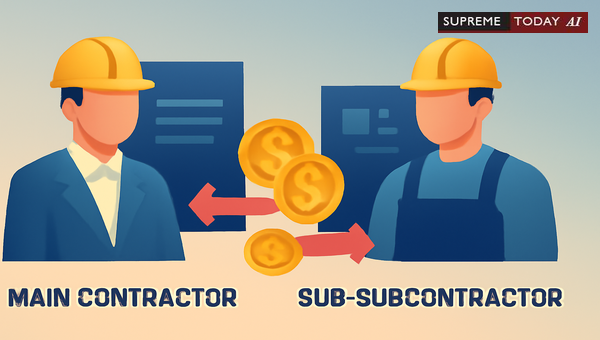
Can Main Contractors Pay Sub-Subcontractors Directly?
In the complex world of construction projects, payment flows are critical to keeping work on track. But what happens when disputes arise between subcontractors and their sub-subcontractors? A common question arises: can a main contractor pay directly to a sub-subcontractor, bypassing the subcontractor? This issue touches on fundamental principles like , industry practices, and specific contractual terms. While direct payments may seem like a practical solution to ensure lower-tier workers get paid, they come with legal nuances that could lead to disputes or breaches.
This article breaks down the legal landscape, drawing from key documents and cases. Note that this is general information based on reviewed materials and not specific legal advice—always consult a qualified attorney for your situation.
Main Legal Finding
Generally, a main contractor can make direct payments to a sub-subcontractor, bypassing the subcontractor, provided such arrangements align with contractual provisions and industry practices
. However, legality hinges on the specific terms of the contracts involved and the relationships between parties
. Without explicit authorization, such payments risk being challenged as unauthorized or leading to breach claims.
Key Points to Consider
- Contractual frameworks and industry norms allow direct payments under certain conditions, such as for nominated sub-subcontractors
.
- Absence of privity typically bars direct payments unless the main contract or subcontract explicitly permits them
.
- Clauses on and payment procedures can enable or restrict these payments
.
- Direct payments to nominated parties are often deemed as payments made by the subcontractor, avoiding disputes
.
- Unauthorized direct payments may constitute a .
Detailed Analysis: and Its Limitations
The Principle of Privity
is a cornerstone: only parties in direct contractual relation owe duties to each other
. For instance, a court ruled that a defendant without privity (like MMCOG) could not be liable for subcontractor claims, underscoring that main contractors generally lack direct ties to sub-subcontractors
. This echoes in other cases where sub-contractors lacked to challenge principal contracts due to no privity with the authority 2020 0 Supreme(Bom) 1467.
In one scenario, has observed that the Contractor had given a sub-contract to the sub-contractor and in the said agreement of sub-contract, the was not a party and there was no liability on the part of the to make any payment to the sub-contractor 2020 0 Supreme(Bom) 1467. Even when permitted and made direct payments, it didn't create liability without privity.
Contractual Provisions Enabling Direct Payments
Specific clauses often greenlight direct payments. For example, states that the main contractor may pay nominated sub-contractors directly, and such payments are deemed to be payments made by the subcontractor to the nominated parties
. Similarly, contractual clauses related to nominated sub-contractors and nominated suppliers specify that the government or main contractor can pay directly to nominated sub-contractors or suppliers, and these payments are deemed as payments to the contractor
.
These '' mechanisms protect all parties, treating the main contractor's payment as if it came from the subcontractor.
Industry Practices Supporting Direct Payments
In construction, direct payments to nominated sub-contractors or sub-subcontractors are common when stipulated. This practice facilitates efficiency, especially in government or large projects
. Supporting this, some contracts allow advances where Half of the amount shall be paid in advance and remaining half shall be paid directly to the suppliers on the behalf of the Sub Contractor 2015 0 Supreme(MP) 1053.
However, other contexts highlight caution. In cases, sub-contractors sought direct payments from principals like , but courts scrutinized privity and approval: a portion of the Contract awarded to the Corporate Debtor was sub-contracted with complete knowledge and approval of , and was controlling the execution of the work both directly and through the... 2024 Supreme(Online)(NCLT) 1328 2024 Supreme(Online)(NCLT) 1333 2024 Supreme(Online)(NCLT) 1332. This shows direct involvement doesn't always override privity.
Tax implications also arise. For sub-contractors, no tax shall be payable under on the turnover relating to the consideration received as a sub-contractor if the main contractor opted to pay tax by way of 2008 Supreme(Online)(SC) 65, indicating payment structures affect fiscal duties.
Risks and Exceptions
Direct payments aren't always straightforward:- If contracts prohibit or omit provisions for them, payments may be invalid
.- Without authority, they could breach obligations or spark disputes
.- Sub-contractors might claim interference, as seen where the liability to pay the sub-contractor charges is to be determined on the basis of the terms of the two agreements 2025 Supreme(Online)(Kar) 22599.
In , sub-contractors without privity couldn't contest terminations: The central legal point established in the judgment is the requirement of for a sub-contractor to challenge the termination of the principal contract 2020 0 Supreme(Bom) 1467. Risks extend to wages, where sub-contractors remain liable as immediate employers 2009 0 Supreme(Guj) 264.
Recommendations for Main Contractors
To navigate safely:- Review contracts thoroughly for direct payment clauses before acting
.- Include explicit provisions in subcontracts for such scenarios.- Document everything—communications, consents, and payments—to prove authority
.- Consider tax and regulatory angles, like on sub-contract works 2010 0 Supreme(Gau) 285.
Key Takeaways and Conclusion
In summary, main contractors may pay sub-subcontractors directly if contracts authorize it or industry practice supports it, but privity limits this absent clear terms
. clauses for nominated parties provide a safe path
. Always prioritize documentation to mitigate risks of breaches or disputes.
Construction projects thrive on clear agreements. By understanding these principles, parties can avoid payment pitfalls. For tailored advice, engage legal experts familiar with your contracts.
References
: Direct payments with consent permissible under provisions.
: Clauses for direct payments to nominated sub-contractors.
: Deemed payments to nominated parties.
: Privity limitations.
- 2020 0 Supreme(Bom) 1467: No liability without privity despite direct payments.
- 2024 Supreme(Online)(NCLT) 1328: Sub-contract approvals in .















