Searching Case Laws & Precedent on Legal Query.....!
Analysing the retrieved Case Laws
Scanned Judgements…!



Searching Case Laws & Precedent on Legal Query.....!
Analysing the retrieved Case Laws
Scanned Judgements…!
Incompetency vs. Misconduct - Incompetency refers to a lack of skill or ability, which is generally not punishable as misconduct; whereas misconduct involves wrongful acts, negligence, or acts with ill motive that can attract disciplinary action ["2023 0 Supreme(All) 202"], ["2024 0 Supreme(Guj) 366"], ["2023 0 Supreme(Guj) 794"].
Legal Principles on Punishment - A person cannot be punished twice for the same misconduct (double jeopardy), and prior punishment for a misconduct does not justify re-initiation of disciplinary proceedings for similar or subsequent misconduct unless it involves a distinct and new act ["2023 0 Supreme(All) 202"], ["2024 0 Supreme(Guj) 344"].
Misconduct Requires Wrongful Intent - Misconduct implies wrongful intention or negligent acts, not mere errors or mistakes. For instance, errors in judgment or innocent mistakes do not constitute misconduct ["2023 0 Supreme(Mad) 2452"], ["2023 0 Supreme(Guj) 794"].
Disciplinary Proceedings and Evidence - Findings must be based on evidence, and suspicion alone cannot replace proof. Proper adherence to principles of natural justice and fair investigation is essential. Evidence must be relevant and not based solely on conjecture ["2024 0 Supreme(Guj) 344"], ["2023 0 Supreme(MP) 404"].
Proportionality and Context - Punishments should be proportionate to the misconduct, considering circumstances such as past conduct, nature of the act, and specific facts of each case. Unauthorized absence, for example, is not automatically misconduct but depends on context and factors like intermittent absence or prevention from signing attendance ["2024 0 Supreme(Guj) 366"].
Misconduct in Specific Cases - Acts like unauthorized absence, negligence, or procedural errors may or may not constitute misconduct depending on the facts. For example, an employee’s act of signing a settlement based on legal advice, within procedural boundaries, may not be misconduct ["2023 0 Supreme(Guj) 794"], ["2025 0 Supreme(Ker) 2699"].
Misconduct Cannot Be Based on Suspicion Alone - Courts emphasize proof and evidence over suspicion; disciplinary actions based solely on suspicion or unsubstantiated allegations are invalid. The absence of clear, specific charges or rules defining misconduct invalidates punishment ["2024 0 Supreme(Guj) 344"], ["2023 0 Supreme(Cal) 245"].
Distinction Between Incompetency and Misconduct in Punishment - Incompetency cannot be punished as misconduct unless accompanied by wrongful acts or negligence. Conversely, misconduct involves wrongful acts that can be penalized independently of competency issues ["2023 0 Supreme(All) 202"], ["2023 0 Supreme(All) 2525"].
Analysis and Conclusion:The sources collectively affirm that Incompetency and Misconduct are fundamentally different. Incompetency relates to a lack of skill or ability and is generally not punishable as misconduct. Misconduct involves wrongful or negligent acts with wrongful intent, which can be subject to disciplinary action. Importantly, a person cannot be punished twice for the same misconduct (double jeopardy), and punishments must be based on concrete evidence, not suspicion. Disciplinary proceedings must adhere to principles of natural justice, and penalties should be proportionate to the misconduct. Misconduct cannot be broadly inferred from errors, negligence, or incompetency alone, and acts not explicitly defined as misconduct in rules or regulations cannot be penalized.
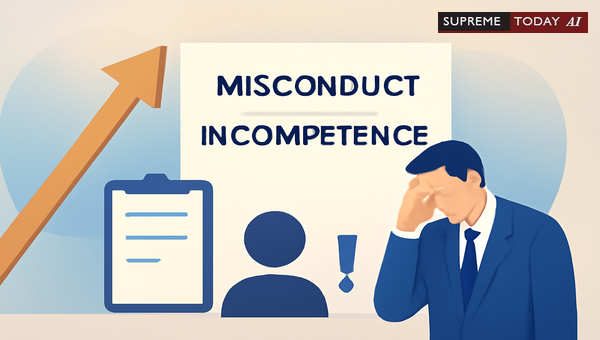
In the realm of employment and service law, distinguishing between and is vital for employers, employees, and legal practitioners. Often, what appears as poor performance might be labeled differently under the law, affecting disciplinary actions, penalties, and even court interventions. But what is the difference between and ? This question frequently arises in , where —typically akin to incompetency or —must be separated from intentional wrongdoing.
This blog post breaks down the concepts, drawing from established legal principles and case law. Note that this is general information and not specific legal advice; consult a qualified lawyer for your situation.
generally involves wrongful intention and cannot be equated with mere or . It implies a deliberate violation of established rules or standards of behavior 2016 5 Supreme 568 2007 0 Supreme(Cal) 148. For instance, a single act of omission or error of judgment typically does not constitute unless shown to arise from ill motive 2007 0 Supreme(Cal) 148.
In disciplined services, acts like or misbehavior towards superiors are treated as serious 2023 1 Supreme 232. Employers have an to initiate for such acts, even if not explicitly enumerated in 2023 0 Supreme(Cal) 245 2014 0 Supreme(AP) 209. This right persists regardless of whether the act is a criminal offense.
, often overlapping with incompetency, refers to a lack of ability or skill to perform duties effectively. It is distinct from , which breaches conduct or ethical standards. For example, a judicial officer's wrong decision may be a and not 2016 5 Supreme 568.
Unlike , does not necessarily involve intent. It might stem from inefficiency, poor judgment without malice, or procedural lapses without deliberate harm. Courts recognize this distinction to prevent disproportionate punishments for non-intentional failings.
Judicial Interference is Limited: Courts have limited authority to interfere with findings of or penalties, especially in serious cases within disciplined forces 2023 1 Supreme 232 2020 0 Supreme(Jhk) 19. The gravity of the determines punishment appropriateness.
Employer's Disciplinary Authority: This is inherent and broad, covering acts harmful to service integrity, even if undefined 2014 0 Supreme(AP) 209. However, penalties must be proportionate.
No for : Once penalized for a specific , an employee cannot be punished twice for the same act. In one case, respondent No.4 was already fined, making further termination invalid 2022 0 Supreme(Bom) 1057.
These principles ensure fairness while upholding discipline.
A judicial officer's good-faith error, absent corrupt intent, does not qualify as , influencing disciplinary scope 2016 5 Supreme 568. This underscores that not every mistake warrants charges.
When past conduct forms the basis for punishment, it must be disclosed in the . In a case, absence from duty was gross indiscipline, but past was only additive, not the core reason for dismissal 2025 7 Supreme 246. The clarified: Penalty of dismissal is a consequence of proved and falls under the first part of Rule 16.2(1) of Rules, 1934.
Non-participation in enquiries can lead to adverse findings, upholding penalties for grave 2017 0 Supreme(Del) 2712. However, authorities must supply reports (e.g., advice) for defense, per .
Even for proven causing minor loss (e.g., Rs. 3000), extreme penalties like removal are disproportionate if no financial gain or corruption is involved 2013 0 Supreme(Del) 2031. The court noted: The nature of is more in the nature of violation of practice and procedure than in the nature of corruption.
For , prior incidents of or incompetency do not automatically require inquiry for termination. It may assess efficiency unless proven otherwise
. Termination during probation is permissible under , if not stigmatic.
Errors within jurisdiction differ from ; mere jurisdictional overreach does not invalidate proceedings 2020 0 Supreme(Guj) 939.
These cases illustrate how courts scrutinize intent, procedure, and proportionality.
Thorough Investigations: Allegations of require evidence; distinguish from to avoid challenges 2016 5 Supreme 568.
Proportionate Actions: For , training or reassignment may suffice, unlike 's potential dismissal 2022 0 Supreme(Bom) 1057.
: Provide notice of past records, legal assistance, and enquiry reports to prevent reversals 2017 0 Supreme(Del) 2712 2022 0 Supreme(Bom) 1057.
In disciplined forces or public service, the stakes are higher, with courts deferring to authorities unless findings are perverse 2020 0 Supreme(Jhk) 19.
(incompetency or ) and differ fundamentally: the former lacks intent and focuses on capability, while the latter demands deliberate breach, justifying stricter measures. Employers must navigate this carefully to ensure valid disciplinary actions, supported by evidence and fair process.
Key Takeaways:- requires proof of wrongful intent; errors alone do not suffice 2007 0 Supreme(Cal) 148.- Distinguish clearly to apply appropriate remedies.- Courts uphold proportionate penalties but intervene on procedural flaws.- Always investigate thoroughly and document past conduct if relied upon.
References: 2016 5 Supreme 568 2007 0 Supreme(Cal) 148 2023 1 Supreme 232 2014 0 Supreme(AP) 209 2023 0 Supreme(Cal) 245 2020 0 Supreme(Jhk) 19 2025 7 Supreme 246 2022 0 Supreme(Bom) 1057 2020 0 Supreme(Guj) 939 2017 0 Supreme(Del) 2712
2013 0 Supreme(Del) 2031
This analysis highlights the nuanced legal landscape. For tailored advice, seek professional legal counsel.
#Maladministration #Misconduct #EmploymentLaw


much as it suffers from vice of double jeopardy as a person cannot be punished again for the same charge on which he has been punished earlier and also that the punishment imposed is excessive. ... The disciplinary authority found that the respondent did not improve in spite of being punished earlier. The High Court agreed with the contention of the respondent and held that a fresh enquiry cannot be initi....

He would contend that a suspicion cannot be allowed to take the place of proof and scrupulous care must be taken to see that the innocent are not punished by recording findings merely based on ipse dixit of the Enquiry Officer. ... It is also an undisputed fact that the petitioner was earlier also punished for his alleged misconduct of misappropriation and was imposed punishment of stoppage of three increments with future ....

of evidence, cannot correct the error of fact and cannot go into the proportionality of the punishment unless it shocks its conscience. ... These deficiencies in personal character or personal ability would not constitute misconduct for the purpose of disciplinary proceedings. Misconduct means, misconduct arising from ill motive, acts of negligence, errors of judgment or innocent mistake, do not constitut....

It may also be made clear that the very order of dismissal from service for gravest misconduct may entail forfeiture of all pensionary benefits. Therefore, the word ‘or’ cannot be read as “and”. It must be disjunctive and independent. ... has not been mentioned in the charge-sheet it cannot be taken into consideration by the punishing authority. ... Thus to my mind, the defendant- appellant cannot derive any mileage from t....

The bone of contention of learned counsel for the petitioner was that even if petitioner was sitting in a bar in drunken condition, since he was not on duty, he cannot be punished for committing misconduct. ... If principles of natural justice are violated while conducting the departmental enquiry which has caused prejudice and enquiry officer has based its reasons on some evidence, this Court cannot re-appreciate the evid....

He would contend that a suspicion cannot be allowed to take the place of proof and scrupulous care must be taken to see that the innocent are not punished by recording findings merely based on ipse dixit of the Enquiry Officer. ... The facts in the present case are quite different. As has been seen from the analysis made by the High Court, it has given emphasis on past misconduct of absence and first time desertion and the....

No finding has been returned with regard to the claim of the writ petitioner that he cannot be held solely responsible for settlement of claim only because of the fact that he had signed the compromise purshis, inasmuch as, processing of claim requires application of mind at different levels and it was ... ‘Misconduct’ implies wrongful intention and not mere error of judgment. 21. It was argued that every act or omission of an officer or em....

The initiation of disciplinary proceedings, it is contended, can take place from the time when the charge sheet is issued to the employee and an employee cannot be punished for the conduct that was not considered as a violation at the time when the incident occurred. ... The learned Single Judge concluded that, at the most, the admitted act of the respondent recording the interview and producing its transcripts could be termed as an impropriety, and it #HL_S....

This Court in that case has not laid down as a general principle that if an act is not specified by rules to be a misconduct then it cannot be regarded as such and an employee cannot be punished for committing such an act. 8. ... It is beyond anybody's comprehension that although an employee might have committed a serious misconduct like defalcation theft, misbehaviour with a lady or similar....

security forces are certainly different. ... to transform such a negligence into a case of misconduct. ... It is submitted that whenever some one falls ill, he immediately goes for rest as per the doctors advise and if such a person cannot approach the authority, he cannot be held guilty. ... imposed upon the petitioner is not commensurate to the charge of misconduct proved. ... On the above principles, i....

So far as the alleged misconduct is concerned, respondent No.4 was already penalized by directing him to pay the amount of fine. Therefore, learned counsel for respondent No.4 is right in submitting that respondent No.4 has been penalized twice for the same misconduct. For the same misconduct, he cannot be punished twice.
That the learned Trial Court ought to have held that it was within the jurisdiction of the Arbitrator to consider the Claim No. 1(B) which related to a dispute regarding the extra payment for extra work. Misconduct Error within jurisdiction and error in excess of jurisdiction are different. Therefore, he has not misconducted himself or to the proceedings.

7. However, we notice that the competent authority has committed legal and procedural infirmity while imposing the punishment without supplying the UPSC advice/report to the applicant and denying him the opportunity to represent and defend himself against the UPSC advice. In this context, we place our reliance on the latest judgment of Hon’ble Supreme Court in Union of India & Others versus S.K. Kapoor 2011 STPL (Web) 277 SC. We are of the considered view that similarity cannot be dr....

Assuming that there was an incident of misconduct or incompetency prior to his discharge from service, the same cannot be ipso facto be termed as misconduct 'requiring an inquiry. It may be a ground for the employer's assessment of the workman's efficiency and efficacy to retain him in service, unless, of course, the workman is able to satisfy that the management for reasons other than efficiency wanted to remove him from services by exercising its power of discharge.'' As no....

The petitioner is guilty of misconduct and has to be suitably punished for the misconduct. In view of what is stated in the foregoing paragraphs, it appears that the extreme penalty of removal from service is shockingly disproportionate to the offence. However the nature of misconduct is more in the nature of violation of practice and procedure than in the nature of corruption.


An indispensable Tool for Legal Professionals, Endorsed by Various High Court and Judicial Officers
Please visit our Training & Support
Center or Contact Us for assistance

Scan Me!
India’s Legal research and Law Firm App, Download now!


For Daily Legal Updates, Join us on :



 Back to top


