


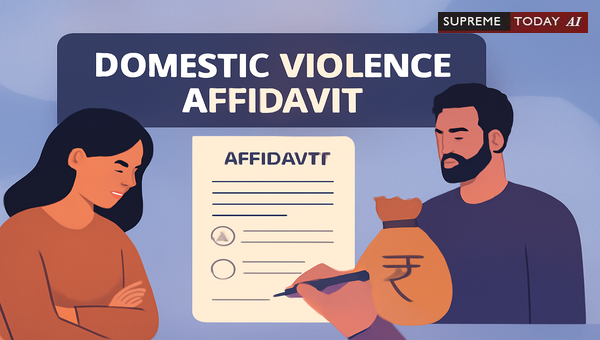
Is Affidavit Mandatory in Domestic Violence Cases? Key Guidelines
In the realm of family law, particularly domestic violence proceedings, transparency in financial disclosures has become a cornerstone for fair adjudication. A common query arises: Priyanka Sreevastava Mandates an Affidavit Whether any Complaint can be Referred for Police Investigation under Even in the Absence of Affidavit are there any Exceptions. While the question touches on procedural aspects like police investigations under the , the core issue revolves around the mandatory nature of disclosure affidavits in domestic violence cases under the (). This blog post delves into the evolution of this requirement, mandates, exceptions, and practical implications, drawing from landmark judgments.
Disclaimer: This article provides general information based on judicial precedents and is not a substitute for professional legal advice. Consult a qualified lawyer for case-specific guidance.
The Shift to Mandatory Disclosure Affidavits
The revolutionized , including those under the , through its landmark judgment in , delivered on . Prior to this, there was no statutory mandate for parties to file affidavits disclosing assets and liabilities in domestic violence cases. 2023 7 Supreme 322 The Court introduced comprehensive guidelines to ensure transparency and prevent frivolous claims or hidden incomes. 2020 6 Supreme 322
Key directives from paragraphs 72.2 and 72.3 of the judgment include:- The applicant claiming maintenance must file a concise application with an of Assets.- The respondent must reply with their own within four weeks. 2020 6 Supreme 322
These guidelines apply universally to all maintenance cases, explicitly encompassing proceedings, effective from the judgment date.
Reinforcement in Subsequent Judgments
The mandatory nature was reaffirmed in Aditi Alias Mithi v. Jithesh Sharma (2023) SCC OnLine SC 1451. The criticized lower courts for passing orders without affidavits, stating that undermines the Rajnesh framework. 2023 7 Supreme 322 This underscores that courts must enforce these procedural safeguards strictly.
In practice, failure to file can result in orders being set aside or cases remanded. For instance, appellate courts have noted lapses where disclosures were not properly considered, leading to revised findings on domestic violence allegations. IND_Delhi_CRLREVP-1274_2019 2022_DHC_4776 The appellate court in paragraph Nos.17 & 18 of the impugned judgment has recorded a categorical finding that the petitioner was subjected to domestic violence at the hands of respondent No.1. IND_Delhi_CRLREVP-1274_2019 2022_DHC_4776
Application to Domestic Violence Complaints and Investigations
Domestic violence cases often involve maintenance claims alongside . While the Rajnesh guidelines focus on aspects, they intersect with . Under (successor to CrPC provisions), magistrates can refer complaints for police investigation. However, the affidavit mandate primarily governs judicial proceedings for maintenance, not initial police referrals.
That said, in DV cases, allegations must be specific to establish validity. Vague claims can complicate investigations or defenses. 2025 Supreme(Online)(Del) 2253 It will not be out of place to mention here that in domestic violence cases, allegations are sometimes vague and lack specificity, which can make it difficult to establish their validity. 2025 Supreme(Online)(Del) 2253
Defendants in alleged false DV cases often seek disclosures via RTI, though personal information may be denied under Section 8(1)(j). 2024 Supreme(Online)(CIC) 4362 Hence, disclosure of the same was denied under .
Exceptions to the Affidavit Requirement
While generally mandatory, exceptions exist:- Economically Weaker Sections (EWS) or Below Poverty Line (BPL) parties may be exempted by the court, subject to verification. This is not the norm but a discretionary relief.- Courts may grant case-specific exemptions based on circumstances, though post-Rajnesh, such leniency is rare without justification.
No blanket exception applies for police referrals under BNSS; affidavits remain crucial for maintenance adjudication even if investigations proceed.
Broader Context from Judicial Trends
DV cases frequently involve overlapping civil and criminal elements. For example, and highlight the need for full disclosures. 2024 Supreme(US)(ca9) 422 Pennington was an alleged abuser because the information she disclosed to him was a domestic violence report against him.
In Indian contexts, courts emphasize living arrangements and rights to residence. 2025 Supreme(Online)(Del) 2253 Act but has at any point of time lived so or had the right to live and has been subjected to domestic violence...
Defensive strategies in contested cases, like those at , often hinge on challenging affidavit compliance or proving falsity. 2024 Supreme(Online)(CIC) 4362
Practical Recommendations for Parties and Courts
To navigate these requirements:- Applicants: Prepare detailed asset affidavits upfront to avoid delays.- Respondents: File replies promptly with full disclosures.- Courts: Enforce Rajnesh guidelines rigorously, as invites higher court intervention. 2020 6 Supreme 322- Advocates: Educate clients on formats; sample affidavits are often court-prescribed.
Post-2020, adherence has streamlined proceedings, reducing disputes over concealed incomes.
Key Takeaways
- Disclosure affidavits became mandatory in DV maintenance cases from , via Rajnesh v. Neha. 2023 7 Supreme 322
- Exceptions are limited to EWS/BPL parties or court discretion.
- Applies to judicial maintenance, influencing but not blocking BNSS investigations.
- Subsequent rulings like Aditi v. Jithesh reinforce compliance. 2023 7 Supreme 322
Understanding these mandates empowers parties in sensitive DV matters. For tailored advice, reach out to a family law expert. Stay informed on evolving jurisprudence to protect your rights effectively.
#DomesticViolenceLaw, #RajneshJudgment, #LegalAffidavit















