


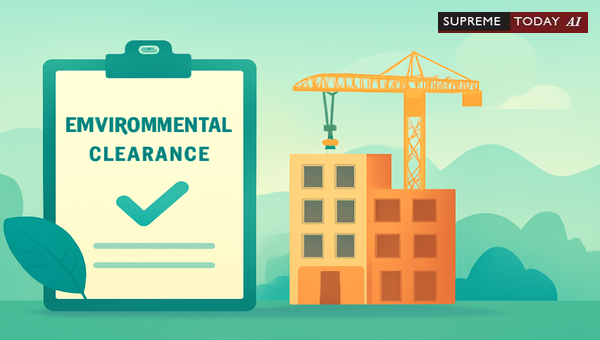
Environment Clearance for New Construction: What Are the Requirements?
In the rapidly developing landscape of India, new construction projects—ranging from residential buildings to large-scale infrastructure—must navigate a complex web of environmental regulations. One critical step often overlooked by developers is obtaining . But what exactly does this entail? If you're asking, Environment Clearance for New Construction—what are the Requirements for this?, this guide breaks it down comprehensively.
Failure to secure this clearance before breaking ground can lead to severe legal consequences, including project halts, fines, and demolition orders from bodies like the . Drawing from key legal frameworks, judicial precedents, and real-world cases, we'll explore the mandates, processes, exceptions, and best practices. Note: This is general information and not specific legal advice. Consult a qualified environmental lawyer for your project.
Legal Framework Governing Environmental Clearance
The cornerstone of environmental regulation in India is the (EP Act), supplemented by the , issued under . This notification explicitly requires for new projects listed in its Schedule, including construction activities. 2016 6 Supreme 198
Projects are categorized based on potential environmental impact:- : High-impact projects needing clearance from the . 2024 0 Supreme(Guj) 1627- : Moderate-impact projects handled by the . 2016 6 Supreme 198 2024 0 Supreme(Guj) 1627
The notification is unequivocal: The following projects or activities shall require from the concerned regulatory authority... before any construction work, or preparation of land by the project management except for securing the land, is started on the project or activity. 2016 6 Supreme 198
This means no site preparation, earthwork, or building can commence without approval. Building and construction projects, area development, and infrastructure fall under categories like 8(a)B2, requiring clearance from SEIAA.
- National Green Tribunal
Step-by-Step Process for Obtaining Clearance
The clearance process is structured into four sequential stages, ensuring thorough environmental scrutiny:
- : Determines if the project needs detailed assessment. 2016 6 Supreme 198
- : Outlines terms of reference for EIA studies, identifying key impacts. 2016 6 Supreme 198
- : Involves local stakeholders to address concerns—a mandatory step for transparency. 2016 6 Supreme 198
- : Expert committees review the EIA report for final approval or rejection. 2016 6 Supreme 198
Developers must submit a detailed application to SEIAA or MoEFCC, including EIA reports assessing impacts on air, water, soil, biodiversity, and communities. For instance, group housing or mixed-use projects must quantify traffic impacts and propose mitigation via an . 2021 Supreme(Online)(NGT) 7
Key Tip: Clearance is site-specific, defined by coordinates. It does not automatically cover ancillary infrastructure like approach roads or highways, which require separate EIAs. 2022 Supreme(Online)(NGT) 2135 2022 Supreme(Online)(NGT) 1525
Judicial Reinforcement: Prior Clearance is Non-Negotiable
Indian courts, including the and NGT, have repeatedly upheld the mandatory prior clearance rule. In a notable airport case, the ruled: The authorities acted in violation of the provisions of the Notification dated by carrying out extensive clearance at the site without Environmental Clearance. 2024 0 Supreme(SC) 456
The NGT has clarified that an EC for one project (e.g., a greenfield airport) does not extend to associated roads: The Environmental Clearance (EC) for Greenfield Airport cannot be considered as Environmental Clearance for the new Highway... No Environment Impact Assessment studies were carried out for the impact of the 4-lane approach road.
LAXMAN NARAYAN RAUL VS M/S ASHOKA BUILDCON LIMITED - National Green Tribunal
LAXMAN NARAYAN RAUL VS M/S ASHOKA BUILDCON LIMITED - National Green Tribunal
are generally invalid. The deprecated lackadaisical attitude of authorities and affirmed: should imply a prior clearance. 2024 0 Supreme(SC) 267
In another instance involving a NIT campus, construction was deferred until clearances were obtained, underscoring enforcement.
- National Green Tribunal
Exceptions and Limitations
Exemptions are narrow:- Activities like land securing (without preparation) or specific operations (e.g., dredging under ). 2016 6 Supreme 198- Temporary waivers in rare cases, but not for core construction.
Most building projects require full compliance. Even pending applications do not permit starting work—violations invite NGT penalties. 2024 Supreme(Online)(MAD) 43085 2023 Supreme(Online)(MAD) 24778
Practical Recommendations for Compliance
To navigate this:- Conduct Preliminary Assessment: Check if your project falls under the Schedule.- Prepare Comprehensive EIA: Include traffic, water, and biodiversity impacts. 2021 Supreme(Online)(NGT) 7- Engage Early: Submit to SEIAA/MoEFCC promptly and participate in public hearings.- Monitor Scope: Ensure EC covers all components; seek separate clearances for roads/highways. 2022 Supreme(Online)(NGT) 2135- Maintain Records: Document compliance to defend against challenges.
Non-compliance risks project delays, fines, or quashing of approvals. Proactive adherence protects investments and the environment.
Conclusion and Key Takeaways
Securing is a legal imperative for new construction in India, governed by the 2006 EIA Notification and reinforced by courts. The multi-stage process—, , consultation, —ensures sustainable development. Remember, clearances are project-specific; omissions like unassessed roads can invalidate them.
Key Takeaways:- Obtain clearance before any land prep or construction. 2016 6 Supreme 198- to MoEFCC; 'B' to SEIAA. 2024 0 Supreme(Guj) 1627- Judicial precedents prohibit post-facto fixes. 2024 0 Supreme(SC) 456- Integrate full EIA for holistic impact assessment.
Stay compliant to build responsibly. For tailored guidance, consult legal experts familiar with MoEFCC/SEIAA procedures.
#EnvironmentClearance, #EIAIndia, #ConstructionLaw












