


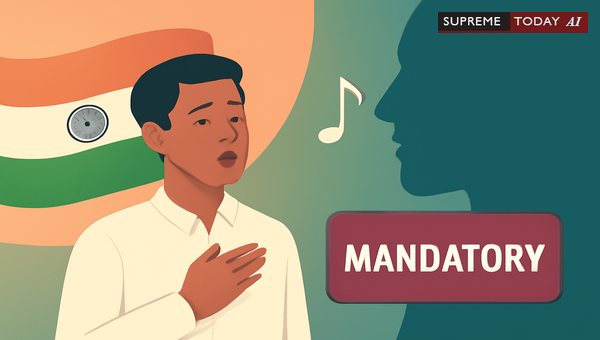
India's Law on National Anthem Singing: Do You Have to Sing?
The National Anthem, Jana Gana Mana, stirs a sense of patriotism in every Indian. But what if you stand respectfully during its rendition without singing? Is that enough, or does the law require you to belt out the lyrics? Many wonder: what is the law in India regulating national anthem singing? This blog post breaks down the legal framework, key statutes, and interpretations to clarify your rights and obligations.
While the law demands respect for national symbols, it generally does not compel singing. Standing silently is typically viewed as sufficient reverence. However, intentionally preventing or disturbing its singing can lead to serious penalties. This is general information based on statutes and judgments—not specific legal advice. Consult a lawyer for personalized guidance.
Constitutional Foundation: Respect, Not Compulsion
The lays the groundwork for respecting national symbols. imposes a on citizens to abide by the Constitution and respect its ideals and institutions, the National Flag and the National Anthem 2005 4 Supreme 149. This duty emphasizes respect but does not explicitly mandate singing the anthem 2009 0 Supreme(All) 3034.
Proper respect is shown through actions like standing in reverence when the anthem is played. As clarified in judicial rulings, non-participation in singing does not equate to disrespect 2009 0 Supreme(All) 3034. The has reinforced that the Constitution recognizes the anthem as a symbol of national pride without prescribing compulsory vocal participation 2005 4 Supreme 149.
Key Statute:
The primary law regulating the national anthem is The . specifically targets disruptions: Whoever intentionally prevents the singing of the Indian National Anthem or causes disturbance to any assembly engaged in such singing shall be punished with imprisonment for a term which may extend to three years, or with fine, or with both 2005 4 Supreme 149.
This provision criminalizes intentional acts that obstruct or disturb the singing process, not mere silence or non-singing. For instance, playing a recorded version instead of live singing at an event honoring the President was held not to violate , as it lacked intent to insult or prevent singing 2008 0 Supreme(AP) 82. Similarly, non-participation while standing respectfully does not trigger this offense 2009 0 Supreme(All) 3034.
The may also apply in related contexts, but the Act is the cornerstone for anthem-specific protections 2005 4 Supreme 149.
Landmark Ruling:
A pivotal case shaping the law is Bijoe Emmanuel v. State of Kerala (), where three children from the Jehovah's Witnesses faith were expelled from school for standing respectfully but not singing the anthem due to religious beliefs
1986 0 Supreme(SC) 255 2009 0 Supreme(All) 3034.
The held: Proper respect is shown to the National Anthem by standing up when the National Anthem is sung. It will not be right to say that disrespect is shown by not joining in the singing 1986 0 Supreme(SC) 255. The Court ruled that no one can be compelled to sing, and their expulsion violated fundamental rights under , 25, and . The children were reinstated, with the Court emphasizing India's tradition of tolerance
.
This judgment clarified that singing is not obligatory; standing suffices to demonstrate respect 2009 0 Supreme(All) 3034 2024 8 Supreme 387.
Other Judicial Clarifications and Contrasting Views
Courts have consistently upheld that the law focuses on preventing disturbances, not enforcing participation. In a case involving a college event, an for non-participation in singing during a surgical strike celebration was quashed. The court noted: It is crystal clear that it is intentional preventing of singing of Indian National Anthem or causing disturbance to any assembly engaged in such singing that is made punishable 2021 0 Supreme(J&K) 163. Mere absence or silence without disruption does not constitute an offense.
Another instance involved playing an instrumental version at a presidential event; the quashed proceedings, stating the act did not amount to an offense under 2008 0 Supreme(AP) 82.
A lower court in Kerala initially viewed singing as a secular act not violating religious freedom under and 26, dismissing a similar challenge 1985 0 Supreme(Ker) 351. However, the 's Bijoe Emmanuel ruling provides the authoritative stance favoring individual choice.
Guidelines on the tune or raagas for singing fall under executive powers and do not infringe rights if they avoid compulsion 1964 0 Supreme(SC) 197 1973 0 Supreme(SC) 305 2013 0 Supreme(SC) 260. For example, causing obstruction by loud noise during singing could violate 2014 0 Supreme(Ker) 682.
Respect, Decorum, and Exceptions
- What shows respect? Standing silently or in reverence when the anthem is sung 2009 0 Supreme(All) 3034.
- What is punishable? Intentional prevention, disturbance, or insult (e.g., contemptuous noise) 2005 4 Supreme 149 2014 0 Supreme(Ker) 682.
- School settings: While schools may encourage participation for national integration, expulsion for non-singing is unconstitutional 1986 0 Supreme(SC) 255.
- Public events: Protocols exist, but deviations without intent to disrespect are generally not criminal 2008 0 Supreme(AP) 82.
The Flag Code and related orders guide decorum but are not enforceable as 'law' under unless they criminalize specific acts 2020 0 Supreme(MP) 1111.
Practical Recommendations
To stay on the right side of the law:- Stand respectfully during the anthem to fulfill the duty under .- Avoid disruptions like loud noises or obstructions, which could invite charges.- In educational institutions, promote voluntary participation without coercion.- Authorities should ensure guidelines respect constitutional freedoms 1964 0 Supreme(SC) 197.
The law prioritizes preventing insults over mandating performance, balancing national honor with personal rights.
Key Takeaways
- No legal obligation to sing the National Anthem; standing is enough 2009 0 Supreme(All) 3034.
- of the Act punishes only intentional prevention or disturbance 2005 4 Supreme 149.
- protects conscientious non-singers, as in Bijoe Emmanuel
.
- Focus on decorum and tolerance to honor India's democratic ethos.
This framework ensures the anthem unites without dividing. For specific scenarios, seek professional legal counsel.
References:- 2005 4 Supreme 149.- Bijoe Emmanuel v. State of Kerala 2009 0 Supreme(All) 3034
1986 0 Supreme(SC) 255.- Various rulings 2008 0 Supreme(AP) 82 2021 0 Supreme(J&K) 163. #NationalAnthemIndia, #IndianLaw, #LegalRights












