


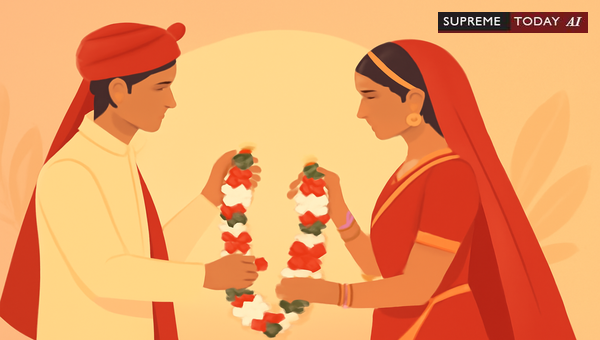
No Performed: Does Garland Exchange Suffice for Cases?
In Hindu traditions, marriage ceremonies are rich with rituals symbolizing lifelong commitment. But what happens when key rites like (the sacred seven steps around the fire) are skipped, and only garlands are exchanged? This question often arises in contentious legal battles, particularly under Section 498A of the Indian Penal Code (IPC), which addresses cruelty by a husband or his relatives toward a married woman.
Where no has been performed by Hindus and only garlands were exchanged in the case of ? This is a common query in family disputes. Courts have provided nuanced answers, emphasizing that strict ritual adherence isn't always required to establish a marital relationship for such claims. This post delves into judicial interpretations, essential evidence, and practical implications, drawing from landmark cases. Note: This is general information, not legal advice. Consult a qualified lawyer for your specific situation.
Understanding and Hindu Marriage Essentials
Under Hindu law, primarily governed by the , a valid marriage typically requires specific ceremonies. is considered the core rite, where the couple takes seven steps together, each vow representing a marital promise. Other rituals like may also apply. Traditionally, these are essential, especially for matters like under
.
However, courts have clarified that the absence of alone doesn't automatically invalidate a marriage, particularly when other indicators exist. The focus shifts to whether a marital relationship was intended and acted upon
. For instance, simple ceremonies like garland exchange () in a temple or before a panchayat, followed by cohabitation, can suffice in certain contexts.
Judicial Stance on Marriage Validity Without
Indian courts, including the and , have consistently held that rigid proof of all rituals isn't mandatory for proceedings. The emphasis is on the existence of a marital tie and evidence of cruelty or harassment
2013 0 Supreme(MP) 117 2011 1 Supreme 347.
In a pivotal ruling, the court observed: Parties exchanged garlands in temple and some Pujas performed thereafter. Parties thereafter lived together as husband and wife for nearly three years and a son was born out of such relationship. This is sufficient to establish the valid claim of maintenance for wife and son. 2013 0 Supreme(MP) 117. This logic extends to 498A cases, where the marital relationship's proof unlocks protections against cruelty.
The further elaborated on legislative intent in Section 498A: The legislative intent is clear from the fact that it is not only the husband but also his relations who are covered by Section 498-A. The legislature has taken care of children born from invalid marriages... Can it be said that the legislature... closed its eyes to the plight of a woman who unknowingly... entered into the marital relationship? 2024 0 Supreme(Ker) 532. This protects women even if rituals were incomplete.
Another case reinforced: The petitioner and respondent No. 1 have exchanged garland before the Panchayat, lived together thereafter as husband and wife and out of that wedlock respondent No. 2 was born. Therefore, the marriage of the petitioner with respondent No. 1 has been proved, at least for the purpose of the proceeding of . 2013 0 Supreme(MP) 117. Similar principles apply to 498A, prioritizing substance over form 2011 1 Supreme 347.
Evidence That Establishes a Marital Relationship
When is absent, courts look for corroborative proof:- Garland exchange and simple ceremonies: Often in temples, panchayats, or homes, with witnesses 2013 0 Supreme(MP) 117 2017 0 Supreme(Mad) 2870.- Cohabitation: Living as husband and wife post-ceremony 2013 0 Supreme(MP) 117.- Children: Birth of offspring strongly indicates marriage 2013 0 Supreme(MP) 117.- Social recognition: Family acknowledgment, joint statements, or photos 2017 0 Supreme(Mad) 2870.
For example, in one instance, Pandithurai uncle of Durairaj blessed the couple by handing over the thali to Durairaj. The evidence of PW4 with regard to a ceremony about the marriage exchanging garlands and tying of thali... proved the union 2017 0 Supreme(Mad) 2870. Documents like ration cards or voter lists can bolster claims, though their absence isn't fatal 2012 0 Supreme(Mad) 2409.
In 498A contexts, charge sheets and investigations often reference these elements, as seen in complaints leading to prosecutions 2024 Supreme(Online)(Tel) 31991 2022 0 Supreme(Cal) 552.
Contrasting Views and Exceptions from Other Cases
While many rulings favor flexibility, exceptions exist. In some scenarios, lack of leads to non-recognition as a full Hindu marriage. For instance, courts have noted: No Performed - In several cases... the rites and ceremonies of had not taken place, leading to the conclusion that the marriage was not a Hindu marriage 2025 0 Supreme(All) 2375.
Garland exchanges without further rites are sometimes deemed non-ceremonial: Exchange of Garlands Without - Multiple sources... describe instances where the parties exchanged garlands... but no other Hindu rites such as were performed 2024 0 Supreme(Telangana) 1232 2024 0 Supreme(Ker) 532. This can weaken 498A cases if contested rigorously 2025 0 Supreme(All) 2375.
In () or civil suits, stricter proof may be demanded
. One case dismissed marriage claims due to prior sexual relations and lack of formalities: Otherwise, there is no material on record to support the prosecution version that actually any marriage took place... 2006 0 Supreme(Jhk) 1007 2006 0 Supreme(Jhk) 1011.
Additionally, historical amendments aimed to legitimize non- marriages: In short, this amendment was introduced to legitimise the marriages performed without , since was considered as an Aryan ritual 2014 0 Supreme(Mad) 3773. Yet, in DV Act or filings alongside 498A, performance strengthens claims
.
Practical Recommendations for 498A Litigants
- Gather comprehensive evidence: Photos, witness statements, cohabitation proofs, and child birth records.
- Focus on relationship dynamics: Highlight cruelty/harassment within the lived marital context, not just rituals.
- Anticipate defenses: Respondents may challenge validity; counter with judicial precedents favoring intent and conduct.
- Seek maintenance parallels: 498A often aligns with , where garland exchanges have sufficed 2013 0 Supreme(MP) 117.
Courts increasingly recognize modern, non-traditional unions based on consent and social acknowledgment.
Key Takeaways and Conclusion
- Essential rituals like are important but not indispensable for if garland exchange, cohabitation, and other evidence support marriage
2013 0 Supreme(MP) 117.
- Judicial trends protect women from cruelty, prioritizing legislative intent over ritual perfection 2024 0 Supreme(Ker) 532.
- Exceptions apply in strict civil or cases; context matters.
In conclusion, while holds cultural significance, its absence doesn't doom 498A claims when substantial evidence of marriage exists. This evolving jurisprudence balances tradition with justice. For personalized guidance, consult a legal expert.












