


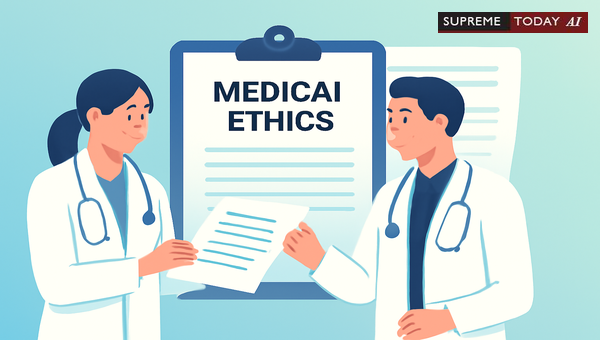
Can Doctors Legally Identify or Exhibit Colleagues' Documents?
In the high-stakes world of healthcare, where collaboration among doctors is essential, questions about handling colleagues' documents often arise. Can a doctor identify or exhibit the documents of their colleagues without repercussions? This issue touches on , , and , making it crucial for medical professionals to understand the boundaries.
The question at hand is: Doctors Colleagues can Identify or Exhibit the Documents of his Colleagues is Correct or Not? While there's no blanket yes or no, legal principles guide us toward ethical and cautious practices. This post breaks down the key considerations, drawing from court rulings and professional standards to provide clarity.
Understanding the Core Legal Principles
Medical professionals operate under strict codes of conduct that emphasize respect, integrity, and fairness. Here's a closer look at the foundational principles:
1. Professional Conduct Among Colleagues
Doctors, like teachers in analogous professional settings, must treat colleagues with respect and avoid exploitation. Documents highlight the expectation to refrain from exploiting their colleagues and to assist each other for professional betterment 2023 0 Supreme(Cal) 515. This implies that identifying or exhibiting a colleague's documents should not be done maliciously or without justification.
In medical practice, collaboration is key. For instance, in cases involving post-operative care, doctors work with fellow ophthalmologists, treating patients with care and best of his skills as per standards of medical practice
. Sharing documents in such team efforts is common, but it must align with ethical norms to avoid claims of negligence or .
2. Principles of
requires that affected parties have a chance to respond to allegations. Courts have ruled that decisions based on colleagues' statements without allowing rebuttal violate this principle 2022 0 Supreme(Gau) 1220. Applied to documents, if a doctor identifies or exhibits a colleague's records in a professional or legal context, the colleague must typically be given an opportunity to respond.
This is echoed in administrative rejections where missing documents like led to denials, underscoring the need for fair process 2024 Supreme(Online)(TEL) 13594. Failing to inform or involve the colleague could lead to legal challenges.
3. and Fair Treatment
Courts uphold among professionals. One ruling affirmed a petitioner's entitlement to and with colleagues, stressing uniform treatment 2003 0 Supreme(Pat) 253. Unequal handling of documents—such as selectively exhibiting one colleague's records—could infringe on these rights.
Applying These Principles: When Can Doctors Identify or Exhibit Documents?
Directly addressing the query, while no law explicitly prohibits it, the principles suggest caution:
Ethical Identification: Doctors may need to identify documents in team settings, like reporting 'Nil' if specialists are unavailable 2024 Supreme(Online)(TEL) 13594. However, this should be done respectfully, without malice.
Exhibition in Proceedings: In legal or disciplinary matters, exhibition might occur, but demands fairness. For example, courts reject decisions without response opportunities 2022 0 Supreme(Gau) 1220.
Contexts: When colleagues collaborate on treatments, such as managing endophthalmitis, documents may be referenced, but only if they meet practice standards—no negligence if treatment given as per standards of medical practice cannot be termed as negligence
.
In broader professional scenarios, like defense civilians receiving allowances erroneously, misinterpretation led to overpayments, but recovery was limited without fraud 2010 0 Supreme(J&K) 23. Similarly, doctors must ensure document handling doesn't stem from misrepresentation.
Relevant and Case Insights
Several cases illustrate these boundaries:
Violation of Response Rights: A court quashed a decision for lacking a reply chance to colleagues' statements 2022 0 Supreme(Gau) 1220.
in Benefits: Petitioners secured parity with colleagues, reinforcing non-discriminatory treatment 2003 0 Supreme(Pat) 253.
Document Submission Failures: Rejections due to missing reports highlight documentation's role, but also the need for procedural fairness 2024 Supreme(Online)(TEL) 13594.
Collaborative Care Defenses: In consumer complaints, doctors defended actions with colleagues as standard practice, dismissing negligence claims
.
These precedents show courts prioritize ethics and fairness over unchecked document use.
Practical Recommendations for Doctors
To navigate this:- Seek Consent: Ideally, obtain colleague consent before identification or exhibition.- Document Justifications: If required for patient care or proceedings, note reasons and inform parties.- Adhere to Codes: Follow guidelines on and .- Legal Consultation: In disputes, consult counsel to ensure compliance.
Generally, actions infringing rights may invite challenges, as seen in and justice rulings.
Potential Risks and Broader Implications
Missteps can lead to professional complaints, negligence suits, or claims. For instance, in election petitions, unchallenged evidence was scrutinized, mirroring how unresponded document exhibitions could falter 2017 0 Supreme(Gau) 1370.
In mental health cases, concealed disorders affected marital consents, but that's tangential—yet it underscores disclosure ethics, akin to document transparency 2017 0 Supreme(Chh) 587.
Conclusion and Key Takeaways
Doctors can identify or exhibit colleagues' documents under specific, ethical circumstances, but respect, , and are paramount. Always prioritize fairness to avoid violations.
Key Takeaways:- Treat colleagues' documents with integrity 2023 0 Supreme(Cal) 515.- Ensure response opportunities 2022 0 Supreme(Gau) 1220.- Uphold 2003 0 Supreme(Pat) 253.- Follow medical standards in collaborations
.
This is general information based on precedents and not specific legal advice. Consult a qualified lawyer for your situation.
References: 2023 0 Supreme(Cal) 515 2022 0 Supreme(Gau) 1220 2003 0 Supreme(Pat) 253 2024 Supreme(Online)(TEL) 13594
2010 0 Supreme(J&K) 23 #MedicalEthics #DoctorDocuments #LegalInsights















