


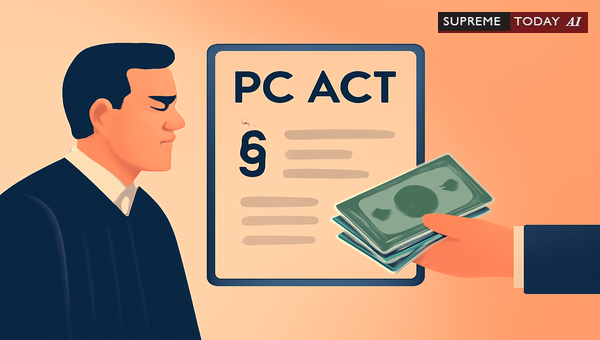
MP High Court Justice Rohit Arya: Key Insights on and 13
In the fight against corruption in India, judicial interpretations play a pivotal role in ensuring fair prosecutions under the (). A notable contribution comes from Justice Rohit Arya of the , whose judgments emphasize stringent proof requirements for offenses under and 13. If you're searching for Justice Rohit Arya of MP High Court Judgement on Section 7 and , this post breaks down the essentials, drawing from his rulings and related precedents.
This analysis is for informational purposes only and does not constitute legal advice. Consult a qualified attorney for specific cases.
Understanding and 13 of the
Section 7 criminalizes a public servant demanding or accepting as a motive or reward for performing official duties. Meanwhile, (1)(d) targets where a public servant obtains a valuable thing or pecuniary advantage without public interest, with (2) prescribing punishment.
Justice Rohit Arya's rulings underscore that convictions under these provisions are not automatic. Prosecutors must prove core elements .
Core Requirements for Conviction: Demand and Acceptance
The cornerstone of offenses under and 13(1)(d) is the demand and acceptance of a bribe. Without concrete evidence of both, courts typically overturn convictions. As highlighted in key findings, the demand and acceptance of a bribe are essential elements for establishing offenses under and 13(1)(d) of the . Without proof of these elements, convictions cannot be sustained 2014 3 Supreme 384 2015 1 Supreme 417.
The , through Justice Arya, has consistently upheld this standard. In multiple instances, lack of proof led to acquittals, reinforcing that mere allegations fall short.
Judicial Precedents on Proof Standards
High Courts across India echo this. For example, in a , conviction was upheld only because recovered from the pant of the Appellant - Demand proved 2021 0 Supreme(Chh) 53. Here, the Investigating Officer testified that upon signal, tainted notes were recovered from the accused's pocket, with chemical tests confirming the recovery, supported by complainant and panch witnesses.
Conversely, where demand wasn't established, courts intervened. The High Court has consistently upheld that both demand and acceptance must be proven beyond a reasonable doubt for a conviction under these sections 2002 0 Supreme(SC) 322 2023 0 Supreme(AP) 750.
The Critical Role of
() is indispensable, particularly under (1)(d). Absence of proven corrupt intent often results in acquittal. Justice Arya's synthesis notes, the requirement of () is integral to offenses under (1)(d). The absence of a guilty intention can lead to acquittal 2020 0 Supreme(Ker) 380.
The clarified legislative intent post-amendments: to mandate clear evidence of intent in corruption cases 2020 0 Supreme(Ker) 380. In one case, a veterinary doctor's demand for visit fees and expenditure of medicines was deemed a probable defense, leading to acquittal as the failed its heavy burden of proof 2018 0 Supreme(Bom) 1563. The court held, It is well settled law that burden, on to prove the guilt of accused beyond doubt, is more heavy than accused. Accused has to prove the probable defence whereas the has to prove .
Impact of Co-Accused Acquittals and Presumptions
Charges are interconnected among co-defendants. Instances where co-accused were acquitted have led to the acquittal of the main accused under the 2019 1 Supreme 399. This highlights prosecutorial challenges in multi-accused scenarios.
Additionally, the presumption under doesn't apply without proven demand and acceptance. If the fails to prove the demand and acceptance of bribes, the presumption under Section 20 of the cannot be invoked 2014 6 Supreme 156.
Lessons from Related Cases
- In a matter, charges under (1)(d) involved fraudulent submissions, but considerations underscored proof needs
.
- Another case saw conviction under set aside for lack of inducement evidence: The court found that there was no evidence that the appellant induced the public servant 2018 0 Supreme(Mad) 3707. However, conviction stood with reduced sentence.
- Demands for donations were not treated as bribes under or 13(1)(d), as no pressure for illegal remuneration was proven: Though payment of donation is highly objectionable but same was not regarded as an offence punishable under Section 7 or under (1)(d) 2015 0 Supreme(Bom) 2255.
- Biased investigations doomed prosecutions: The court found that the failed to prove the demand of illegal gratification... highlighted the biased investigation 2018 0 Supreme(Mad) 202.
These cases illustrate courts' reluctance to convict on surmise, demanding indispensable proof of demand of illegal gratification.
Broader Implications for Prosecutions and Defenses
Justice Rohit Arya's judgments serve as a blueprint:- Prosecutors: Prioritize trap evidence, witness corroboration, and chemical verification. Collect irrefutable proof of demand (e.g., audio/video) and acceptance.- Defendants: Leverage probable defenses like legitimate fees or lack of intent. Challenge weak links in co-accused chains.
Staying abreast of such precedents is vital, as amendments to the aimed to balance anti-corruption zeal with fair trial rights.
Key Takeaways
- Demand + Acceptance + : Essential for and 13(1)(d) convictions 2014 3 Supreme 384 2015 1 Supreme 417.
- Acquittals common without rigorous proof; presumptions don't bridge gaps.
- Co-accused outcomes influence main cases 2019 1 Supreme 399.
- Judicial trend favors accused defenses over conjecture.
This overview of Justice Rohit Arya's contributions and allied rulings equips readers with clarity on enforcement. For tailored guidance, seek professional legal counsel.
#PCAct, #CorruptionLaw, #MPHighCourt















