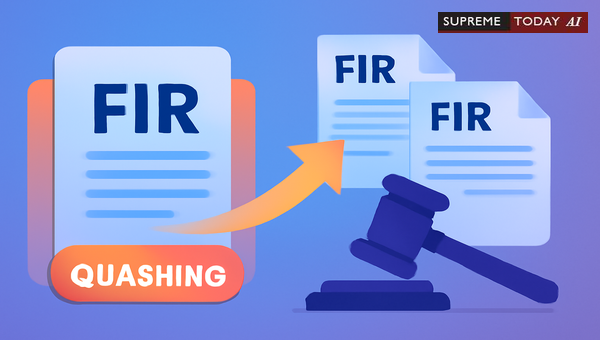
Multiple FIRs for Same Incident: Legal Rules Explained
In the Indian criminal justice system, the First Information Report (FIR) is the cornerstone that initiates police investigation under Section 154 of the Code of Criminal Procedure (CrPC). But what happens when multiple FIRs are registered for what appears to be the same event or transaction? This is a common dilemma for accused persons, witnesses, and legal practitioners alike. Questions like First Information Reports FIRs Arise from the same Event or Transaction frequently arise in courts, leading to petitions for quashing under Section 482 CrPC.
This blog post breaks down the legal principles, tests applied by courts, relevant case laws, and practical strategies. While this provides general insights based on established precedents, it is not a substitute for professional legal advice. Consult a lawyer for case-specific guidance.
Legal Principles Governing Multiple FIRs
The Single FIR Rule
It is a well-settled principle that there cannot be multiple FIRs for the same occurrence or incident. The first FIR sets the criminal law machinery in motion, and any subsequent information must be treated as supplementary to it. As held in key judgments, The subsequent informations about the said cognizable offences, should be part of the First and earlier Information. Law does not permits a Station House Officer to register multiple FirstInformationReports (FIRs) for the same occurrence, unless it is complaint and complaint-in-counter. C. Ve. Shanmugam, B. A. B. L. VS State, rep. by Inspector of Police, Villupuram West Police Station, Villupuram Dist. (Crime No. 194 of 2022) - 2024 0 Supreme(Mad) 1315
Similarly, There cannot be second FIR in respect of the same offence/ event because whenever any further information is received by the investigating agency, it is always in furtherance of the first FIR. Majhaulia Sugar Industries Pvt. Ltd. VS State of Bihar - 2023 0 Supreme(Pat) 1415Syed Minhaz Hussain vs The State of Telangana - 2025 Supreme(Online)(Tel) 9624
This rule prevents abuse of process and multiplicity of proceedings, ensuring efficiency in investigations. Courts emphasize that FIRs must not be used to harass the accused through repetitive filings. Tarak Dash Mukharjee VS State of Uttar Pradesh - Supreme Court (2022)Matchan @ Abubacker Siddik VS State Rep by The Inspector of Police - Madras (2019)
The 'Sameness' Test
To determine if FIRs relate to the same incident, courts apply the test of sameness. This involves checking if they arise from the same event or transaction. If so, the second FIR is typically quashed. Factors include:- Common substratum of facts: Shared time, place, and participants.- Connected offences: Even if different sections are invoked, if part of one transaction, they fall under the first FIR. Tathagata Roy @ Raju Roy VS State of West Bengal - 2024 0 Supreme(Cal) 335
Courts apply the test of 'sameness' to determine if multiple FIRs relate to the same incident or are parts of the same transaction. If both FIRs arise from the same incident, the second FIR may be quashed. Md. Yusuf Khan VS State of U. P. - Allahabad (2019)J. Shekar Reddy VS State represented by Inspector of Police, Central Bureau of Investigation, Anti-Corruption Branch - Madras (2018)
However, distinct offences or different incidents allow a second FIR. If the FIRs pertain to distinct offences or different incidents, the registration of a second FIR is permissible. Each offence is treated as a distinct entity under the law. ASHOKBHAI KHODIDAS CHALODIYA VS STATE OF GUJARAT - Gujarat (2015)Raj Pal Singh VS Central Bureau of Investigation - Himachal Pradesh (2015)
When Multiple FIRs Are Permissible
Not all cases warrant quashing. Exceptions include:
Rival Versions of the Same Incident: When parties present conflicting narratives (e.g., complainant vs. counter-complainant), separate FIRs may be registered to investigate both sides fairly. If there are rival versions of the same incident, they may lead to the registration of separate FIRs, allowing for investigations under both. Kari Choudhary VS Sita Devi - Supreme Court (2001) Thus, rival versions in respect of the same incident do take different shapes and in that event, lodgment of two FIRs is... AJIT KUMAR CHATURVEDI Vs STATE OF UTTARKAHAND - Uttarakhand
Distinct Crimes in the Same Transaction: Police can investigate not merely the cognizable offence reported in the FIR but also other connected offences found to have been committed in the course of the same transaction. Majhaulia Sugar Industries Pvt. Ltd. VS State of Bihar - 2023 0 Supreme(Pat) 1415Syed Minhaz Hussain vs The State of Telangana - 2025 Supreme(Online)(Tel) 9624
Counter-Cases or Fresh Facts: Successive FIRs are allowed for new offences or separate transactions, but not mere repetitions. Filing successive FIRs that arise out of the same incident but describe different crimes or distinct facts is permissible, but the core principle remains that repetition of the same FIR for the same offence is generally barred. (From summarized insights in sources)
In cases like multiple FIRs from the same source (e.g., Income Tax raids), they are quashed if lacking distinct facts. J. Shekar Reddy VS State represented by Inspector of Police, Central Bureau of Investigation, Anti-Corruption Branch - Madras (2018)
Case Law Illustrations
Other examples include scenarios where FIRs for the same date's events were scrutinized, like those on 05.10.2018 and 06.10.2018 for incidents on 6.08.2018 and 11.08.2018. T. Padmaja VS State of Telangana - 2019 Supreme(Telangana) 153 - 2019 0 Supreme(Telangana) 153
Practical Recommendations for Legal Strategy
If facing multiple FIRs:- Analyze Sameness: Compare dates, facts, and offences meticulously.- File Quashing Petition: Under Section 482 CrPC in High Court, citing precedents like the single FIR rule. Pinaki Samanta VS State of Tripura - Gauhati (2011)Anju Chaudhary VS State of U. P. - Supreme Court (2012)- Seek Consolidation: For connected matters, request clubbing to streamline proceedings.- Document Thoroughly: Support with timelines, witness statements, and case laws.
When representing a client facing multiple FIRs, it is crucial to analyze the facts to determine if they arise from the same incident. If so, a motion to quash the second FIR should be filed, citing the relevant case law and legal principles.
Key Takeaways and Conclusion
In summary, while the law discourages multiple FIRs for the same event or transaction, exceptions ensure justice for genuine cases. The balance prevents harassment yet allows thorough probes. Always verify with current precedents, as judicial interpretations evolve.
Key References: Md. Yusuf Khan VS State of U. P. - Allahabad (2019)J. Shekar Reddy VS State represented by Inspector of Police, Central Bureau of Investigation, Anti-Corruption Branch - Madras (2018)ASHOKBHAI KHODIDAS CHALODIYA VS STATE OF GUJARAT - Gujarat (2015)Raj Pal Singh VS Central Bureau of Investigation - Himachal Pradesh (2015)Kari Choudhary VS Sita Devi - Supreme Court (2001)Tarak Dash Mukharjee VS State of Uttar Pradesh - Supreme Court (2022)Matchan @ Abubacker Siddik VS State Rep by The Inspector of Police - Madras (2019)C. Ve. Shanmugam, B. A. B. L. VS State, rep. by Inspector of Police, Villupuram West Police Station, Villupuram Dist. (Crime No. 194 of 2022) - 2024 0 Supreme(Mad) 1315Tathagata Roy @ Raju Roy VS State of West Bengal - 2024 0 Supreme(Cal) 335Majhaulia Sugar Industries Pvt. Ltd. VS State of Bihar - 2023 0 Supreme(Pat) 1415AJIT KUMAR CHATURVEDI Vs STATE OF UTTARKAHAND - UttarakhandSyed Minhaz Hussain vs The State of Telangana - 2025 Supreme(Online)(Tel) 9624
Word count: 1028. This is general information based on public legal sources; seek tailored advice from a qualified advocate.
#FIR #CriminalLawIndia #QuashingFIR