


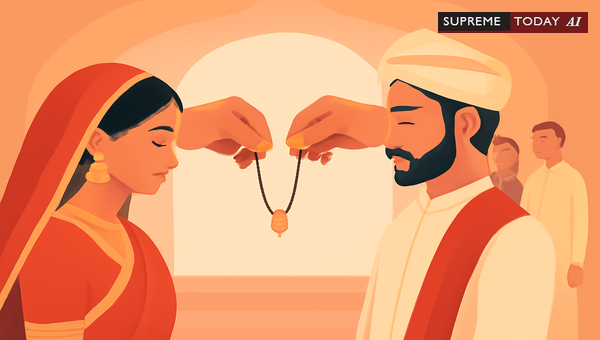
Is Nata Marriage Valid Under Indian Law?
In certain communities across India, particularly in regions like Rajasthan and Madhya Pradesh, a unique known as Nata marriage serves as a form of . But a pressing question arises: Is Nata marriage recognized as a valid marriage under Indian law? This blog post delves into the legal standing of Nata marriages, drawing from and statutory provisions to provide clarity for those navigating family law matters.
While this article offers general insights based on court rulings, it is not a substitute for professional legal advice. Consult a qualified lawyer for advice tailored to your situation.
What is Nata Marriage?
Nata marriage is a customary form of marriage prevalent among specific tribal and rural communities. Unlike formal Hindu weddings governed by (seven steps around the fire), Nata involves simpler rites, often including rituals like exchanging a water pitcher or symbolic payments. It is typically entered into by widows or divorced women, where the second husband may provide consideration (such as money) to the first husband or family.
Courts have described it as a legitimate union when community customs are followed. For instance, 'Nata' is a customary marriage where the second husband is required to pay 'money' to the first husband in consideration of marriage with his wife. 2003 0 Supreme(Raj) 1388
This practice raises questions about its alignment with modern Indian family law, particularly the (HMA).
Legal Recognition of Nata Marriage
Indian courts have consistently upheld Nata marriages as valid when solemnized according to prevailing community customs. explicitly states: provides that Hindu Marriage can be solemnised in accordance with the of either party thereto. 2012 0 Supreme(Raj) 1573
The landmark finding is clear: Nata marriage is recognized as a valid form of marriage under Indian law if customary rites are performed and the parties cohabit as husband and wife. In one key case, the court affirmed: Nata marriage, when performed according to the of the community, is recognized as a valid marriage under Indian law. 2012 0 Supreme(Raj) 1573
This recognition extends to rights like under , where the claimant must prove spousal status. The court held: Sec. 125 has been enacted in the interest of a wife, and one who intends to take benefit under has to establish the necessary condition, namely, that she is the wife of the person concerned. 2012 0 Supreme(Raj) 1573
Key Judicial Pronouncements on Validity
Several judgments emphasize proof of ceremonies and long-term :
Customary Ceremonies as Proof: The document Ex. P-1 and the oral evidence led by Ganga go to show that necessary ceremonies were performed at the time of 'Nata' marriage. 2012 0 Supreme(Raj) 1573 The respondent's admission of bringing the woman into Nata 17 years prior solidified the union's validity.
Long : Parties living together as husband and wife for 17 years supports legitimacy, even without formal registration. 2012 0 Supreme(Raj) 1573
Other cases reinforce this:- In a ruling, a Nata marriage was admitted by both parties, entitling the spouse to protections akin to formal wives: prolong relationship even without marriage has to be considered as marriage and this is a case where ‘nata’ marriage is admitted by both the parties.
- Admissions in disputes confirm community acceptance: The appellant also admitted that... he had contracted a Nata marriage.
However, not all claims succeed. Therefore, we are of the view that this 'Nata' marriage does not stand proved. 2017 0 Supreme(Raj) 2370 when evidence was lacking.
Essential Rites and Evidence Requirements
For validity, claimants must demonstrate:- Performance of Specific Ceremonies: Water pitcher rituals or community-recognized rites. What specific ceremonies are required to be performed in a 'Nata' marriage is not on record. However... necessary ceremonies were performed. 2012 0 Supreme(Raj) 1573
Community Acknowledgment: Panchayat resolutions or affidavits help. In one instance, an was made of living in Nata.
Witness Testimonies and Documents: Oral evidence, certificates, or payments like one gold Mandaliya, gold anklets and a sum of Rs.3 lakhs. 2025 Supreme(Online)(Raj) 9679
Courts stress: The performance of the ceremonies required for the 'Nata' marriage was established. 2012 0 Supreme(Raj) 1573
Rights and Implications for Spouses
Once validated:- and : Wives gain entitlements under Section 125 and inheritance laws.- Protection from Domestic Violence: Treated similarly to formal marriages.
- : Divorce or possible if customs allow.
In or cases, Nata spouses receive safeguards: Nata marriage of the deceased... was solemnized... about four months prior. 2025 Supreme(Online)(Raj) 9679
Exceptions, Challenges, and Limitations
Nata marriages may fail scrutiny if:- No Customs Followed: If the marriage is performed without following the community customs or ceremonies, it may not be recognized. 2012 0 Supreme(Raj) 1573- Secrecy or Lack of Proof: Hearsay alone insufficient. 2003 0 Supreme(Raj) 1388- Disputes Over Consideration: Money disputes can undermine claims, as in Panchayat resolutions gone awry. 2012 0 Supreme(Raj) 1315
Challenges include varying proof standards across courts, often requiring affidavits or community elders' testimony. 2024 0 Supreme(Raj) 1220
Recommendations for Claimants
- Gather evidence: Photos, videos, witness statements, or panchayat records of ceremonies.
- File affidavits acknowledging the union.
- Seek court declaration early to secure rights.
Courts encourage recognition: Legal recognition of Nata marriage supports the rights of spouses in matters of , , and other matrimonial rights. 2012 0 Supreme(Raj) 1573
Conclusion: A Valid Customary Union with Safeguards
Nata marriage stands as a valid marital form under Indian law when rooted in community customs, supported by evidence of rites and . Judicial trends affirm its legitimacy, balancing tradition with legal protections—much like formal Hindu marriages under Section 7 HMA. However, success hinges on robust proof.
Key Takeaways:- Valid if customs followed and proven. 2012 0 Supreme(Raj) 1573- Entitles , inheritance. 2012 0 Supreme(Raj) 1573- Prove via ceremonies, witnesses, .- Consult experts; customs vary by community.
For those in Nata relationships, understanding these nuances can protect your rights. Stay informed, document everything, and prioritize legal counsel.
(Word count: 1028. References based on provided judgments; general information only.)
#NataMarriage #IndianFamilyLaw #CustomaryMarriage












