


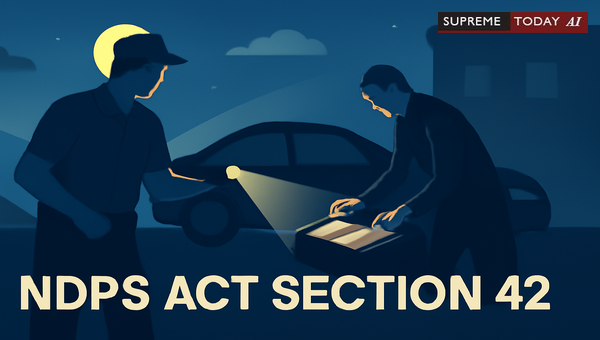
: Is Search After Sunset Legal?
In the high-stakes world of narcotics enforcement in India, the timing of a can make or break a case. Imagine a raid that starts just before sunset but stretches into the night—does it comply with the law? The question Commenced before Sunset and Continued after Sunset strikes at the heart of under the (). Non-compliance can vitiate trials, leading to acquittals or bail. This post breaks down the legal framework, key precedents, and practical implications, drawing from judicial rulings to help you navigate this complex area.
Disclaimer: This article provides general information based on legal precedents and is not a substitute for professional legal advice. Consult a qualified lawyer for case-specific guidance.
Overview of Section 42
governs searches between sunset and sunrise, imposing strict procedural requirements to protect individual rights and prevent abuse. Generally, searches should occur during daylight—after sunrise and before sunset—to ensure transparency. However, nighttime searches are permissible under specific conditions outlined in the . The officer must record grounds for believing a cannot be obtained without risking evidence concealment or offender escape. This recording is mandatory, and failure to comply can render the search illegal. 2021 0 Supreme(Bom) 239
As one ruling notes: The should normally be done after sunrise and before sunset. However, if it is conducted after sunset and before sunrise, the grounds as to why it was felt necessary to take such action should be recorded and copy of the grounds so recorded must be sent to the immediate official superior. 2021 0 Supreme(Kar) 2 2020 0 Supreme(Kar) 2159
When Does Section 42 Apply?
The applicability hinges on timing:
- Searches Starting Before Sunset: If a search commences before sunset and continues after, Section 42 provisions may not trigger if the officer had no prior reason to anticipate extension into the night. 2011 0 Supreme(Bom) 883
- Searches Initiated After Sunset: Full compliance is required, including recording grounds in writing before proceeding. These grounds must be communicated to the immediate superior . 1995 0 Supreme(Bom) 443 2016 0 Supreme(Raj) 1586
In practice, courts scrutinize whether officers anticipated nighttime operations. For instance, in cases where raids extended unexpectedly, leniency might apply, but deliberate nighttime initiations demand strict adherence.
Mandatory Compliance: Judicial Precedents
The has repeatedly emphasized Section 42's mandatory nature. In , it held that failure to comply . 2007 0 Supreme(HP) 92 2016 0 Supreme(Raj) 903
Similarly, reiterated: if a search occurs after sunset, reasons for not obtaining a warrant must be recorded, or the prosecution falters. 2016 0 Supreme(Raj) 903 2004 0 Supreme(Bom) 965
From additional precedents:- Non-compliance with led to acquittal where search was after sunset without recorded grounds: Admittedly, the of the contraband was after sunset and before sunrise... PW 1 – Sanjay Kumar Sinha in his cross-examination has admitted that he was aware when he prepared the information note (Exhibit-31) that the said vehicle was to b....
Gurmeet Singh s/o Harjinder Singh vs Davinder Singh, Intelligence Officer,
- Another case highlighted: Prior to conducting search in such situation, it is provided that the officer conducting search should record in writing the grounds for belief and , the same should be communicated to the immediate superior. It is not disputed that the search was conducted after sunset and before sunrise. 2020 0 Supreme(All) 456These rulings underscore that procedural lapses , often resulting in .
Evidence and Witness Testimonies
Prosecution bears the burden to prove compliance didn't . Witnesses frequently admit lapses:- PW-1 Sanjay Kumar Sinha acknowledged not applying for a warrant despite knowing the search would occur post-sunset. 2021 0 Supreme(Bom) 239- In midnight raids without warrants or recorded beliefs, convictions were set aside: the recovery was made from the house of appellant in the midnight without obtaining warrant from magistrate and without recording grounds of belief as required under the Proviso of section 42. 2020 0 Supreme(All) 456
Courts may dismiss cases or grant bail if prejudice is shown. 2000 0 Supreme(P&H) 272
Integrating Broader Safeguards
Section 42 aligns with other NDPS provisions like (right to be searched before a gazetted officer) and 57 (immediate reporting). Holistic non-compliance amplifies risks. For example, unweighed contraband based on 'guesswork' or unsigned further weakens cases. 2020 0 Supreme(All) 456
have vitiated trials for gross non-compliance with mandatory provisions under Section 42, which are aimed at protecting the rights of the accused.
Gurmeet Singh s/o Harjinder Singh vs Davinder Singh, Intelligence Officer,
Defense Strategies for the Accused
If facing a nighttime search:1. Challenge Timing and Documentation: Demand proof of pre-search grounds recording and superior notification.2. Highlight Witness Admissions: Cross-examine on awareness of sunset timing and warrant absence.3. Cite Precedents: Leverage Baldev Singh and Jagraj Singh for mandatory compliance arguments.4. Prove Prejudice: Show how lapses tainted evidence chain.
Typically, such challenges lead to bail or acquittal, as seen in appeals allowed due to Section 42 violations. 2020 0 Supreme(All) 456
Gurmeet Singh s/o Harjinder Singh vs Davinder Singh, Intelligence Officer,
Recommendations for Law Enforcement
Officers should:- Record grounds proactively if nighttime seems likely.- Send copies to superiors .- Obtain warrants where feasible to avoid disputes.
Strict adherence safeguards convictions and upholds justice.
Key Takeaways
- Daylight Preference: Searches are ideally before sunset; nighttime requires recorded justification under Section 42 proviso. 2021 0 Supreme(Kar) 2
- Mandatory, Not Directory: Non-compliance often vitiates proceedings. 2007 0 Supreme(HP) 92
- Timing Critical: Pre-sunset starts may exempt if unplanned; post-sunset demands full procedure. 2011 0 Supreme(Bom) 883
- Prosecution Burden: Must prove no prejudice from lapses. 2000 0 Supreme(P&H) 272
Understanding these nuances is vital for both enforcers and the accused. Stay informed on evolving jurisprudence to protect rights or build airtight cases.
References:- 2021 0 Supreme(Bom) 239 2011 0 Supreme(Bom) 883 2007 0 Supreme(HP) 92 1995 0 Supreme(Bom) 443 2016 0 Supreme(Raj) 903 2000 0 Supreme(P&H) 272 2004 0 Supreme(Bom) 965 2016 0 Supreme(Raj) 1586
Gurmeet Singh s/o Harjinder Singh vs Davinder Singh, Intelligence Officer,
2021 0 Supreme(Kar) 2 2020 0 Supreme(Kar) 2159 2020 0 Supreme(All) 456Word count: Approximately 1050. This post draws from established precedents for educational purposes.
#NDPSAct, #SearchAndSeizure, #LegalCompliance















