Searching Case Laws & Precedent on Legal Query.....!
Analysing the retrieved Case Laws
Scanned Judgements…!



Searching Case Laws & Precedent on Legal Query.....!
Analysing the retrieved Case Laws
Scanned Judgements…!
Lack of Poison Report Evidence - Several sources indicate that poison or toxic substances were not detected or conclusively proved in cases of suspected suicide. For example, ["2025 0 Supreme(Raj) 324"] states, the police had filed a negative final report and both of these vital documents were, therefore, not sent for forensic examination, suggesting the absence of concrete poison evidence. Similarly, ["2014 0 Supreme(All) 2182"] notes, Container of poison was not recovered, and source of procuring poison has not been proved, highlighting the lack of direct poison evidence.
Negative Viscera and Forensic Reports - Multiple cases emphasize that viscera reports can be negative, especially when testing for common poisons yields no results. ["2023 0 Supreme(SC) 1232"] mentions, the viscera report is negative on three major basis, and a chemical examination of the viscera is not mandatory in every case of a dowry death, indicating that a negative report does not necessarily rule out poisoning or suicide.
Evidence Insufficient to Confirm Poisoning - Several sources demonstrate that absence of poison detection complicates establishing poisoning as cause of death. ["2025 0 Supreme(Gau) 934"] states, there was negative test for common poison, and the opinion of the Doctor who was examined as PW8 had given an opinion that the death was natural, implying that without positive poison detection, death may be attributed to other causes.
Main Points and Insights:
The absence of a poison report or a positive toxicology result weakens claims of poisoning in suspected suicide cases, often leading courts to favor natural death or other causes ["2013 0 Supreme(MP) 18"], ["2022 0 Supreme(Kar) 547"].
Analysis and Conclusion: The provided sources collectively highlight that in many suspected suicide cases, especially where poison is involved, forensic reports often return negative results for common poisons. This lack of evidence complicates establishing poisoning as the cause of death and can influence judicial outcomes, often leading courts to conclude that the death was natural or due to other reasons. The absence of poison detection does not definitively rule out poisoning but significantly weakens the prosecution's case regarding poisoning as the cause of death ["2025 0 Supreme(Raj) 324"], ["2014 0 Supreme(All) 2182"], ["2023 0 Supreme(SC) 1232"], ["2025 0 Supreme(Gau) 934"].
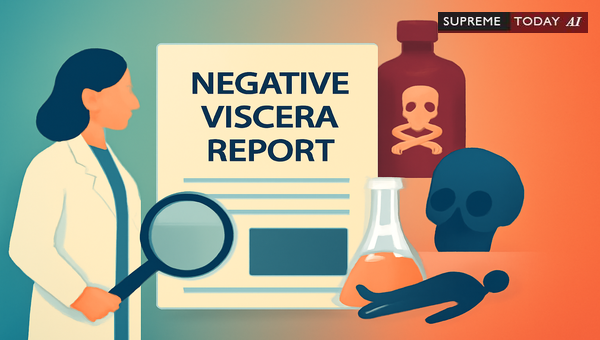
In the realm of criminal investigations, particularly classified as suicides, a negative poison report from viscera or toxicology tests often raises critical questions. What happens when a case screams poisoning based on circumstances, but the lab report comes back clean? Does this single piece of evidence dismantle the entire prosecution's case?
The question at the heart of many such disputes is: lacks of poision report negative in suicide case—or more precisely, does the absence of poison in toxicology reports rule out death by poisoning in a suicide scenario? Indian courts have repeatedly addressed this, emphasizing that a negative report is not the final word. This blog post delves into the legal nuances, judicial precedents, and practical considerations, drawing from established case law and forensic realities. Note that this is general information based on precedents and not specific legal advice—consult a qualified lawyer for your situation.
aims to detect poisons in body tissues, but it's far from infallible. Courts recognize several factors that can lead to :
Decomposition and Elimination: Poisons may evaporate from lungs, be purged via vomiting, or be metabolized and excreted by kidneys before testing. As observed in 2023 0 Supreme(SC) 1232, under some circumstances, if the whole of the poison has disappeared from the lungs by evaporation, or has been removed from the stomach and intestines by vomiting and purging, and after absorption has been detoxified, conjugated and eliminated from the system by the kidneys and other channels, it is possible that there may not be traces of poison.
Preservation Issues: Improper sample handling or delays in examination can degrade traces. Time lapses between death and testing exacerbate this.
Technical Limitations: Not all poisons are detectable with standard tests, especially fast-acting or rare substances.
These limitations mean a negative viscera report does not automatically negate poisoning, especially in where other clues point to it 2023 0 Supreme(SC) 1232 2024 0 Supreme(All) 463.
Indian courts, including the and , have consistently held that negative reports are just one piece of the puzzle. In 2024 0 Supreme(All) 463, the court clarified, the absence of a viscera report would not make any difference to the fate of the case of poisoning when other circumstances point toward poisoning.
Similarly, in and abetment cases, convictions have stood despite negative tests if —like smell of poison, bodily signs, witness accounts, or motives—establishes poisoning. For instance, another ruling notes that the non-detection of poison in the viscera is not necessarily fatal if other evidence indicates poisoning 2013 7 Supreme 716 2023 0 Supreme(SC) 1232.
In a case
, the prosecution alleged suicide by poison due to dowry harassment, with no mention of poison in the , yet the court scrutinized broader circumstances like ill-treatment.
judgments 2022 Supreme(Online)(Guj) 5547 2022 Supreme(Online)(Guj) 552 reference postmortem reports suggestive of poison consumption in abetment claims, stressing that mere insults or threats don't suffice without instigation proof, but negative findings don't override direct evidence like witness depositions of threats leading to poison ingestion.
In a 2023 0 Supreme(Del) 3793, a suicide note implicated relatives, but the court demanded cogent and convincing proof of the act/s of incitement, highlighting that prima facie cases under can proceed despite toxicology gaps if other materials (e.g., PM reports) support unnatural death by poison.
These precedents underscore: Lack of positive toxicology evidence won't derail prosecution if circumstances clearly point out the guilt of the accused 2023 0 Supreme(SC) 1232.
When viscera tests fail, courts pivot to a chain of circumstances forming a complete narrative:
Physical Signs: Smell on the body, froth at mouth, convulsions noted in PM reports.
Witness Testimony: Family or neighbors reporting sudden illness or purchase of poison.
Motive and Context: Dowry demands, harassment, or disputes, as in many abetment suits under IPC Section 306.
For example, in a
, CCTV and statements showed unprovoked insecticide consumption, with police and PM reports analyzed holistically. Conversely, in Telangana 2025 Supreme(Online)(Tel) 20740, pesticide suicide followed humiliation, leading to abetment charges despite investigative final reports.
Even in closure report scenarios, magistrates aren't bound to accept if exists 2024 3 Supreme 310. A ruling affirmed: There cannot be any doubt with respect to the power of the Magistrate to even after filing of a negative report by the police 2024 3 Supreme 310.
While not conclusive, a properly conducted, timely viscera exam strengthening the no-poison case can weaken prosecution:
If no other evidence supports poisoning (e.g., no smell, no witnesses), courts may lean toward suicide without foul play 2022 0 Supreme(Raj) 378.
In or family pressure cases 2018 0 Supreme(Raj) 909, lack of direct links to accused plus alternative motives (e.g., relationships) led to acquittals.
Forensic discrepancies, like in a case where PM suggested throttling over hanging
, prompted re-investigation beyond toxicology.
However, courts caution against over-reliance: Courts should interpret negative viscera reports with caution, especially when other evidence suggests poisoning.
Forensic advances help, but basics remain key:
Timely Collection: Viscera within ideal windows.
Comprehensive Testing: Multiple samples, advanced spectrometry.
Holistic Probes: As in a matter 2012 0 Supreme(Mad) 4840, incomplete reports ignoring circumstances warranted intervention.
Investigators must weigh PM reports, inquest notes, and statements 2015 0 Supreme(Bom) 1018, avoiding tunnel vision on toxicology.
For Families/Prosecutors: Build a robust circumstantial chain; negative reports aren't fatal.
For Accused/Defendants: Challenge testing protocols and highlight alternatives like voluntary suicide.
For Authorities: Prioritize proper preservation and multi-evidence analysis.
In conclusion, Indian law firmly establishes that a negative poison report does not preclude poisoning as the cause of death in suicide cases. Courts prioritize the bigger picture— often seals the deal, recognizing toxicology's limits 2023 0 Supreme(SC) 1232 2024 0 Supreme(All) 463. This balanced approach ensures justice in complex unnatural death probes. Always seek professional legal counsel for case-specific guidance.
#NegativePoisonReport, #SuicideCaseLaw, #IndianForensicLaw


Looking to the merg intimation report and the report received from the Forensic Science Laboratory, prima facia, it was a case of suicide. The learned Additional Sessions Judge has committed an error in holding that it was not proved that the death of the deceased Mona Bai was suicidal in nature. ... The prosecution’s case relating to the present revision, in short is that, Smt. Mona Bai had expired in the month of April 2006. It is alleged that she committed suicide. ... He has mentio....

by consuming poision. ... As per prosecution case, the present applicant solemnized love marriage with the deceased in the year of 2006. ... and also it is not mentioned in inquest report, charge-sheet has demand of dowry, as a result of which the deceased committed the deceased mentally and physically, and due to this continuous ill treatment, on 03.09.2020 at 10.15 a.m. she committed suicide

(PW-11), who investigated the case and furnished the final negative report, appeared in the witness box and proved the same. Dr. ... After the investigation, the police had filed a negative final report; against which the complainant filed a protest petition. ... The complainant – Jasnath (PW-6) appeared in the witness box and proved the report dated 02.01.2006 (Ex.P/7), which was registered as ‘Marg’ or ‘death report’, typed complaint dated 19.01.2006 (Ex.P/8), diary....

Commissioner of Police and Another, (1985) 2 SCC 537 held that when a Final Report under Section 173 (2), Cr.P.C. is filed before the Magistrate, which happens to be a negative report, usually called a “closure report” he gets the following four choices to be adopted, taking ... There cannot be any doubt with respect to the power of the Magistrate to issue summons even after filing of a negative report by the police. In other words, the Magistrate is not duty bound to accept the Final ....

Learned counsel also submitted that the CCTV footage as analysed in the challan papers shows that the deceased committed suicide by consuming insecticide/ poision without any provocation/ instigation from the petitioner or any of Learned counsel drew attention of the Court towards the dead body inspection report (fard surathal laash) prepared by the police and post mortem report of the deceased prepared by ... Santosh (mother of deceased), recorded under Section 161 CrPC to urge that the dec....

has clearly stated in his deposition that in his presence, the accused persons had threatened the deceased to kill him and hence, his nephew had committed suicide by consuming poision. ... The Court has also referred to the Post Mortem Report, Exh. 15 of the deceased, which is suggestive of the aforesaid aspect. ... 6.9 In the case on hand also, as discussed herein above, there is nothing on record to show or suggest that the accused had instigated the deceased to commit suicide. ... Unless the ingredi....

Container of poison was not recovered from the possession of victim and source of procurring poision has not been proved. There is no report of hand writing expert to prove that suicide note is in the hand writing of the victim. The evidence of father is hearsay evidence and is not believable. ... He did not find any suicide note in the room where dead body was found. Suicide note was given to him after two days, i.e. on 14.2.2008 by the informant, and on that very day, case was regist....

the deceased to kill him and hence, his nephew had committed suicide by consuming poision. ... The Court has also referred to the Post Mortem Report, Exh. 15 of the deceased, which is suggestive of the aforesaid aspect. ... 6.9 In the case on hand also, as discussed herein above, there is nothing on record to show or suggest that the accused had instigated the deceased to commit suicide. ... The act of the accused, however, insulting the deceased by using abusive language will not, by itself, constitut....

Rajni Babbar and her PM report as well as other material placed on record, this court is prima facie of the considered opinion that a prima facie case for the offence punishable u/s 306 IPC, read with sec.34 IPC, is made out against all five accused herein. ... In the case of accusation for abetment of suicide, the Court would be looking for cogent and convincing proof of the act/s of incitement to the commission of suicide. ... The complainant handed over a suicide note on 03.07.2016 ....

Basing on the report given by respondent No.2, a case in Crime No.175/2018 was registered against the petitioner and another for the offences punishable under Section 306 r/w 34 of IPC and Section 3(2)(v) of SC and ST (POA) Amendment Act, 2015 and after completing the investigation, respondent No.1 filed ... Respondent No.2 informed the same to his brother K.Praveen, K.Praveen unable to digest such humiliation has consumed pesticide (Gross Poision). ... In the light of the aforesaid facts and circumstances of the case an....

6. After thorough investigation and considering the postmortem report, which indicated reasons of death as 'asphyxia' -due to drowning and finding absence of external injury, the police filed a negative final report so far as offences under Sections 302 & 201 of Indian Penal Code are concerned and concluded the case to be a case of suicide.
It is also contended that from perusal of the suicide note, it is apparent that the deceased was not happy because of the fact that her relationship with some boys became known to the public. She also had some issues with regard to her mother who left her when she was three years old. The police after due investigation submitted negative final report, after coming to the conclusion that deceased has committed suicide. 8. Learned counsel appearing for the respondents and for Mukesh Budaniya in Criminal Revision Petition No. 1012/2018, contends that thorough investigation has....
After due investigation police submitted charge-sheet under Section 306 IPC against the appellant. 4. In brief, the facts of the case are that on 16.08.2013, deceased committed suicide, an inquest report was lodged on the same day with regard to suicide. After eight days i.e. on 24.08.2013, complaint Ex.P-2 was lodged which was sent to the police for registration of F.I.R. Consequently, F.I.R. Ex.P-14, was registered.

I am, therefore, not impressed by this contention, and proceed on the basis that Renuka had, in all probability, committed suicide by consuming poision. However, there is no material to support such a theory, and no such material was attempted to be obtained from the cross-examination of the witnesses. Coming to the reliability of the evidence of Nagappa, Laxmi Kamble and Bhimsha, it needs to be kept in mind that the evidence of these witnesses cannot be accepted or believed as true, merely because they all speak in the same voice.

42. Now, let us see whether the other circumstances would lead to the only inference that the death was suicidal. The CBI submitted its first report on 26.07.2011 and in that report, the CBI did not conclude that it was a case of suicide. In Paragraph No.27 of the said report the CBI has stated as follows:


An indispensable Tool for Legal Professionals, Endorsed by Various High Court and Judicial Officers
Please visit our Training & Support
Center or Contact Us for assistance

Scan Me!
India’s Legal research and Law Firm App, Download now!


For Daily Legal Updates, Join us on :



 Back to top


