


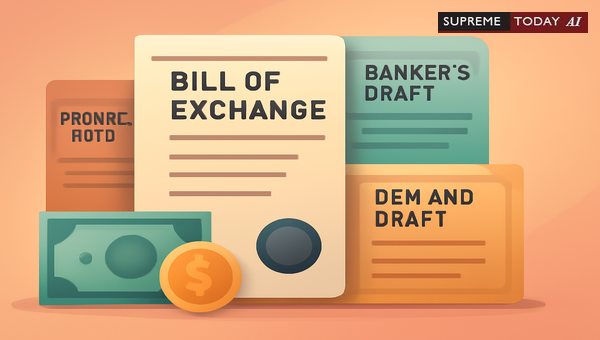
Examples of Bills of Exchange: Key Types Explained
In the world of commerce and finance, play a crucial role in facilitating smooth transactions. Among them, the stands out as a versatile tool used in both domestic and international trade. But what exactly are bills of exchange, and what are some practical examples? If you're a business owner, exporter, or simply curious about financial instruments, understanding these can help navigate payments securely.
This post explores examples of , drawing from legal definitions under the (NI Act) and real-world case illustrations. We'll break down their features, types, and applications while citing key legal documents. Note: This is general information and not specific legal advice; consult a qualified attorney for your situation.
What is a ?
A is fundamentally a written, unconditional order directing a person to pay a certain sum of money ( 2012 0 Supreme(Gau) 594). It must be in writing, contain an unconditional order or promise, and be payable either to order or to bearer. This distinguishes it from other documents like IOUs or conditional agreements.
Key characteristics include:- Unconditional order: No contingencies attached to payment.- Specified sum: Exact amount stated.- Parties involved: (issuer), (payer), and (recipient) 2012 0 Supreme(Gau) 594.
Unlike , which involve a direct promise to pay, bills of exchange feature an order from one party to another (Section 13 2012 0 Supreme(Gau) 594, Judgments 1999 0 Supreme(Del) 348).
Common Examples of Bills of Exchange
Legal documents provide clear illustrations of bills of exchange in action. Here are the primary examples:
1. Drafts (Domestic and Foreign)
Drafts are classic bills of exchange where one party orders another to pay a sum. - : Payable immediately on presentation. These are recognized as bills of exchange payable on demand 2012 0 Supreme(Gau) 594 1999 0 Supreme(Del) 196 2021 0 Supreme(MP) 434. Often used in banking for quick transfers.- : Payable after a fixed period, e.g., 60 days from 1928 0 Supreme(Cal) 77 2009 0 Supreme(SC) 1425. Common in trade shipments.
For instance, a draft drawn in a foreign country like London, payable at a future date and accepted by a bank, qualifies fully (Judgments 1928 0 Supreme(Cal) 77 1928 0 Supreme(Cal) 293 1999 0 Supreme(Del) 196).
2. (or Banker's Bills)
These are issued by banks and are highly reliable. issued by banks, payable on demand or at a specified future date, are recognized as bills of exchange 2012 0 Supreme(Gau) 594 1999 0 Supreme(Del) 348. They're prevalent in international transactions due to the bank's credibility.
In one case, a No. 04201801 dated for US $25736 was drawn by the plaintiff, accepted by the bank, authorizing document handover post-shipment (The bank had accepted the terms and conditions of the 2023 0 Supreme(Cal) 823). The court upheld recovery for non-payment after goods delivery.
3. (Under Specific Conditions)
While primarily a promise to pay, certain function as bills if they meet negotiability criteria. are a subset of , characterized by a promise to pay, whereas bills of exchange involve an order to pay (Section 13 2012 0 Supreme(Gau) 594, 1999 0 Supreme(Del) 348).
Examples include notes drawn domestically or internationally, payable on demand or future date (Legal documents 2023 0 Supreme(Mad) 109 1992 0 Supreme(SC) 934). They're used in commercial dealings but differ in lacking a - dynamic.
Variations in Forms and Uses
Bills of exchange adapt to various scenarios:- Payable on Demand: Like 2012 0 Supreme(Gau) 594.- Payable at Future Date: 1928 0 Supreme(Cal) 77.- International Bills: Drawn abroad, e.g., in London, accepted locally (Judgments 1928 0 Supreme(Cal) 77 1999 0 Supreme(Del) 196).
In , a was drawn by the plaintiff and the same was discounted with the plaintiff's Banker... Once the is accepted by the Bank, the Banker would be liable as an acceptor under 2024 0 Supreme(Mad) 166. Courts enforce this, rejecting claims of improper documentation post-.
Insights from Court Cases
Judgments reinforce these examples:- Foreign drafts in trade disputes confirmed as valid bills, leading to payment decrees (Plaintiff's Suit for Recovery of Payment - Documents Submitted as Proof of Shipment and Delivery 2023 0 Supreme(Cal) 823).- Bank acceptances bind under NI Act Section 37, as in recovery suits for discounted bills 2024 0 Supreme(Mad) 166.
Distinctions from cheques are clear: A as defined by is an instrument in writing containing an unconditional order, directing a certain person who may not be a Banker to make payment 2019 0 Supreme(Ker) 681. Cheques are specifically banker-drawn on demand ( 2001 6 Supreme 875).
In cases, bills differ: attachment of accounts doesn't trigger liability like cheques, as operations are court-restricted (Judgments
Vijay Chaudhary VS Gyan Chand Jain
2008 0 Supreme(Del) 511). Pay orders, akin to , qualify as cheques under NI Act (A 'Pay Order' is like a Demand Draft and thus is a cheque within the meaning of 2001 6 Supreme 875).Practical Applications in Trade
Bills of exchange streamline commerce:- Exporters use them for shipments, handing documents to importers' banks upon 2023 0 Supreme(Cal) 823.- Banks discount them for immediate liquidity, assuming acceptor liability 2024 0 Supreme(Mad) 166.- International Trade: Foreign bills ensure cross-border payments (Origin Bill Of Lading No. TSVINCCU1805785 linked to bills 2023 0 Supreme(Cal) 823).
Key Takeaways
- Core Examples: Demand/, , qualifying 2012 0 Supreme(Gau) 594 1928 0 Supreme(Cal) 77.
- Legal Foundation: Unconditional, written order/promise (Section 13 NI Act).
- Distinctions: Order vs. promise; broader than cheques.
- Risks: binds parties; leads to suits.
| Type | Payable | Common Use ||------|---------|------------|| Demand Draft | On presentation | Quick payments 2012 0 Supreme(Gau) 594 || Time Draft | After period (e.g., 60 days) | Trade shipments 1928 0 Supreme(Cal) 77 || Banker's Draft | Demand/Future | Secure transfers 2012 0 Supreme(Gau) 594 || Promissory Note | Demand/Future | Promises in deals 1999 0 Supreme(Del) 348 |
In summary, bills of exchange offer flexibility in transactions, backed by robust legal precedents. Whether in a Kolkata-to-UAE shipment or bank discounting, they ensure accountability (Court's Decree in Favor of Plaintiff 2023 0 Supreme(Cal) 823).
Disclaimer: This overview is for informational purposes only and reflects general principles. Laws vary by jurisdiction; seek professional legal counsel for advice tailored to your circumstances.
References
- Section 13, 2012 0 Supreme(Gau) 594.
- Trade dispute with bill 2023 0 Supreme(Cal) 823.
- liability 2024 0 Supreme(Mad) 166.
- Various judgments on forms and distinctions 1928 0 Supreme(Cal) 293 1999 0 Supreme(Del) 196 2019 0 Supreme(Ker) 681.















