Searching Case Laws & Precedent on Legal Query.....!
Analysing the retrieved Case Laws
Scanned Judgements…!



Searching Case Laws & Precedent on Legal Query.....!
Analysing the retrieved Case Laws
Scanned Judgements…!
Tax Liability Based on Vehicle Usage in Public Places The primary criterion for levying motor vehicle tax is the vehicle's use or keeping for use in a 'public place' in the state. Actual use or non-use of public roads does not exempt a vehicle from tax if it is used or kept for use in a public place, as per Sections 3(1) and 2(34) of the Motor Vehicles Act, 1988.Tarachand Logistic Solutions Limited VS State Of Andhra Pradesh - Supreme Court, State of Andhra Pradesh VS Tarachand Logistic Solutions Ltd. , Chandigarh - Andhra Pradesh
Definition of 'Public Place' A 'public place' includes roads, streets, or any area accessible to the public, regardless of whether the vehicle is actively plying on the road. Vehicles kept in premises like steel plants or restricted areas are generally not considered used in a public place, and thus, may not attract tax during non-use periods.State of Andhra Pradesh VS Tarachand Logistic Solutions Ltd. , Chandigarh - Andhra Pradesh, Rajeshwari and Others v. Rasool Mohammed and Another - Chhattisgarh
Vehicles Not Suitable for Use on Public Roads Vehicles such as tractors or vehicles not capable of plying on public roads (e.g., due to design or restrictions) are not liable for road tax if they are not used in public places. The tax liability depends on actual or intended use in accessible public areas.Rajeshwari and Others v. Rasool Mohammed and Another - Chhattisgarh
Obligation to Intimate Scrapping and Its Relevance The obligation to inform authorities about vehicle scrapping under Section 34(1) of the Motor Vehicles Act pertains to the Motor Vehicles Act itself and is not directly relevant for tax liability under the Motor Vehicles Taxation Act. The existence of a vehicle is a prerequisite for tax liability, regardless of scrapping or non-use status.M/S.SHREE VINAYAK INFRATECH PVT LTD vs STATE OF KARNATAKA - Karnataka
Impact of Vehicle Non-Use and Valid Fitness Certificates No tax can be levied for periods when the vehicle is non-operational, especially if it lacks a valid fitness certificate required for legal use on public roads. Expired fitness certificates or non-operation due to non-use or repair mean the vehicle is not 'used or kept for use in a public place,' thus exempting it from tax during such periods.M/S.PNK SRT TRAVELS vs The State Transport Authority - Madras, M/S.PNK SRT TRAVELS vs The State Transport Authority - Madras
Tax Calculation and Payment Timing When vehicles are registered, tax is levied based on the vehicle's invoice price or class, with provisions for periodic payments (every two years or multiples). Delays in payment attract additional fees, but non-use or scrapping of the vehicle does not automatically exempt from tax if the vehicle was used or kept for use in a public place during the period.Principal Secretary To Government VS Ranjith K. P. - Karnataka, Harish Kumar K. P. S/o Achutha Pisharodi VS Union of India - Kerala
Legal Requirements for Vehicle Registration and Fitness Registration and valid fitness certificates are necessary for legal operation. Vehicles without valid registration or fitness certificates cannot be legally used on public roads, and consequently, no tax is payable during periods of non-operation due to invalidity or scrapping.Harish Kumar K. P. S/o Achutha Pisharodi VS Union of India - Kerala, M/S.PNK SRT TRAVELS vs The State Transport Authority - Madras
Analysis and Conclusion:Motor vehicle tax is fundamentally linked to the vehicle's use or keeping for use in a 'public place' within the state, regardless of whether the vehicle is actively plying on roads at a given time. When a vehicle is demolished, scrapped, or not used in public areas, and especially if it lacks valid registration or fitness certificates, it generally cannot be subjected to tax for periods of non-operation. The legal framework emphasizes actual or intended use in accessible public places as the basis for tax liability, and non-use or scrapping effectively exempts the vehicle from tax during those periods.
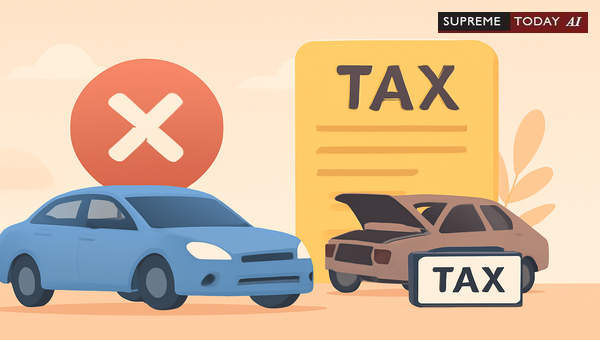
Imagine receiving a road tax notice for your old car that's already been scrapped and turned into metal scraps. Frustrating, right? Many vehicle owners in India face this issue, questioning: If a motor vehicle is demolished or scrapped, can tax be levied for a non-existing or non-operational vehicle in a public place?
The short answer, based on key judicial precedents, is generally no. Courts have ruled that such vehicles cease to be used or kept for use on public roads, nullifying tax liability. This blog dives deep into the legal reasoning, supporting judgments, exceptions, and practical steps for owners. Note: This is general information, not specific legal advice—consult a lawyer for your case.
Indian courts, interpreting motor vehicle taxation laws, hold that road tax applies only to vehicles used or kept for use in the state. Once a vehicle is demolished or scrapped, it physically ceases to exist or function, rebutting the presumption of use tied to current registration. As per judgments, the law presumes that a registered vehicle is kept for use in the state as long as the registration remains current State Of Orissa VS BIJAYA C. TRIPATHY - 2004 0 Supreme(SC) 249Nandyala Ramakrishna Reddy VS Government of A. P. - 2022 0 Supreme(AP) 484, but this is rebuttable for non-existent vehicles.
Tax liability hinges on actual or potential use on public roads, defined under Section 2(34) of the Motor Vehicles Act, 1988, as areas accessible to the public. A scrapped vehicle can't meet this criterion Tarachand Logistic Solutions Limited VS State Of Andhra Pradesh - Supreme CourtState of Andhra Pradesh VS Tarachand Logistic Solutions Ltd. , Chandigarh - Andhra Pradesh.
Laws presume current registration means potential road use, but owners can rebut this with evidence of scrapping. The burden of proving that a motor vehicle has not been used during any period shall be on the registered owner VAKIYATH KOYA S/o HYDRU VS STATE OF KERALA - 2022 Supreme(Ker) 300 - 2022 0 Supreme(Ker) 300. For scrapped vehicles, certificates from scrapping facilities or authorities suffice.
Judgments clarify: mere valid certificates don't imply operation if the vehicle is destroyed. No tax can be levied for periods when the vehicle is non-operational, especially if it lacks a valid fitness certificate M/S.PNK SRT TRAVELS vs The State Transport Authority - MadrasM/S.PNK SRT TRAVELS vs The State Transport Authority - Madras. Scrapping goes further—it's permanent non-existence.
When scrapped under Motor Vehicles Act rules, the vehicle loses roadworthiness. The existence of a vehicle is a prerequisite for tax liability, regardless of scrapping or non-use status M/S.SHREE VINAYAK INFRATECH PVT LTD vs STATE OF KARNATAKA - Karnataka. Courts in State Of Orissa VS BIJAYA C. TRIPATHY - 2004 0 Supreme(SC) 249 held: the vehicle's non-existence nullifies the basis for tax liability. Similarly, Nandyala Ramakrishna Reddy VS Government of A. P. - 2022 0 Supreme(AP) 484 states: when a vehicle is demolished or no longer exists, the basis for imposing tax is absent.
Contrast with temporary non-use: Vehicles off-road for repairs might still owe tax if capable of use, but scrapping removes that capacity.
High Courts reinforce: Tax isn't levied on vehicles incapable of public road use, like tractors not designed for streets Rajeshwari and Others v. Rasool Mohammed and Another - Chhattisgarh. Vehicles kept in premises like steel plants or restricted areas are generally not considered used in a public place State of Andhra Pradesh VS Tarachand Logistic Solutions Ltd. , Chandigarh - Andhra Pradesh. For scrapped ones, this is absolute—no public place involvement.
Supreme Court principles align: Basis is use or potential use on public roads. Destroyed vehicles fail this test State Of Orissa VS BIJAYA C. TRIPATHY - 2004 0 Supreme(SC) 249Nandyala Ramakrishna Reddy VS Government of A. P. - 2022 0 Supreme(AP) 484.
While scrapped vehicles typically escape tax, nuances exist:
To avoid disputes:
Tax calculation ties to invoice price or class, payable periodically Principal Secretary To Government VS Ranjith K. P. - KarnatakaHarish Kumar K. P. S/o Achutha Pisharodi VS Union of India - Kerala. Non-use doesn't auto-exempt if previously used—prove periods clearly.
In summary, demolished or scrapped vehicles generally can't be taxed as they aren't used or kept for use in a public place. Key judgments State Of Orissa VS BIJAYA C. TRIPATHY - 2004 0 Supreme(SC) 249Nandyala Ramakrishna Reddy VS Government of A. P. - 2022 0 Supreme(AP) 484 provide strong backing, emphasizing physical existence and road capability.
Key Takeaways:- Scrapping rebuts use presumption—tax invalid.- Prove non-use with documents for exemptions.- Cancel registration promptly.- Public place use is core; restricted/non-road vehicles often exempt.
Stay compliant, save money, and avoid penalties. For personalized advice, reach out to a legal expert familiar with your state's Motor Vehicles Taxation Act.
Word count: 1028. References are to specific judgments; full texts via legal databases.
#RoadTaxExemption, #ScrappedVehicles, #MotorVehicleTax


Actual use or non-use of public roads cannot be a ground for escaping tax liability. He held that vehicles of the appellant were being used in the State of Andhra Pradesh and hence liable to pay the applicable motor vehicle tax. 41. ... From a reading of Section 3(1), it is evident that the government i.e. the State Government may by notification direct that a #HL_START....

Levy of tax on Motor Vehicles.-(1) The Government may, by notification, from time to time, direct that a tax shall be levied on every motor vehicle used or kept for use, in a public place in the State. ... 'Public place' according to Section 2(34) of the MOTOR VEHICLES ACT , 1988, reads thus: "(34)....

If no such use of public roads is made or the vehicles are not such as can be used on the public roads, then no tax could be levied under the Taxation Act. ... In the instant case, it is said that the tractor cannot ply in a public place, nor does it ply in any other place for carrying passengers or goods. It could not evidently fall within S.22 of the....

The notification further provides motor vehicle tax will be levied for two years or in multiples of two. That after completion of fourteenth year, the motor vehicle tax shall be levied annually which shall be half of the amount which was charged earlier for that vehicle. ... Principle for motor vehicle#HL_E....
There is an obligation on the petitioner to intimate that the vehicle has been scrapped under Section 34 (1) of Motor Vehicles Act. But that requirement is not relevant for the purpose of levy of tax under the Act. ... One of the circumstances relied on by the respondents for holding that the petitioner is liable to pay the tax is the fact that the intimation that the vehicle had been #H....

The notification further provides motor vehicle tax will be levied for two years or in multiples of two. ... Principle for motor vehicle tax.—(1) In case of fully built non-transport vehicles, the motor vehicle tax shall (2) The Motor Vehicle ....

According to Section 56 of the Motor Vehicles Act, 1988, and Rule 62 of the Tamil Nadu Motor Vehicles Rules, 1989, a valid fitness certificate is required for a vehicle to be legally used on public roads. ... At this juncture, it would be useful to refer Section 3 of the Tamil Nadu Motor Vehicles Taxation Act, 1974: - "Subject to the provisions of sub-section (2), tax shall be ....

According to Section 56 of the Motor Vehicles Act, 1988, and Rule 62 of the Tamil Nadu Motor Vehicles Rules, 1989, a valid fitness certificate is required for a vehicle to be legally used on public roads. ... In view of the above, the vehicles were not in use; therefore, no tax can be imposed for the period when the vehicles were non-operational, as stipulated under Se....

Provided [further] that where the vehicle is detained under sub-sec. (2) of Sec. 17 of the Act for the non-payment of tax before the issuance of the notice in Form M.T.R. such vehicle shall not be released unless full tax due in respect of such vehicle has been paid.” ... Insertion of S.No. 7(a)(iii) cannot be said to be anything beyond specifying the rate of #HL_START....

13.1 Section 39 of the MV Act mandates the registration of a motor vehicle and without registration in accordance with the provisions of Chapter IV, no motor vehicle is legally permitted to be driven in any public place or any other place. ... Principle for motor vehicle tax. (1) In case of fully built #HL....

(3) Notwithstanding anything contained in sub-section (1), in an appeal under section 23 or a revision under section 24, the burden of proving that a motor vehicle has not been used during any period shall be on the registered owner or the person having possession or control of the motor vehicle, as the case may be.” (1) In the case of a motor vehicle which is not intended to be used or kept for use during any calendar month of a quarter or two successive calendar months of a quarter, or the w....

10. (1) Where the tax due in respect of any motor vehicle has not been paid by the owner, within the specified time, then in addition to payment of the tax due, he shall also be liable to pay penalty, at such rate, as may be specified in the notification issued under section 3: 3. (1) Subject to other provisions of this Act, there shall be levied and collected a tax on all motor vehicles used or kept for use in the State, at such rates and penalties, as may be specified by the State Government....

9. The licensing officer may direct a notice to be served upon the owner requiring him to fill up and sign a declaration, to be endorsed with such notice, stating that owner is liable to the payment of tax and to pay the tax to which he appears by such declaration to be liable, to the person named therein before the expiry of fourteen days from the date of service of such notice. 4. (3) No motor vehicle shall be used or kept for use in the State unless the tax levied under section 3 ....
The impugned provisions read as under:- 4-B Levy of tax- (1) Notwithstanding anything contained in Section 3, there shall be levied and collected a tax on the purchase value of a motor vehicle an entry of which effected into a local area for use or sale therein and which is liable for registration or assignment of a new registration mark in the State under the Motor Vehicles Act, 1988, at such rate as may be fixed retrospectively or prospectively by the State Government by Notification but not....
The impugned provisions read as under:- 4-B Levy of tax- (1) Notwithstanding anything contained in Section 3, there shall be levied and collected a tax on the purchase value of a motor vehicle an entry of which effected into a local area for use or sale therein and which is liable for registration or assignment of a new registration mark in the State under the Motor Vehicles Act, 1988, at such rate as may be fixed retrospectively or prospectively by the State Government by Notification but not....


An indispensable Tool for Legal Professionals, Endorsed by Various High Court and Judicial Officers
Please visit our Training & Support
Center or Contact Us for assistance

Scan Me!
India’s Legal research and Law Firm App, Download now!


For Daily Legal Updates, Join us on :

 Back to top


