


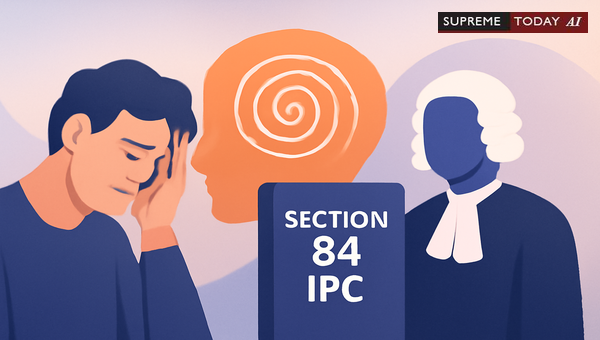
Can OCD Qualify as an in India?
Obsessive Compulsive Disorder (OCD) affects millions worldwide, characterized by intrusive thoughts and repetitive behaviors. But when it intersects with the criminal justice system, a pressing question arises: Is Obsessive Compulsive Disorder a plea of insanity? This query often surfaces in high-stakes legal battles, where defendants claim their condition negated their ability to understand their actions. Under Indian law, the answer is far from straightforward. This post delves into the legal nuances, drawing from the and judicial precedents to clarify when—or if—OCD can support an .
Understanding Under IPC
of the IPC provides the cornerstone for the : Nothing is an offence which is done by a person who, at the time of doing it, by reason of , is incapable of knowing the nature of the act, or that he is doing what is either wrong or contrary to law. This defines , distinct from .
- vs. : is narrow, focusing on cognitive impairment at the exact moment of the offense. covers broader mental disorders that may not absolve criminal responsibility. As courts have noted, has to be distinguished from . 2008 7 Supreme 351
- The term insanity lacks a precise definition but describes varying degrees of mental disorder. Courts treat as equivalent to insanity, but mere mental illness isn't enough. 2008 0 Supreme(MP) 919
The rests on the accused, though it's not as rigorous as the prosecution's standard—sufficient to raise reasonable doubt. Evidence like medical records, expert testimony, and behavioral assessments is crucial. 1964 0 Supreme(SC) 91 2011 5 Supreme 193
Does OCD Meet the Threshold for ?
A diagnosis of OCD does not automatically qualify as . OCD involves obsessions and compulsions, but these must significantly impair the ability to know the act's nature or wrongfulness at the time of the offense. Compulsive actions alone fall short.
- Key Limitation: Mere abnormality of mind or partial delusion, irresistible impulse or compulsive behaviour of a psychopath affords no protection under . 2008 0 Supreme(MP) 919 Courts emphasize that OCD-like compulsions don't negate () unless reasoning is completely impaired. 2022 0 Supreme(MP) 417 2008 7 Supreme 493
- In practice, abnormal behavior or lack of motive isn't sufficient. For instance, Mere absence of motive for a crime, howsoever atrocious it may be, cannot in the absence of plea and proof of , bring the case within this section. 2008 0 Supreme(MP) 919 2008 7 Supreme 351
Judicial scrutiny focuses on the material time of the offense. Post-crime consciousness of guilt or pre-crime deliberation can undermine the plea. Every mentally diseased person isn't exempt; only those with cognitive faculty impairment qualify. 2022 0 Supreme(MP) 417
Relevant Case Law Insights
Indian courts have repeatedly rejected OCD or similar conditions as insanity pleas without strong evidence of total incapacity.
- In a murder case, unusual behavior by witnesses didn't trigger benefits. The accused beat victims methodically and set a fire, showing awareness. The crucial point of time for deciding whether the benefit of this section should be given or not, is the material time when the offence takes place. 2008 0 Supreme(MP) 919
- Another ruling clarified: Every person who is mentally diseased is not ipso facto exempted from criminal responsibility—Court is concerned with , not with . 2008 0 Supreme(MP) 919
- Compulsive obsessiveness appeared in a divorce context, deemed cruelty due to incompatibility, not excusing behavior. While not criminal, it highlights OCD's limits in legal excuses. 2022 0 Supreme(Ker) 72
In disciplinary proceedings, an employee's OCD claim was challenged for lacking evidence. The court stressed: Need for evidence and finding of fact before applying the provisions of disability laws, restoring inquiry proceedings. 2018 0 Supreme(Gau) 1346
These cases underscore that OCD must render the accused —like an idiot, illness-afflicted person, lunatic, or drunk—at the offense time. A lunatic is one who is afflicted by mental disorder only at certain periods.... 2008 0 Supreme(MP) 919
Evidence Required for a Successful Plea
To succeed, defendants must prove:1. Defect of Reason from Mind Disease: Not just OCD symptoms, but proven incapacity. 2022 0 Supreme(MP) 4172. Timing: Insanity at the act's moment, supported by prior/post behavior. Evidence as to conduct of accused shortly prior to offence and at the time of or immediately afterwards. 2008 0 Supreme(MP) 9193. Expert Support: Medical history, psychiatric evaluations. Previous insanity helps but isn't conclusive if lucid intervals exist. of an insane person is not merely a cessation of violent symptoms... but a restoration of the faculties. 2008 0 Supreme(MP) 919
Failure to medically examine during investigation can create doubt, but prosecution presumes knowledge of natural consequences and law. 2008 0 Supreme(MP) 919
Broader Implications and Alternatives
OCD may influence sentencing or mitigation but rarely absolves fully. In non-criminal contexts, like pensions or bail, it's considered for accommodations, not exemptions. For example, bipolar disorder led to disability pension, not invalidation without service length. 2019 0 Supreme(Cal) 299 Bail denials for OCD/panic disorders emphasize no automatic release. 2020 0 Supreme(Del) 1450
If insanity fails, explore , mental health defenses, or pleas like alternatives (e.g., intoxication nuances).
Key Takeaways
- OCD typically does not qualify as without proof of total cognitive impairment. 1995 0 Supreme(MP) 983 2003 0 Supreme(Gau) 217
- Burden on accused: Gather robust evidence. 1964 0 Supreme(SC) 91
- Courts prioritize + ; compulsions alone insufficient. 2022 0 Supreme(MP) 417
- Consult experts early for viable defenses.
Conclusion
While OCD profoundly impacts lives, Indian law sets a high bar for insanity pleas under IPC. Mere compulsions or medical diagnosis won't suffice—compelling proof of incapacity is essential. This defense embodies (no act is guilty without ). 2008 0 Supreme(MP) 919
Disclaimer: This is general information based on precedents and not specific legal advice. Laws evolve, and outcomes depend on facts. Consult a qualified lawyer for personalized guidance.
References: 2022 0 Supreme(MP) 417 2023 6 Supreme 508 1964 0 Supreme(SC) 91 2011 5 Supreme 193 1995 0 Supreme(MP) 983 2003 0 Supreme(Gau) 217 2007 4 Supreme 627 2008 7 Supreme 493 2008 0 Supreme(MP) 919 2008 7 Supreme 351 2022 0 Supreme(Ker) 72 2018 0 Supreme(Gau) 1346
#OCDInsanityDefense















