Searching Case Laws & Precedent on Legal Query.....!
Analysing the retrieved Case Laws
Scanned Judgements…!



Searching Case Laws & Precedent on Legal Query.....!
Analysing the retrieved Case Laws
Scanned Judgements…!
Main points and insights:
Courts consistently require concrete evidence to prove an oral partition. Merely claiming an oral partition without supporting material is deemed unproved and insufficient to establish ownership or title ["2025 0 Supreme(Kar) 644"], ["2026 Supreme(Online)(Mad) 4975"], ["2024 0 Supreme(Mad) 2360"], ["2025 Supreme(Online)(Kar) 41570"], ["2025 Supreme(Online)(Mad) 63330"].
The burden of proof lies with the person asserting an oral partition. When such proof is lacking, courts tend to reject claims of ownership based solely on oral partition, emphasizing the necessity of documentary evidence or clear witnesses ["2024 0 Supreme(Mad) 2360"], ["2026 Supreme(Online)(Mad) 4975"], ["2025 Supreme(Online)(Kar) 41570"].
Courts have held that partition, especially oral, does not amount to a transfer of title. It merely alters possession or shares among co-owners; thus, claiming absolute ownership solely on the basis of oral partition is inadequate ["2025 0 Supreme(Kar) 644"], ["ARALAPPA"], ["2024 0 Supreme(Mad) 2360"].
In cases where revenue records or other documents do not support the existence of an oral partition, courts tend to dismiss claims of ownership based on such unproved oral arrangements ["2025 0 Supreme(Kar) 644"], ["2026 Supreme(Online)(Mad) 4975"], ["2024 0 Supreme(Mad) 2360"].
When a person claims ownership through oral partition, they must also establish exclusive possession or adverse possession, which is difficult without documentary proof or clear evidence of ouster of other co-owners ["2026 Supreme(Online)(Mad) 4975"], ["2025 Supreme(Online)(Kar) 41570"], ["2025 Supreme(Online)(Mad) 63330"].
Analysis and Conclusion:
Stating that one is the owner of a property based solely on an oral partition is generally not sufficient to establish legal title. Courts require clear, credible evidence—such as registered deeds, revenue records, or witnesses—to prove that an oral partition actually occurred and resulted in transfer of ownership rights. Without such evidence, claims based solely on oral arrangements are typically rejected, as oral partition does not convey title but only indicates a division of shares or possession among co-owners. Therefore, an oral assertion of ownership alone does not constitute legal proof of title.
References:
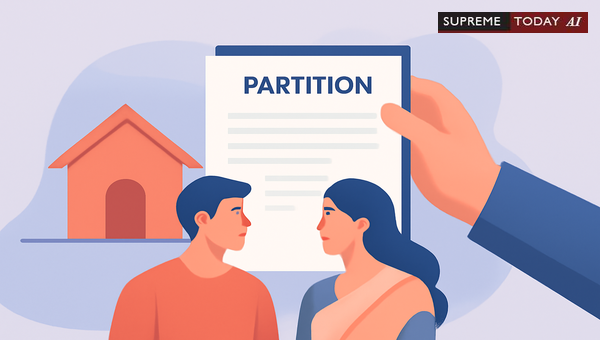
# Is Enough for Property Title in India?In the realm of property disputes, family partitions are common, especially in India where have deep roots. But what happens when someone claims ownership of a property solely based on an ****? Is a verbal agreement or statement sufficient to establish ? This question arises frequently in courts and can lead to prolonged litigation if not handled correctly.This blog post dives into Indian law on oral partitions, drawing from key judicial precedents and statutory principles. We'll examine why such claims typically fall short and what steps are needed for solid ownership proof. **Note: This is general information, not legal advice. Consult a qualified lawyer for your specific situation.**## The Core Question: Does a Statement of Establish Title?Consider this scenario: A person states, I am the owner of this property based on an among family members. Is this declaration enough to prove title?**Short answer: No.** Under Indian law, a mere statement or claim of does not, by itself, establish . Courts consistently require more—typically formal documentation like a registered deed—to confer enforceable . Oral assertions may hint at family arrangements but lack the weight to override statutory formalities. [
#OralPartition #PropertyLawIndia #TitleDisputes


On other hand, failure to produce any material to establish oral partition was fatal to plaintiffs’ claim. It was submitted, production of sale deed and partition deeds – Exs.D1 to D3 would establish defendant's title. ... Therefore, contention of defendants about equal partition was without basis. ... It was submitted, there was no dispute that Smt.Mehaboob Bi was absolute owner of property bearing Sy.no.13 measuring 13 Acres 37 gu....

Mere payment of kist, patta entries, or assertions of management do not establish exclusive possession so as to sustain a decree for injunction against another co-owner or a person claiming under a co-owner. ... It is contended that the very foundation of the plaintiff’s claim namely the oral partition is unproved, and therefore any subsequent mutation in revenue records said to have been effected on the basis of such partition is wholly unsustainabl....

When a party claims exclusive title to the suit property and is able to establish that he is entitled to half of the suit property, it will not be unusual for the Court to pass a decree for partition and possession of his half share. ... In fact such a relief flows from the relief prayed for in the plaint that he is the exclusive owner of the entire property. ... Though he failed to establish his exclusive title over the entire suit property, he succ....
Plaintiff for the reasons best known did not choose to examine 'bajudar' or any other person to establish that suit property is the portion that has fallen to his share in the suit property and plaintiff is in actual possession. 23. ... Admittedly, on what basis, the plaintiff has furnished the boundaries to the suit property is not forth- coming on record, nor any material documents are placed on record to establish the identity of the suit property#HL_END....

Learned trial Court also came to a finding on the basis of the materials on record that the plaintiffs could not establish their title over the suit property. 9. ... From the judgment of the first appellate Court, it will appear that after dealing in detail the evidence on record both documentary or oral concurred with the finding of fact that the appellants could not establish a case that the judgment ... On the basis of evidence on record both the courts below have co....

The oral and documentary evidence clearly establish that the plaintiff has failed to prove his title based on oral partition over the suit schedule property. ... It is further asserted that the plaintiff has approached the Court asserting acquisition of title on the basis of oral partition. But, when the oral partition itself is not proved, question of declaring the plaintiff as owner in respect o....
It is equally well settled that such person must necessarily first admit the ownership of the true owner over the property to the knowledge of the true owner and secondly, the true owner has to be made a party to the suit to enable the court to decide the plea of adverse possession between the two rival ... It is a settled principle of law of adverse possession that the person, who claims title over the property on the strength of adverse possession and thereby wants ....
It is settled law that the burden of proving the plea of Oral Partition falls on the person who brings it up. ... In this case, the plaintiffs miserably failed to establish their case of oral partition. The first defendant also failed to establish his case. Further, the Suit is bad of non-joinder of necessary parties. ... Jevana Gowder, as per Section 8 of the HINDU SUCCESSION ACT , 1956, as the plaintiffs failed to establish the Oral#HL_....

its judgment held that on the basis of partition deed dated 27.02.1974, plaintiff Bheem Sen became owner of the suit property. ... It is alleged in the plaint that the plaintiff on the basis of registered partition deed dated 27.02.1974 (Ex.P/1) is owner and is entitled for possession of the suit property. ... Learned both the Courts below have after appreciation of oral as well as documentary evidence, come to conclusion that the d....
According to the plaintiff, the suit property was allotted to her husband in an oral partition that took place in the year 1992. Though the defendants admit the oral partition, they deny that the suit property was allotted to the husband of the plaintiff. ... the person claiming any right in the disputed property ought to have sought for the relief of declaration of title. ... The oral partition was done only in ....

The first defendant was a Teacher by profession and he was away from the suit property. The Registered documents produced by the plaintiff prove that one of the co-owner has dealt the property for various loan transaction and the manner, in which several documents have been executed, makes it very clear that the Jospeh Nadar, brother of the first defendant has dealt the property for loan transaction. Hence, it is the contention that the oral partition has not been established. When one of the co-owner dealt the property for his loan purpose, that itself cannot be a ground to presum....
Since a co-owner is entitled, as a matter of right, to partition the co-ownership property, he is also entitled to claim allotment of a specified extent of property to him. The possible difficulty to the other sharers in case the property is divided into two or more shares, cannot be a ground to deny physical division of property and separate allotment to the co-owners in accordance with the share position. This makes the position very clear that the Commissioner is obliged to effect physical division of property into two or more shares.
This makes the position very clear that the Commissioner is obliged to effect physical division of property into two or more shares. Since a co-owner is entitled, as a matter of right, to partition the co-ownership property, he is also entitled to claim allotment of a specified extent of property to him. The possible difficulty to the other sharers in case the property is divided into two or more shares, cannot be a ground to deny physical division of property and separate allotment to the co-owners in accordance with the share position.
8. The plaintiffs having filed the suit for partition of huge extent of lands covered in S.No.251 to an extent of 23.28 acres and S.No.261 to an extent of 9.21 acres was unable to satisfy both the courts below, regarding the basic and vital issue as to whether the plaintiffs are the co-owners or owners of the suit property. It is well settled that a person, who is seeking partition of his family property, is required to establish the basic ingredient that he is legally entitled to inherit the property, to which, he is asking for partition. On this aspect the judgment of bot....

According to him, the said petition was filed in the month of April, 1999 as per Exs P23, P24, P25 and P26. In the circumstances he requests the court to dismiss the appeal. Relying upon these documents, he contends that the entire case pleaded by the appellant that he has become the owner of the property by virtue of oral partition is not correct.


An indispensable Tool for Legal Professionals, Endorsed by Various High Court and Judicial Officers
Please visit our Training & Support
Center or Contact Us for assistance

Scan Me!
India’s Legal research and Law Firm App, Download now!


For Daily Legal Updates, Join us on :



 Back to top


