
Searching Case Laws & Precedent on Legal Query.....!
Analysing the retrieved Case Laws
Scanned Judgements…!
Searching Case Laws & Precedent on Legal Query.....!
Analysing the retrieved Case Laws
Scanned Judgements…!
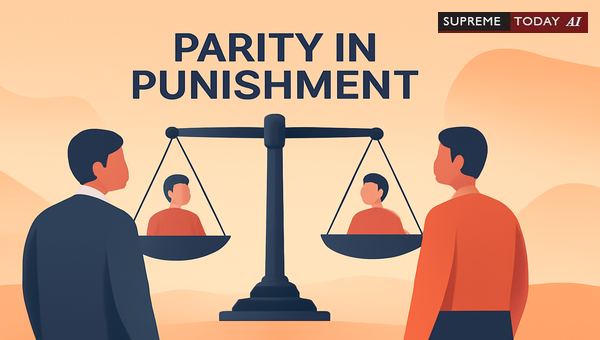
Parity in Punishment - The principle of parity requires that individuals involved in similar misconduct should receive comparable punishments, unless there are significant differences in responsibility or severity of the offense. Several judgments emphasize that parity is not an absolute law but a guiding principle to ensure fairness, taking into account the role and culpability of each offender ["2025 0 Supreme(Bom) 931"], ["2025 0 Supreme(HP) 897"], ["2025 Supreme(Online)(MP) 9770"].
Role and Responsibility - Courts highlight that differences in responsibility and the gravity of misconduct justify different punishments. For example, higher responsibility or involvement in more severe misconduct can warrant stricter penalties, and uniform punishment in such cases would violate principles of justice ["2025 0 Supreme(Bom) 931"], ["2023 Supreme(Online)(DEL) 1705"].
Discrimination and Fairness - When co-delinquents are involved in the same incident, disciplinary actions should maintain consistency to prevent discrimination. If a lesser punishment is given to one, others should not be subjected to harsher penalties without justified reasons. Disparities without proper basis are viewed as unfair and can be challenged ["2024 0 Supreme(Pat) 481"], ["2025 Supreme(Online)(MP) 9770"].
Legal and Constitutional Principles - The principle of parity aligns with constitutional mandates like Article 14, ensuring equality before the law. However, it must be balanced with the need to consider individual culpability and the context of misconduct. Courts have quashed disproportionate or inconsistent punishments to uphold constitutional fairness ["2025 0 Supreme(HP) 897"], ["2024 0 Supreme(Pat) 481"].
Sentencing Parity - In sentencing, parity entails that similar offenders should receive similar sentences unless distinctions in culpability justify different penalties. Imposing harsher sentences on individuals for reasons unrelated to their role or responsibility violates this principle ["2024 Supreme(SRI)(CA) 496"].
The principle of parity in punishment aims to promote fairness and equality, but it is not an absolute rule. Courts recognize that differences in responsibility, severity of misconduct, and individual culpability justify variations in punishment. Disparities lacking such justification can be challenged and set aside. Ultimately, the courts advocate for a balanced approach where parity is maintained among co-delinquents, but nuances of responsibility and the gravity of misconduct are duly considered to ensure just and equitable disciplinary actions ["2025 0 Supreme(Bom) 931"], ["2025 0 Supreme(HP) 897"], ["2025 Supreme(Online)(MP) 9770"], ["2024 Supreme(SRI)(CA) 496"].
In the realm of disciplinary proceedings against government employees or public servants, fairness is paramount. One recurring question that arises is: Parity in Punishment Higher Responsibility—does holding a position of greater authority automatically warrant harsher penalties for similar misconduct? This issue strikes at the heart of equality under Article 14 of the Indian Constitution, ensuring that similarly situated individuals receive comparable treatment.
This blog post delves into the legal principles governing parity in punishment, particularly when higher responsibility is involved. We'll explore judicial interpretations, key precedents, and practical implications for disciplinary authorities and employees alike. Note that this is general information based on established case law and should not be considered specific legal advice—consult a qualified lawyer for personalized guidance.
The doctrine of equality, enshrined in Article 14, mandates that equals must be treated equally. In disciplinary contexts, this translates to parity in punishment for co-delinquents or similarly placed employees involved in identical or substantially similar misconduct. Courts have repeatedly held that deviations from this principle require clear justification.
As emphasized in key judgments, if there is complete parity in the two sets of cases, imposing different penalties would not be appropriate as inflicting of any/higher penalty in one case would be discriminatory 2022 0 Supreme(Jhk) 523. This principle applies rigorously, ensuring punishments are proportionate and not arbitrary.
A common defense by disciplinary authorities is that higher-ranking officials bear greater accountability, justifying harsher penalties. However, courts clarify that position alone does not suffice. There has to be complete parity between the two, not only in respect of nature of charge but subsequent conduct as well after the service of charge sheet in the two cases 2013 0 Supreme(SC) 685.
In cases like an Executive Engineer's dismissal for financial irregularities, despite subordinates receiving lesser penalties (e.g., stoppage of increments), the court upheld the punishment due to the supervisory role's pivotal nature 2025 0 Supreme(Mad) 2254. Yet, this was not solely based on hierarchy but on gross misconduct and failure to ensure compliance.
Conversely, in a Jharkhand Urja Vikas Nigam Ltd. case, the High Court quashed a punishment for improper file notings, citing lack of parity and non-compliance with discipline rules—no multiple punishments for a single misconduct 2023 Supreme(Online)(JHK) 7842. The court noted, Even assuming that due to the noting of the petitioner anything has happened, the entire responsibility cannot be fastened upon the petitioner 2023 Supreme(Online)(JHK) 7842.
Unjustified disparities often lead to judicial intervention. For instance:- Courts remit matters back for re-evaluation if employees are equally placed with similar misconduct 2013 0 Supreme(SC) 685 2022 0 Supreme(Jhk) 523.- In one case involving forest offenses, dismissal orders were quashed solely on parity grounds, with directions to reconsider quantum afresh, referencing the doctrine of equality and the principle of parity among co-delinquents 2022 0 Supreme(Jhk) 880.- Another precedent stressed, Parity among co-delinquents has also to be maintained when punishment is being imposed. Punishment should not be disproportionate while comparing the involvement of co-delinquents who are parties to the same transaction or incident 2021 0 Supreme(Gau) 754 2019 0 Supreme(All) 359.
In a CRPF recruitment misconduct case, parity claims failed because the petitioner was primarily involved, distinguishing from an exonerated co-delinquent 2019 0 Supreme(All) 359. This highlights that exceptions exist for differences in conduct or involvement.
While parity is the rule, exceptions are permissible:- Differences in Subsequent Conduct: Better cooperation post-charge sheet may warrant leniency 2013 0 Supreme(SC) 685.- Nature of Misconduct: Greater culpability in higher roles, if proven, justifies variation—but not merely hierarchy 2024 Supreme(Online)(Mad) 49946.- Hierarchy Alone Insufficient: Disparities based solely on hierarchy or position without supporting reasons violate the equality principle 2013 0 Supreme(SC) 685.
In a Madhya Pradesh case, lack of parity among co-delinquents in administrative file approvals led to scrutiny, noting superiors' crucial role but insisting on justification 2024 Supreme(Online)(Mad) 49946.
Courts refrain from substituting their judgment but direct re-assessment when disparities are evident. For example:- Remand to disciplinary authorities for fresh consideration on punishment quantum 2013 0 Supreme(SC) 685.- In pension withholding cases, double jeopardy was ruled out, enforcing parity across schemes (pension vs. CPF), as parity has to be maintained in cases of awarding punishment 2019 0 Supreme(Jhk) 907.- A Bihar service case quashed harsher punishment on a co-delinquent, directing reinstatement due to involvement in the same incident 2021 0 Supreme(Gau) 754.
To avoid challenges:- Document objective differences (e.g., conduct, role-specific lapses) before varying punishments.- Ensure proportionality, especially for higher responsibility roles—focus on actual impact, not just position.- Maintain records of co-delinquents' treatments for transparency.
Employees facing disparities should gather evidence of similar cases and seek judicial review under Article 226.
The principle of parity in punishment remains a cornerstone of fair disciplinary action, even amid higher responsibility. Disparities must stem from verifiable differences in misconduct, conduct, or circumstances; otherwise, they risk judicial correction to uphold Article 14.
Key Takeaways:- Parity is constitutionally mandated for similarly situated individuals 2013 0 Supreme(SC) 685 2022 0 Supreme(Jhk) 523.- Higher responsibility amplifies accountability but doesn't override equality without justification.- Courts prioritize proportionality and may remand for fairness 2016 0 Supreme(Ori) 796.- Always justify variations to withstand scrutiny.
In conclusion, while positions of authority demand vigilance, equality demands consistency. Disciplinary processes that balance both foster trust in public service. For tailored advice, reach out to a legal expert.
References:1. 2013 0 Supreme(SC) 685: Core on parity, proportionality, higher responsibility.2. 2022 0 Supreme(Jhk) 523: Supreme Court on complete parity for co-delinquents.3. 2016 0 Supreme(Ori) 796: Disparities and judicial remand.4. Additional cases: 2025 0 Supreme(Mad) 2254, 2023 Supreme(Online)(JHK) 7842, 2022 0 Supreme(Jhk) 880, 2021 0 Supreme(Gau) 754, 2019 0 Supreme(All) 359, 2024 Supreme(Online)(Mad) 49946, 2019 0 Supreme(Jhk) 907.
#ParityInPunishment, #Article14, #DisciplinaryLaw
In the impugned order, this aspect of parity in punishment between delinquents, namely two doctors and difference of responsibility and gravity of misconduct is not considered. ... with parity. ... It is therefore clear that the State has in fact maintained parity between the Respondent and Dr. Kembhavi by awarding punishment of dismissal to both of them. ... The responsibility....
The High Court has evidently misunderstood the central aspect of what is meant by parity. Parity while granting bail must focus upon the role of the accused. ... A society expects responsibility and accountability from the member, and it desires that the citizens should obey the law, respecting it as a cherished social norm. No individual can make an attempt to create a concavity in the stem of social stream. It is impermissible. ... Howeve....
In the aforesaid Appeal before the Hon’ble Supreme Court, the appellant sort for parity of punishment with similarly placed constable against whom departmental proceeding was initiated and minor punishment was granted. ... On the principle of parity, the order of punishment passed by the concerned respondents against the petitioner is not permissible. Accordingly, the order of major punishment#H....
Even assuming that due to the noting of the petitioner anything has happened, the entire responsibility cannot be fastened upon the petitioner. The higher authorities have thereafter considered the case of the persons for such promotion and they have passed the order. ... Shaileshkumar Harshadbhai Shah” (2006) 6 SCC 548 on the issue of parity in punishment and held as under: “7. ... The aforesaid punishment#HL_EN....
Shaileshkumar Harshadbhai Shah” (2006) 6 SCC 548 on the issue of parity in punishment and held as under: “7. ... The higher authorities have thereafter considered the case of the persons for such promotion and they have passed the order. ... Even assuming that due to the noting of the petitioner anything has happened, the entire responsibility cannot be fastened upon the petitioner. ... The identically situated pers....
To the competent authority and released the payment as per the agreement rate which is for the higher duty pumpsets. He wantonly ignored the certificate furnished by the Assistant Engineer and the entries in the M.Book to make higher payment. ... Ramakrishnan, Assistant Executive Engineer were given lesser punishment of stoppage of 3 increments with cumulative effect, the appellant alone given the major punishment of dismi....
The persons who have been found guilty can also claim equality of treatment, if they can establish discrimination while imposing punishment when all of them are involved in the same incident. Parity among co-delinquents has also to be maintained when punishment is being imposed. ... However, there has to be a complete parity between the two, not only in respect of nature of charge but subsequent conduct as well after the s....
The parity principle, entails that where two or more offenders are to be sentenced for the participation in the same offence, the sentences passed on each of them should be the same, unless there is a relevant and appreciable difference in their culpability and responsibility for the offence or their ... In these circumstances, awarding sentences of a different nature of a higher degree to the 2nd accused, to my mind, is reasonable and rati....
Even in the case on hand, though punishment is not disproportionate, there is no parity between the co-delinquents. In the administrative file movement, the superior officer who approves the note also, no doubt plays a crucial role. ... State of Madhya Pradesh and others [(2013) 3 SCC 73] wherein, it is held that while imposing punishment where a set of people involved in a same incident, parity among co-delinquents shoul....
Sukhdev Singh were holding different posts and the allegations were not identical and that being a Branch Manager and overall in-charge of the Bank, Petitioner had higher responsibility and therefore greater culpability. ... Petitioner was, however, awarded the punishment of ‘dismissal’ from service. In the Appeal, Petitioner alleged bias against Respondent No.4 herein and discrimination in awarding higher punish....
The persons who have been found guilty can also claim equality of treatment, if they can establish discrimination while imposing punishment when all of them are involved in the same incident. The disciplinary authority cannot impose punishment which is disproportionate i.e. lesser punishment for serious offences and stringent punishment for lesser offences.” Punishment should not be disproportionate while comparing the involvement of co-delinquents who are parties to the same transaction or in....
The disciplinary authority cannot impose punishment which is disproportionate i.e. lesser punishment for serious offences and stringent punishment for lesser offences. Punishment should not be disproportionate while comparing the involvement of co-delinquents who are parties to the same transaction or incident. Parity among co-delinquents had also to be maintained when punishment is being imposed. The persons who have been found guilty can also claim equality of treatment, if....
He submits that one Prem Prakash Sinha was also charge sheeted in the said departmental proceeding and he has been left out by the respondents whereas the petitioner has been punished and due to which the petitioner has got no any promotion whereas the juniors to the petitioner have been promoted in the year, 2009, 2013 respectively. Thus, he makes out a case of the parity in punishment. He further submits that in absence of the misappropriation of the fund, for which the fin....
Merely because the petitioners had opted Pension Scheme and other similarly situated persons had opted CPF, no double standard ought to have been adopted by the respondents, which amounts to discrimination. Parity has to be maintained in cases of awarding punishment. Pursuant to order of conviction, withholding of pension of the petitioners amounts to double jeopardy as the petitioners have already been punished in Departmental Proceedings and as such, on the same charges/ sa....
Parity among co-delinquents has also to be maintained when punishment is being imposed. Punishment should not be disproportionate while comparing the involvement of co-delinquents who are parties to the same transaction or incident. The persons who have been found guilty can also claim equality of treatment, if they can establish discrimination while imposing punishment when all of them are involved in the same incident. The Disciplinary Authority cannot impose punishment whi....
Login now and unlock free premium legal research
Login to SupremeToday AI and access free legal analysis, AI highlights, and smart tools.
Login
now!
India’s Legal research and Law Firm App, Download now!
Copyright © 2023 Vikas Info Solution Pvt Ltd. All Rights Reserved.








