


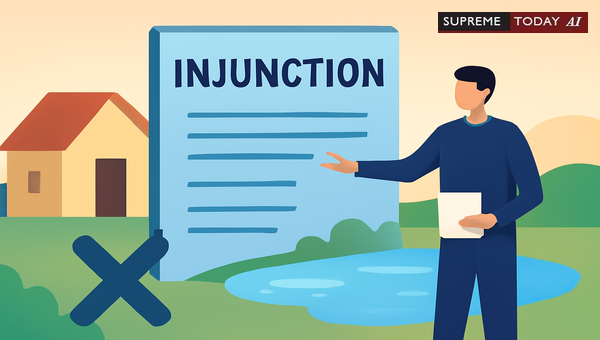
on Shared Pond: Legal Requirements
Property disputes over shared natural features like ponds can escalate quickly, leading plaintiffs to seek permanent injunctions to protect their rights. Imagine a scenario where the plaintiff seeking on a pond which extends to the property of defendant also claims interference. But will courts grant such relief? This blog explores the legal grounds, drawing from key judicial findings and related cases to help you understand the nuances.
Note: This is general information based on legal precedents and not specific legal advice. Consult a qualified attorney for your situation.
What is a in Property Disputes?
A is an courts grant to prevent ongoing or future harm to property rights. It's typically sought after a full trial, unlike temporary injunctions. In pond-related disputes, success hinges on proving a clear legal right, such as ownership or possession, and demonstrating without the injunction. Courts are cautious, especially when boundaries are unclear or the feature spans multiple properties. 2018 0 Supreme(Mad) 679
Core Requirements for Granting Relief
To secure a , plaintiffs must meet stringent criteria:
- Establish Valid Title or Possession: Mere claims aren't enough; credible evidence like title deeds, surveys, or possession proofs is essential. 2018 0 Supreme(Mad) 679
- Precise Property Description: The must accurately describe the disputed area, including the pond's location. Vague or altered descriptions undermine claims. 2018 0 Supreme(Mad) 679
- Pond Location Evidence: Courts rely on commissioner reports, surveys, and inspections. If evidence shows the pond lies outside the plaintiff's property or on the defendant's land, relief is denied. 2018 0 Supreme(Mad) 679
- : The plaintiff bears the onus. Defendants challenging title force the need for a alongside the injunction. 2018 0 Supreme(Mad) 679
Failure in these areas often leads to dismissal, as mere assertion of ownership without supporting evidence or proper pleadings is insufficient for a . 2018 0 Supreme(Mad) 679
Detailed Case Analysis: The Pond Extension Dispute
In a pivotal case, the plaintiff sought a over a pond allegedly extending into the defendant's property. The court scrutinized:
Property Description and Possession
The plaintiff's initial omitted the pond, later amended, raising doubts. Materials didn't prove the pond was within their property. The plaintiff had deleted the pond from the property description, casting doubt on his claim. 2018 0 Supreme(Mad) 679
Conflicting Reports on Location
Initial inspections placed the pond on the defendant's land, corroborated by commissioner reports. The reports of the Commissioner, which showed the pond was located in the defendant’s property, undermining the plaintiff’s claim. Courts noted reports aren't definitive for possession but critical for injunctions. 2018 0 Supreme(Mad) 679
Absence of Title Declaration
When defendants contested title, the plaintiff didn't seek ownership declaration. The ’s decision cited reinforces that in property disputes, especially involving title, a suit for injunction alone is insufficient if the plaintiff does not seek a declaration of ownership. The suit was deemed unmaintainable. 2018 0 Supreme(Mad) 679
Result: Injunction denied due to weak evidence and procedural lapses.
Insights from Related Cases
Similar disputes reinforce these principles:
In a suit for injunction over a pond used for water access, plaintiffs failed to prove easementary rights via long-term use. Easementary rights must be demonstrated through established, long-term use; failure to substantiate these claims invalidates requests for declaratory relief. The restored the trial court's dismissal, stressing evidence of prior enjoyment under the Sections 4 and 118. 2025 0 Supreme(Kar) 695
Another case involved a disputed pond on alleged private land versus public eviction. Plaintiffs sought injunction against proceedings but lacked title proof. A claim for must be supported by demonstrable legal title or right, barring maintainability if the claimant lacks such evidence. Concurrent findings by lower courts upheld denial under .
Easement claims for water from ponds require 40+ years of unchallenged use, which plaintiffs couldn't substantiate despite family history assertions. The appellate reversal was overturned for ignoring trial evidence. 2025 0 Supreme(Kar) 695
In fraud-challenged sale deeds tied to possession suits, courts demand proof beyond admission. The importance of proving fraud and passing of consideration in challenging a sale deed, and the requirement of evidence once a document is admitted. Without it, injunctions fail. 2018 0 Supreme(P&H) 4788
Co-sharer possession disputes highlight that sale agreements alone don't confer owner-like rights without . Courts granted injunctions protecting actual possession. 2016 0 Supreme(All) 258
Plaints lacking , like missing key documents (e.g., development agreements), face rejection under . must disclose some . Vague averments and delays doom suits.
Anand J. Datwani VS Geeti Bhagat Datwani
2013 0 Supreme(Del) 1749
These cases show courts prioritize evidence over assertions, especially for shared features like ponds.
KOTHANDAPANI vs SUBAMANIAM
Exceptions and When Injunctions May Still Succeed
Relief isn't impossible:- Prior Possession Proven: Strong evidence of longstanding, peaceful possession can sway courts, even without perfect title.- Holistic Evidence Review: Reports aren't sole deciders; pleadings, witnesses, and context matter. 2018 0 Supreme(Mad) 679- Declaration Sought: Pairing injunction with title declaration strengthens cases against challenges.- Easements: Proven (e.g., water access) may grant limited injunctions without full ownership. 2025 0 Supreme(Kar) 695
Practical Recommendations for Property Owners
To bolster your injunction suit:
- Document Everything: Secure title deeds, revenue records, and professional surveys pinpointing the pond.
- Accurate Pleadings: Describe property precisely, including encroachments.
- Seek Comprehensive Relief: File for declaration if title is disputed.
- Gather Evidence Early: Use commissioners, photos, and witness testimonies.
- Address Easements: For shared use, prove historical enjoyment.
Courts are cautious in granting injunctions without clear proof of ownership, especially when the defendant challenges the claim. 2018 0 Supreme(Mad) 679
Key Takeaways
Permanent injunctions for ponds extending to neighbors' properties demand ironclad proof of ownership, possession, and location. Weak evidence, poor pleadings, or standalone injunction suits often fail, as seen across precedents. Always substantiate claims to avoid —to your case.
Facing a similar dispute? Gather evidence meticulously and consider declaration relief. This guide highlights general principles; professional advice is crucial for tailored strategy.
References:1. 2018 0 Supreme(Mad) 679: Core case on proof requirements.2. 2025 0 Supreme(Kar) 695: Easement insights.3.
: Title necessity.4. Others as cited inline. #PropertyLaw, #PermanentInjunction, #PondDispute















