


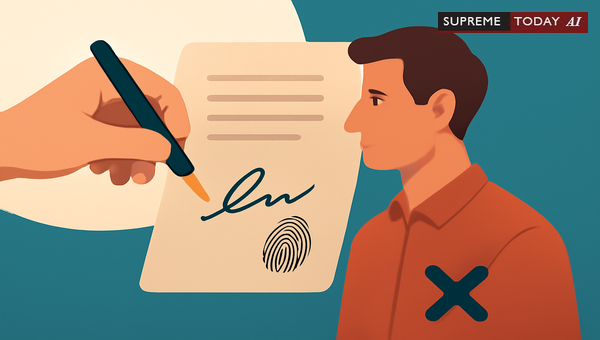
Plaintiff Denies Signature on : What Happens to the Case?
In the high-stakes world of litigation, every detail matters—especially when it comes to the authenticity of key documents like the and . Imagine this scenario: If the Plaintiff Refuses to Recognize his Signature or on his and his , then what will be the Fate of the Plaintiff's Case? This question strikes at the heart of evidentiary reliability in court. Refusing to acknowledge one's own signature or can cast serious doubt on the entire case, potentially leading to its dismissal or severe weakening.
This blog post dives deep into the legal implications, drawing from judicial precedents and evidentiary principles under Indian law. We'll explore why recognition is crucial, the consequences of denial, real-world case examples, and strategies to mitigate risks. Whether you're a litigant, lawyer, or simply curious about court procedures, understanding this can save your case—or alert you to pitfalls.
The Critical Role of Signature and Recognition
Signatures and thumb impressions serve as the cornerstone of document authenticity in legal proceedings. They not only confirm execution but also imply that the signatory understood the contents. Under the , particularly Section 73, courts are empowered to compare signatures, writings, or thumb impressions with admitted or proved specimens. As noted in one ruling, Section 73 of the empowers a Court to compare signature, writing or seal or with other signature/ writing or seal or admitted or proved. 2023 0 Supreme(Gau) 125
Recognition by the plaintiff establishes a and voluntary action. Courts emphasize that without this acknowledgment, documents lose their presumptive validity. For instance, in a key case, it was held that it is not likely that he would subscribe his signature to these documents if they had been executed by a person who was unable to understand contents there of. 1998 3 Supreme 614 This highlights how acknowledgment proves both authenticity and comprehension.
Consequences of the Plaintiff's Refusal
When a plaintiff disowns their signature or on the or , the evidentiary value of these documents plummets. Courts may view them as unreliable, leading to:
- Rejection of Documents: Without admission, the court cannot rely on them as . The absence or denial of signature/ undermines the and understanding, casting doubt on the validity of the documents. 1998 3 Supreme 614
- Doubt on Voluntariness: Refusal raises questions about whether the documents were signed knowingly. In contrast, where validity was upheld, evidence adduced in case has established that Savoy Ranganna validly executed and because he affixed his after understanding the contents. 1998 3 Supreme 614
- Adverse Impact on Case: The plaintiff's suit may be dismissed or weakened due to lack of admissible proof. Courts have held that if a person refuses to recognize or admit signatures/thumb impressions on his documents, such documents may not be relied upon as , thereby affecting the case adversely. 1998 3 Supreme 614
This refusal effectively sabotages the foundation of the case, as pleadings and affidavits are pivotal to proving claims.
Judicial Precedents and Case Insights
Indian courts have consistently addressed this issue. In 1998 3 Supreme 614, the court stressed that the plaintiff's consciousness and mental faculties at execution were key, proven through acknowledgment. Conversely, denial prevents such proof, making documents suspect.
Another precedent reinforces: The case emphasizes that a declaration or document not acknowledged by the declarant’s signature or , especially when refused, cannot be relied upon as substantial evidence. 2001 8 Supreme 610
From additional sources:- In a dispute over thumb impressions, the plaintiff failed to seek expert verification, while the defendant did: But in this case, the Plaintiff has not taken out any application for referring the under Ex.A2 to the finger print experts. It was the first Defendant who had taken out an application... 2025 0 Supreme(Mad) 4595- Courts scrutinize discrepancies: In this case, the court held that there was no discrepancy between the signature of the petitioner in the admitted documents, namely, written statement, affidavit-in-chief... 2024 0 Supreme(Cal) 388
Broader analysis shows that when plaintiffs deny signatures on sale deeds or promissory notes, courts demand or witnesses. Without them, claims falter: Plaintiff's Disputed Signatures and Thumb Impressions - The plaintiff denies the signatures and thumb impressions on key documents... Courts have examined expert opinions... but in some cases, the court has found no conclusive evidence of forgery without proper expert testimony... (drawing from 2024 0 Supreme(Kar) 626, 2023 0 Supreme(Gau) 58, 2023 0 Supreme(AP) 1453).
Exceptions: When Other Evidence Can Save the Day
Not all hope is lost. Courts may consider alternatives:- Independent Corroboration: Witnesses, conduct, or circumstances proving validity. If other independent evidence (e.g., witnesses, conduct, or circumstances) strongly supports the validity of the documents, the court might still rely on them despite the refusal... - Forensic Analysis: Under Section 73, courts can order expert comparisons. However, plaintiffs must proactively apply, as seen in cases where defendants succeeded by doing so 2025 0 Supreme(Mad) 4595.- Expert Opinions: matching impressions can sway outcomes, but absence weakens the case: Expert Evidence and - Courts often rely on forensic comparisons... The absence of eyewitness testimony or proper comparison witnesses weakens the plaintiff's proof... (2023 0 Supreme(Gau) 58, 2023 0 Supreme(AP) 1453, 2025 Supreme(Online)(P&H) 2272).
In food safety sampling contexts, even refusals to sign are handled via witnesses: Provided that where such person refuses to sign or put his , the shall call upon one or more witnesses... (2020 0 Supreme(Ker) 84, 2019 0 Supreme(Ker) 516). This procedural flexibility underscores fact-specific evaluations.
Practical Recommendations for Litigants
To avoid pitfalls:- Acknowledge Promptly: Always verify and admit signatures/thumb impressions to preserve document strength.- Bolster with Evidence: Secure eyewitnesses, forensic experts early. If denial occurs, pivot to independent proof.- Seek Court Directions: Apply for signature comparisons under .- Consult Professionals: Engage lawyers to strategize pre-trial.
The plaintiff should acknowledge signatures/thumb impressions on all legal documents to ensure their admissibility and weight. Courts too should carefully evaluate the circumstances and evidence before dismissing the documents solely based on non-recognition.
Key Takeaways and Conclusion
Refusing to recognize signatures or thumb impressions on core documents like the and typically dooms a plaintiff's case by eroding evidentiary trust. Judicial trends show courts dismissing or weakening such suits absent strong corroboration, as in 1998 3 Supreme 614, 2001 8 Supreme 610, 2024 0 Supreme(Kar) 626, 2023 0 Supreme(Gau) 58,
. The fate? Often unfavorable, but salvageable with proactive evidence gathering.
Important Disclaimer: This post provides general insights based on precedents and is not specific legal advice. Outcomes vary by facts and jurisdiction—consult a qualified lawyer for your situation.
Stay informed, sign wisely, and litigate smartly!
#PlaintiffSignature, #LegalEvidence, #CourtCaseFate















