


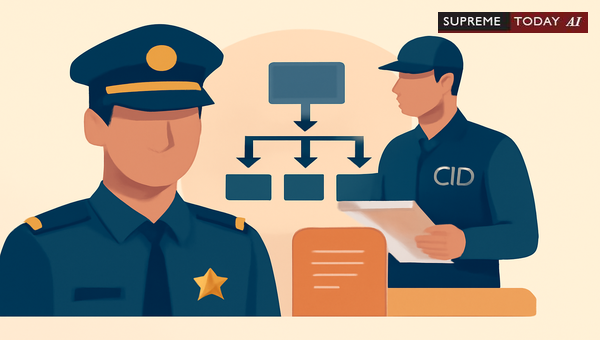
Can Police Commissioner Delegate Powers?
In the complex world of criminal investigations in India, questions about authority and delegation often arise. A common query is: Does the Police Commissioner can be Delegated Powers of ? More precisely, can a Police Commissioner delegate the powers typically exercised by the ) to other officers, or exercise those powers themselves? This issue touches on the hierarchy of police powers under the ), 1973, and relevant judicial precedents.
Understanding this is crucial for law enforcement officials, legal practitioners, and even the public navigating police procedures. This post breaks down the legal framework, key principles, limitations, and practical recommendations—based on established case law and statutory provisions. Note: This is general information and not specific legal advice. Consult a qualified lawyer for your situation.
Overview of Police Powers and Role
The plays a pivotal role in handling serious and complex criminal cases, often taking over investigations from local police stations. However, the delegation of its powers—or whether superior officers like the Police Commissioner can assign these to teams—depends on statutory limits and judicial interpretations.
Under the , powers related to investigation, filing reports, and forming opinions on forwarding cases for trial are not freely delegable. The officer in charge of a typically holds primary responsibility, but superior officers, including those in , may step in under specific conditions. 2024 0 Supreme(Ker) 122
Key Legal Principles Governing Delegation
1. Non-Delegation of Filing Powers Under
The in ruled that the power to file a final report under must be exercised by the officer in charge of a and cannot be delegated to another officer, except to a superior officer of that . 2024 0 Supreme(Ker) 122
This underscores that delegation is restricted to superiors, preventing dilution of accountability.
2. Officers as Superior Authority
The in clarified that officers of the , such as Inspectors, are considered superior in rank to officers in charge of police stations. Therefore, they can exercise the powers of an officer in charge of a when investigations are entrusted to them by the Director General of Police. 2024 0 Supreme(Ker) 122
This hierarchy allows Inspectors to handle investigations seamlessly when formally assigned.
3. Powers Under
states that police officers superior in rank to an officer in charge of a
may
exercise the same powers throughouttheir
jurisdiction. This provision supports officers performing station-level functions. 2007 0 Supreme(Raj) 1486 2007 0 Supreme(SC) 1610Additionally, explicitly provides: makes the Inspectors and superior officers of superior in rank to an officer in charge of a and they have been conferred with the same powers as may be exercised by an officer in charge of a . This Rule, therefore, envisages that an Inspector of can exercise the power of an officer in charge of a . 2021 0 Supreme(Kar) 22
4. Administrative Structure and Delegation Practices
The functions under its own hierarchy, often led by an Additional Director General of Police. Cases transferred to are investigated by dedicated teams without local police interference. 2021 0 Supreme(Pat) 68 2021 0 Supreme(Pat) 915
The Police Commissioner, as a senior authority, may delegate investigative powers to when aligned with these structures. For instance, powers under certain acts can be delegated to Commissioners, as seen in detention scenarios: those powers can be delegated to the Jurisdictional District Magistrate or the Commissioner. 2019 0 Supreme(SC) 1257
Further, general principles affirm: The powers under sub-section (4) of Section 9 thus, concurrently vest in the Director General as well as the Officer authorized by him. Nevertheless, as a delegator, the Director General would still retain the concurrent authority to exercise such power. The authorized officer would be exercising powers under the delegated authority. 2019 0 Supreme(Telangana) 40
Limitations and Exceptions on Delegation
Delegation is not unlimited:- The station officer retains ultimate authority to form opinions on forwarding cases for trial, though can act when formally assigned. 2024 0 Supreme(Ker) 122- offices must be declared as police stations for officers to fully exercise station-level powers. Without this, they cannot be deemed officers in charge. 2021 0 Supreme(Kar) 463
The doctrine applies: There can be no dispute that the powers once delegated cannot be further delegated. 2017 0 Supreme(Bom) 1234 Sub-delegation requires specific permission, distinguishing legislative from administrative powers. 2018 0 Supreme(Del) 2854
In practice:- Inspectors can submit Section 173 reports if superior in rank. 2024 0 Supreme(Ker) 1677 2024 0 Supreme(Ker) 122- Police Commissioners can entrust cases to , leveraging Section 36. 2024 0 Supreme(Ker) 1677 2024 Supreme(Online)(Ker) 62839 2024 Supreme(Online)(KER) 6522
Practical Implications and Case Insights
Recent contexts, like notices, show officers invoking powers for enquiries: the investigating officer of the has the powers to invoke the provisions of Section 179 of the . 2025 0 Supreme(AP) 480
In delegated scenarios, documentation is key. For example, powers delegated to regional deputies must be explicit. 2024 Supreme(Online)(CIC) 5162
Courts emphasize: The power to form opinions on trials resides with station officers or higher ranks, but fulfills this in entrusted cases. 2024 0 Supreme(Ker) 1677 2024 Supreme(Online)(Ker) 62839
Recommendations for Compliance
To avoid challenges:- Document delegations clearly: Ensure formal orders specifying scope.- Verify status: Confirm if is designated as a . 2021 0 Supreme(Kar) 463- Adhere to hierarchy: Only superiors exercise delegated powers. 2024 0 Supreme(Ker) 122- Review provisions: Sections 36, 173(2), and police rules like 431(b).- Maintain records: For transparency in investigations.
Conclusion and Key Takeaways
Generally, a Police Commissioner can delegate certain powers to superior officers like Inspectors, as they hold equivalent or higher rank under and police rules. However, this must comply with statutory limits—no sub-delegation to inferiors, formal entrustment required, and 's status where needed.
Key Takeaways:- officers exercise station powers when superior and assigned. 2024 0 Supreme(Ker) 122 2021 0 Supreme(Kar) 22- Section 36 enables broad jurisdiction for superiors. 2007 0 Supreme(Raj) 1486- Always document to prevent quashing of proceedings.
This framework ensures efficient investigations while upholding accountability. For tailored advice, seek professional legal counsel.
References: 2024 0 Supreme(Ker) 122 2007 0 Supreme(Raj) 1486 2007 0 Supreme(SC) 1610 2021 0 Supreme(Pat) 68 2021 0 Supreme(Pat) 915 2021 0 Supreme(Kar) 463 2021 0 Supreme(Kar) 22 2019 0 Supreme(SC) 1257 2019 0 Supreme(Telangana) 40 2017 0 Supreme(Bom) 1234 2018 0 Supreme(Del) 2854 2024 0 Supreme(Ker) 1677 2025 0 Supreme(AP) 480
#PolicePowers #CIDDelegation #CrPC












