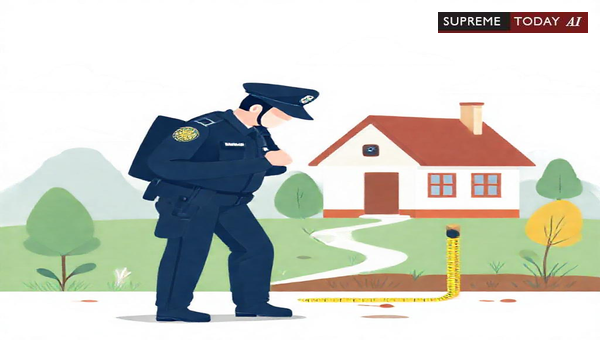
Rights Regarding Police Protection for Land Measurement During Pending Civil Suits and Title Disputes
Property disputes are among the most contentious legal battles, often involving deep-seated emotional attachments and significant financial stakes. When a landowner seeks to measure their land to establish boundaries or identify encroachments, the process can frequently escalate into physical confrontations. In such scenarios, the assistance of law enforcement is critical. However, a common point of contention arises when police authorities refuse to provide protection on the grounds that a civil suit is already pending in court.
The central legal question is: Police Protection Cannot be Refused for Measurement the Land on the Basis of Filing the Civil Suit. This issue touches upon the intersection of administrative duty and judicial proceedings, specifically whether a pending litigation over title or ownership can strip a party of the right to maintain law and order during a lawful measurement process.
The Legal Stand on Police Protection for Land Measurement
The judicial consensus is clear: the mere existence of a civil suit does not authorize the police to deny protection for land measurement. Courts have consistently held that police protection cannot be denied when land measurement is required, even if a civil suit is pending or there are disputes over ownership 2019 0 Supreme(Guj) 913 and 2021 Supreme(Online)(KER) 2915
Dhanam Ammal VS Varadarajan - Madras
.
The primary objective of police assistance in these cases is not to decide who owns the land—which is the role of the civil court—but to ensure that the measurement process occurs without violence. In cases involving land measurement or eviction, the courts have emphasized that police assistance is a necessity to ensure smooth proceedings, regardless of ongoing civil litigation or title disputes 2019 0 Supreme(Guj) 913.
Why Civil Suits Do Not Bar Police Assistance
It is a common misconception that once a matter is sub judice (under judicial consideration), the police must remain entirely hands-off. However, the law distinguishes between the adjudication of rights and the maintenance of peace. While the civil court determines the legal title to the property, the police are responsible for ensuring that no party takes the law into their own hands.
Legal precedence establishes that police protection is a facilitator of lawful civil proceedings, including measurements, construction, or eviction 2021 Supreme(Online)(KER) 2915 and 2019 0 Supreme(Guj) 913
Dhanam Ammal VS Varadarajan - Madras
. Therefore, police protection cannot be refused solely based on pending civil suits or title disputes because such protection is essential for maintaining law and order during property-related disputes
2021 Supreme(Online)(KER) 2915.
Furthermore, the courts have noted that disputes over land measurement, encroachments, or property boundaries are not valid justifications for denying police protection or court orders for measurement 2019 0 Supreme(Mad) 1592 and 2014 0 Supreme(Kar) 669 and 2019 0 Supreme(Guj) 913. Even if there are allegations of irregularities or collusion in the measurement process, these factors do not impede lawful intervention, especially when public or judicial interest is involved 021000133846.
Distinguishing Civil Disputes from Criminal Allegations
In many property disputes, parties attempt to escalate the matter by filing criminal complaints to pressure the opposing side. This is a critical area where the courts exercise caution to prevent the abuse of the legal process.
There is a recurring trend where a dispute between the parties is primarily civil in nature which has been given the colour of a criminal case, resulting in abuse of process 2018 0 Supreme(Ori) 712. For instance, when a party fails to execute a sale deed or return a deposit, some may allege cheating under Section 420 of the Indian Penal Code. However, courts have clarified that mere breach of contract cannot give rise to criminal prosecution for cheating unless fraudulent or dishonest intention is shown right at the beginning of the transaction 2018 0 Supreme(Ori) 712.
Similarly, the courts have ruled that for an offence of cheating to be established, the complainant must show a fraudulent or dishonest intention at the time of making promise or representation 2012 0 Supreme(Guj) 238. This distinction is vital because if a land measurement dispute is purely about boundaries or title, it remains a civil matter. The police cannot use the civil nature of the dispute as an excuse to avoid providing protection, nor should they be used to harass parties through unfounded criminal charges.
Key Takeaways for Landowners
When seeking police protection for land measurement, it is important to keep the following principles in mind:
- Facilitation, Not Adjudication: The police are there to maintain peace and facilitate the measurement process, not to determine who the rightful owner is.
- Civil Suits are Not Barries: A pending court case regarding the title of the land does not legally justify a police refusal to provide security during a scheduled measurement.
- Law and Order Priority: The maintenance of law and order is a primary duty of the police, which overrides the administrative convenience of avoiding a disputed area.
- Avoid Criminalization: Be aware that civil disputes regarding land should not be erroneously converted into criminal cases of cheating or breach of trust unless there is evidence of fraudulent intent from the inception 2012 0 Supreme(Guj) 238 and 2018 0 Supreme(Ori) 712.
In conclusion, the legal framework ensures that the pursuit of a civil remedy (a lawsuit) does not leave a party vulnerable to violence or obstruction during necessary procedural steps like land measurement. While the ultimate decision on ownership rests with the judiciary, the immediate requirement for peace and security is a matter for law enforcement. These principles generally suggest that police protection is an integral part of ensuring justice and order in property-related issues.
#LandLaw #PropertyDispute #PoliceProtection #LegalRights