


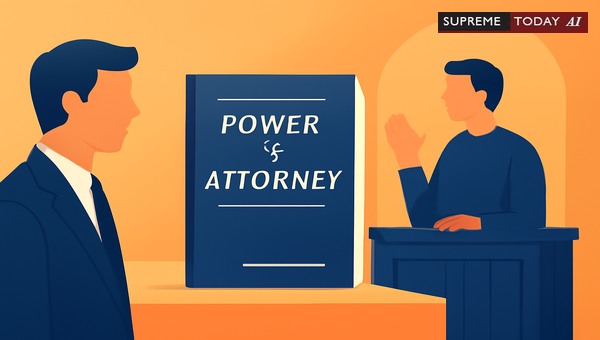
Can a Holder Enter the for the Main Plaintiff?
In legal proceedings, the question often arises: Can a witness come in the suit in the through before the main plaintiff? This issue is critical in civil suits where the principal (plaintiff or party) may be unavailable, and a (PoA) holder steps in. While a can assist, their role in giving evidence is strictly limited. This blog explores the legal boundaries, drawing from judgments and key precedents to provide clarity.
Understanding these rules helps litigants avoid procedural pitfalls and ensures evidence . Note: This is general information based on established case law and not specific legal advice. Consult a qualified lawyer for your case.
Main Legal Finding: Limited Scope of 's Testimony
Generally, a witness can give evidence in a suit through a , but only within the scope of acts and transactions authorized by the PoA. The cannot depose on matters solely within the of the principal unless the evidence pertains to acts or transactions performed by the under the granted authority. 2010 7 Supreme 209 2026 1 Supreme 225
Key points include:- A may depose only for acts or transactions done in pursuance of the PoA. 2010 7 Supreme 209 2026 1 Supreme 225- The cannot depose on matters of which the principal has exclusive . 2026 1 Supreme 225 2022 0 Supreme(MP) 618- Scope is limited to acts under PoA authority; they cannot speak on the principal’s behalf regarding or conduct. 2026 1 Supreme 225 2022 0 Supreme(MP) 618- Evidence from a is admissible only to prove acts or transactions in pursuance of the PoA, not facts solely within the principal’s knowledge. 2010 7 Supreme 209
This principle ensures the integrity of testimony, as requires .
Detailed Analysis: Clarifications
Scope of Holder’s Deposition
The in 2022 0 Supreme(MP) 618 clearly states:
The holder cannot depose in place and instead of the principal. He can only depose for the principal in respect of such acts, but he cannot depose for the acts done by the principal and not by him. Similarly, he cannot depose for the principal in respect of the matter which only the principal can have and in respect of which, the principal is entitled to be cross-examined.
This is reaffirmed in recent decisions like , which holds:
A Power-of-Attorney holder is thus, not entitled to depose in place of the principal... where the plaintiff refuses to testify, the proxies cannot substitute his personal testimony on key issues within the of the plaintiff. 2026 1 Supreme 225 2010 7 Supreme 209
Evidence in Court and the Role of the Principal
If the principal cannot appear, the may testify about PoA-related acts. However, for facts—like ownership, conduct, or state of mind—the principal must testify. 2026 1 Supreme 225 2010 7 Supreme 209
Supporting this, , referenced in 2020 0 Supreme(Ker) 51, rules that a general can appear, plead, and act but cannot become a witness on behalf of the party. No one can delegate the power to appear in the .
In rent control cases under , courts have faulted proceedings where the (e.g., wife) described herself as the respondent and the principal refused to testify, proving fatal to claims. 2020 0 Supreme(Ker) 51
Limitations and Clarifications from Case Law
PoA holders face strict limits:- Cannot depose on principal’s , conduct, or state of mind unless tied to PoA acts. 2026 1 Supreme 225- Evidence admissible only for PoA-exercised acts, not principal-exclusive facts. 2010 7 Supreme 209- Consistent across cases like 2022 0 Supreme(MP) 618 and 2023 0 Supreme(SC) 20.
In 2020 0 Supreme(MP) 461, it's trite law that a can enter the to a limited extent and cannot depose on facts without , especially if the principal isn't participating.
Further, in suits, plaintiffs examining PoA holders instead of themselves fails to prove —a matter of personal state of mind. As in one case, evidence of the holder in respect of matter of the plaintiff’s state of mind i.e. of his ... could not be admissible. 2018 0 Supreme(Raj) 154
Brij Mohan Divedi VS Shikhar Chand
In possession disputes, plaintiffs choosing PoA holders over entering the box themselves raised evidentiary issues under . 2019 0 Supreme(Kar) 1677
Exceptions and Practical Considerations
Limited exceptions exist:- Where the manages the entire transaction (e.g., family members), evidence on principal's intent may be accepted insofar as PoA acts. 2026 1 Supreme 225- Principal’s testimony remains necessary for facts like ownership or conduct. 2026 1 Supreme 225
Practically:- Courts scrutinize PoA evidence scope.- In eviction or injunction suits, non-examination of principals via PoA flaws proceedings. 2020 0 Supreme(Ker) 51 2019 0 Supreme(Kar) 1677
Recommendations for Litigants
- Ensure the principal testifies on matters; PoA cannot substitute.
- Limit PoA deposition to authorized acts/transactions.
- Courts must verify evidence aligns with PoA scope.
Key Takeaways
- PoA holders cannot fully replace principals in the —limited to their own PoA-performed acts. 2026 1 Supreme 225 2022 0 Supreme(MP) 618
- requires principal's testimony to withstand .
- Violations lead to evidence rejection, as seen in multiple precedents.
This framework upholds evidentiary fairness. For tailored advice, engage a legal professional familiar with your jurisdiction's nuances.
#PoAWitness #LegalTestimony #PowerOfAttorney















