


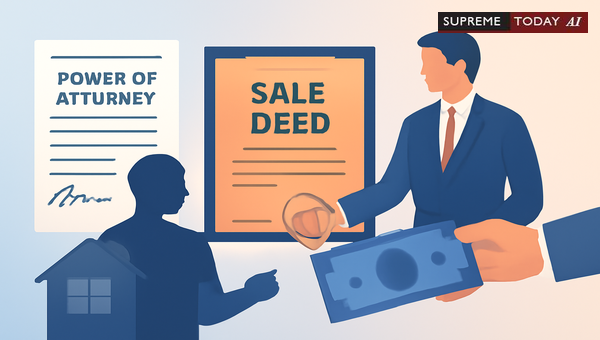
Effect of Attorney Paying Full Sale Consideration to Principal
In property transactions, (POA) are commonly used to authorize agents to handle sales on behalf of principals. But what happens when the attorney pays the whole consideration of the sale directly to the principal? This question often arises in disputes over , , and the obligations under the POA. Understanding the legal implications can prevent costly litigation and ensure smooth transactions.
This article delves into court interpretations, key findings from judgments, and practical recommendations. We'll examine scenarios where full payment strengthens or weakens claims, drawing from real case law. Note: This is general information based on precedents and not specific legal advice. Consult a qualified lawyer for your situation.
Understanding the Core Issue: Power of Attorney and Sale Payments
The query What Effect when Hole Consideration of the Sale has been Paid to the Principal by Attorney (likely referring to the full or whole consideration) highlights a critical aspect of in property sales. Under Indian law, a POA holder acts as the principal's agent, but the document's terms dictate their duties regarding sale proceeds.
Typically, when an attorney executes a and receives the consideration, they must account for it to the principal unless the POA specifies otherwise. Courts scrutinize:- Whether the POA mandates remitting proceeds to the principal.- Evidence of actual payment.- Impact on if payment is complete or partial.
Key Court Findings on Full Payment by Attorney
1. Absence of Stipulation in Power of Attorney
In cases where the POA lacks a clause requiring the attorney to pay sale proceeds to the principal, courts have ruled that the attorney may retain authority over the funds. For instance, the power of attorney did not include any stipulation requiring the attorney to pay the sale proceeds to the principal. This absence of a condition implies that the attorney had full rights to act on behalf of the principal without an obligation to remit sale proceeds back to the principal 2011 0 Supreme(All) 888.
This interpretation underscores that clear drafting is essential. Without explicit terms, the principal may lose claims to the proceeds post-sale.
2. Acknowledgment of Full Payment Validates Transactions
Conversely, when full payment is admitted, it bolsters the transaction's legitimacy. In another instance, it was acknowledged that the entire sale consideration was paid to the vendors through the power of attorney holder, indicating that the transaction was recognized as valid and complete 2021 0 Supreme(Mad) 3302.
Here, the court upheld the sale, emphasizing that payment through the POA holder fulfills the principal's obligations.
3. Trial Court Scrutiny of Evidence
Not all cases favor the attorney. Trial courts often demand proof of payment. The trial court found that the defendants failed to prove that the sale consideration was paid as claimed. The court emphasized that the power of attorney was executed only as security and that no valid sale transaction occurred without the actual passing of consideration 2022 0 Supreme(Mad) 3307.
This ruling highlights that mere execution of a without consideration transfer invalidates the deal.
Broader Implications from Related Judgments
Court decisions extend beyond POA specifics, influencing how full payments affect disputes:
Unpaid Portions and Statutory Charges: In disputes over incomplete payments, plaintiffs may claim a . Therefore, this court is of the that the some portion of the sale consideration has not been paid... The main legal point established in the judgment is the entitlement of the plaintiff to a for the unpaid sale consideration 2020 0 Supreme(Mad) 1287. The court allowed amendments to reflect this charge, permitting banks to proceed with sales subject to depositing proceeds.
of Consideration: Full payment claims can be challenged if misrepresented. A sum of Rs.1,00,000/- out of the sale consideration was paid... Remaining amount of the sale consideration was paid in cash... The main legal point... is the fraudulent nature of the , misrepresentation of sale consideration 2020 0 Supreme(Mad) 171. Courts dismissed appeals where evidence failed to prove ownership.
Plaintiff's Full Payment and Possession Rights: When buyers prove full payment, courts protect possession. The plaintiff has paid the entire sale consideration. The plaintiff having made out case, the suit premises need to be protected till final adjudication 2019 0 Supreme(Bom) 2135. A court receiver was appointed to secure the property.
and Valid Sales: Even with POA involvement, prior sales stand if consideration passed fully. Cases like 2017 0 Supreme(Mad) 3963 invalidated improper pre-emption claims, stressing that owners not governed by outdated codes (e.g., ) hold post-sale.
and Readiness: Plaintiffs ready to pay full consideration may seek alternatives if sellers default. The appellant-plaintiff was always ready and willing to perform his part of contract but the respondent-defendant has failed... Trial court has exercised discretion in granting alternative prayer 2017 0 Supreme(Raj) 2520.
These precedents show that full payment by or through an attorney generally validates sales, but disputes hinge on POA terms, evidence, and fraud absence.
Practical Implications of Full Consideration Payment
If the attorney pays the entire sale consideration to the principal:- Strengthens : It evidences completion, reducing cancellation risks 2021 0 Supreme(Mad) 3302.- No Automatic Remittance Obligation: Absent POA stipulations, proceeds aren't reclaimable 2011 0 Supreme(All) 888.- Risks if Payment Unproven: Courts may deem no sale occurred 2022 0 Supreme(Mad) 3307.
Key Factors Courts Consider:- POA wording.- Payment receipts/bank records.- Witness testimonies.- Conduct of parties (e.g., possession handover).
Recommendations for Principals and Attorneys
To mitigate risks:- Draft Clear POAs: Explicitly state payment obligations, e.g., Attorney shall remit full proceeds to principal within X days.- Document Everything: Use banker cheques, acknowledgments, and ledgers for payments.- Verify Transactions: Principals should monitor POA actions; attorneys must maintain accounts.- Seek Legal Review: Before sales, have lawyers assess POA scope.
Conclusion and Key Takeaways
The effect of an attorney paying full sale consideration to the principal typically affirms the transaction's validity but depends heavily on POA terms and proof. Courts prioritize contractual clarity and evidence, as seen in rulings like 2011 0 Supreme(All) 888 2021 0 Supreme(Mad) 3302 2022 0 Supreme(Mad) 3307. Partial or disputed payments invite charges or invalidation claims 2020 0 Supreme(Mad) 1287.
Takeaways:- Always include remittance clauses in POAs.- Collect robust payment evidence.- Act promptly on disputes to preserve rights.
For personalized guidance, consult a property law expert. Stay informed to safeguard your transactions.
References:- 2011 0 Supreme(All) 888- 2021 0 Supreme(Mad) 3302- 2022 0 Supreme(Mad) 3307- 2020 0 Supreme(Mad) 1287- 2020 0 Supreme(Mad) 171- 2019 0 Supreme(Bom) 2135- 2017 0 Supreme(Mad) 3963- 2017 0 Supreme(Raj) 2520
#PowerOfAttorney #PropertyLaw #SaleDeed















