


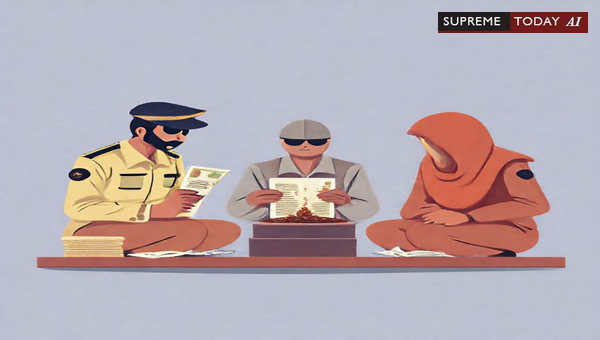
Why a Is Essential Before a Bribe Trap Under the Prevention of Corruption Act
When the () lays a trap to catch a public servant demanding a bribe, the operation does not begin at the moment money changes hands. It begins earlier — with a careful, documented preparatory stage known as the . A recurring question in bribery trials is why this preliminary document is treated as so important, and why its absence or deficiency can unravel an otherwise strong prosecution case.
The short answer is that the is the evidentiary foundation of the trap. It records, before the accused comes into the picture, the production of , their serial numbers, the application of , and the instructions given to the complainant and . Without this documented baseline, the prosecution struggles to prove the two foundational facts required under the — the .
What the Actually Records
The , typically prepared at the office in the presence of , serves several simultaneous functions:
- Production of tainted currency: The complainant produces the bribe amount before the officers and panchas. In one documented trap, PW No.1 produced tainted currency to the tune of Rs.10,000/- (nine notes of Rs.1000 denomination and two notes of Rs.500 denomination), and All the procedure about applying and testing it have been complied 2023 0 Supreme(Bom) 710.
- Recording serial numbers: The serial numbers of each note are noted. At the time of the post-trap search, notes recovered from the accused are matched against these numbers. Courts have noted that Serial numbers on the bank notes collected from the spot were verified with the serial numbers recorded in and were found to be same 2025 Supreme(Online)(Bom) 168097.
- Demonstration of the chemical test: The anthracene (or phenolphthalein) powder treatment is demonstrated, so that traces found later on the accused's hands can be linked to the notes handled during the trap.
- Instructions and signal arrangement: The pre-trap formalities include giving instructions, what is to be done at the time of actual trap, production of by the de-facto Complainant and demonstration about the and recording 2024 0 Supreme(Bom) 717.
This chain of documentation is what allows the court to connect money recovered from the accused to money the complainant carried into the trap — the very link that proves acceptance of a bribe rather than innocent possession of cash.
The Foundation for Proving Demand and Acceptance
Under and of the Prevention of Corruption Act, mere recovery of money from an accused is not enough. Courts have consistently held that proof of demand and acceptance is a for establishing the offence under the Act 2025 Supreme(Online)(Bom) 168097. The supports this proof in two ways:
- It establishes the complainant's readiness to pay in response to a prior demand, showing that the money carried into the trap was meant as gratification.
- It preserves an untainted record of the notes before the trap, so any anthracene traces or matching serial numbers found afterwards can only be explained by the accused having accepted those very notes.
Where this record is solid and corroborated by independent witnesses, courts have upheld convictions, observing that corroborated testimony of independent witnesses, supported by forensic evidence of chemical markers on the accused, can prove the offence 2025 Supreme(Online)(Bom) 168097.
How Defective Pre-Trap Panchnamas Lead to Acquittals
The case law is equally clear about what happens when the pre-trap stage is flawed. Several patterns of failure appear repeatedly:
- Contradictory dates of currency production: In one matter, the trial court disbelieved the tainted notes evidence because the notes were produced by the complainant not on 11th November, 2009, the date of the , but on 9th November, 2009 itself — a variance that cast doubt on the entire trap 2023 0 Supreme(Bom) 710.
- not present or not credible: Where a panch witness was not present at the , or where the complainant has resile from the contents of pre trap and verification of demand of bribe panchnama, the prosecution was held to have failed to establish the pre-trap stage 2021 0 Supreme(Bom) 1313
SATISH MURLIDHAR MAGAR vs THE STATE OF MAHARASHTRA
. - Uninformed panchas: In one acquittal, the panch witness admitted that he was not told by the officers about the accused and the case, till he was taken to the Juice Center, which throws serious doubt on the prosecution case about 2022 0 Supreme(Bom) 908.
- Discrepancies in note denominations: Where the pre-trap and post-trap panchnamas recorded one Rs.500 note and five Rs.100 notes, but the prosecution case suggested two Rs.500 notes were recovered, the apparent discrepancy undermined the case and the accused was acquitted 2020 0 Supreme(Bom) 1193 and 2020 0 Supreme(Bom) 974.
In each of these situations, the court's underlying reasoning is the same: a flawed pre-trap stage creates reasonable doubt about whether the money recovered was in fact the bribe demanded and accepted.
Panchnamas Are Corroborative, Not Substantive, Evidence
An important limitation is often overlooked. A panchnama — whether pre-trap or post-trap — does not prove the case by itself. As courts have held, A panchnama which can be used only to corroborate the panch has to be read over to the panch and only thereafter it can be exhibited 2022 6 Supreme 553. The panchnama must be supplemented by:
- the substantive testimony of the complainant and ;
- independent witness evidence of the demand, since mere recovery of money from the accused is insufficient for conviction without evidence of a demand 2022 0 Supreme(Bom) 2649; and
- consistent accounts of what happened on the day of the trap, because both demand and acceptance must be established through reliable and consistent evidence 2024 0 Supreme(Bom) 717.
This is also why the panchnama must be read over to the panch before it is exhibited — its value depends on the panch adopting and confirming its contents in court.
Practical Lessons from the Case Law
For investigators and complainants alike, the precedents suggest clear safeguards:
- Conduct the with strict procedural regularity — correct date, correct place, correct personnel.
- Record the serial numbers and denominations of every note accurately and ensure the matches.
- Ensure are genuinely independent, informed about the case, and present throughout the demonstration.
- Read the panchnama over to the panch and exhibit it only thereafter.
- Ensure the complainant's testimony remains consistent with the pre-trap record at every stage of trial, since retraction or resiling from the panchnama contents can be fatal to the prosecution.
Key Takeaways
The is necessary in anti-corruption cases because it freezes the evidentiary baseline of the trap — the tainted currency, its serial numbers, the chemical treatment, and the instructions given — thereby enabling the prosecution to prove the that the Prevention of Corruption Act requires. Time and again, courts have acquitted accused persons where this foundational document was inconsistent, procedurally defective, or uncorroborated 2023 0 Supreme(Bom) 710 and 2021 0 Supreme(Bom) 1313 and 2022 0 Supreme(Bom) 908. Conversely, where the pre-trap record is meticulous and supported by independent testimony and forensic markers, convictions have been sustained. This article is intended as general information about how courts treat pre-trap panchnamas and may not address the specifics of any individual case.
#PreventionOfCorruptionAct #AntiCorruption #BriberyTrap #Panchnama #CriminalLaw









