Searching Case Laws & Precedent on Legal Query.....!
Analysing the retrieved Case Laws
Scanned Judgements…!



Searching Case Laws & Precedent on Legal Query.....!
Analysing the retrieved Case Laws
Scanned Judgements…!
Intermittent Use Easement by Prescription - Main Points and Insights
Easement by Prescription Requires Continuous, Open, and Uninterrupted Use for 20 Years To establish an easement by prescription under Section 15 of the Indian Easements Act, the claimant must prove peaceful, open, and continuous use of the right for at least 20 years. Several judgments emphasize that mere use is insufficient unless these essential ingredients are proven through credible evidence, such as witnesses capable of testifying to the use during the statutory period.References: ["2023 0 Supreme(Ker) 988"], ["
Satheeshkumar S/o. Vasu VS Paul S/o. Cherur Vazhiyil Neelankavil Lazar - Current Civil Cases
"], ["2024 0 Supreme(Ker) 373"], ["2025 Supreme(Online)(Mad) 67808"], ["2025 0 Supreme(Kar) 463"]Burden of Proof and Evidence The burden lies on the claimant to prove their use of the pathway or property as an easement by prescription. Courts have consistently held that the absence of proper pleadings or failure to examine witnesses capable of confirming the use undermines the claim. The proof must demonstrate that the use was without permission, peaceful, and continuous for the statutory period.References: ["
Satheeshkumar S/o. Vasu VS Paul S/o. Cherur Vazhiyil Neelankavil Lazar - Current Civil Cases
"], ["2024 0 Supreme(Ker) 373"], ["2025 Supreme(Online)(Mad) 67808"], ["2025 0 Supreme(Kar) 463"]Permissive Use Cannot Ripen into Prescriptive Easement Use based on permission or license cannot develop into a prescriptive easement. If the use is permissive, it does not meet the requirements of adverse, open, and continuous use necessary for prescription. Courts have rejected claims where the use was deemed permissive or where the defendant proved exclusive or controlled use.References: ["2025 0 Supreme(Ker) 545"], ["2022 0 Supreme(Mad) 3676"], ["2025 0 Supreme(Kar) 696"]
Pleadings and Evidence Must Clearly State and Support Prescription Claim Courts require that the pleadings specifically allege the ingredients of prescription, and evidence must support these allegations. Failure to do so leads to dismissal of the claim. In some cases, even if the use was alleged, the absence of proof or proper examination of witnesses results in the denial of easement rights.References: ["2023 0 Supreme(Ker) 988"], ["
Satheeshkumar S/o. Vasu VS Paul S/o. Cherur Vazhiyil Neelankavil Lazar - Current Civil Cases
"], ["2023 0 Supreme(Raj) 561"], ["2024 0 Supreme(Mad) 1701"]Legal Distinction Between Easement of Necessity and Prescription Easement of necessity arises from the need for access at the time of property transfer and is different from prescription, which depends on long-term use. Courts have clarified that claims based on necessity are not equivalent to those based on prescription, and each requires different proof and pleadings.References: ["2025 0 Supreme(Kar) 696"], ["2025 0 Supreme(Ker) 545"]
Judicial Trends and Final Outcomes The consistent judicial stance is that easement by prescription is not automatically established by mere use; it must be proven with clear, credible evidence over the statutory period. Many judgments have reversed or dismissed claims where the use was not sufficiently established or was deemed permissive.References: Multiple sources including ["2023 0 Supreme(Ker) 988"], ["
Satheeshkumar S/o. Vasu VS Paul S/o. Cherur Vazhiyil Neelankavil Lazar - Current Civil Cases
"], ["2024 0 Supreme(Ker) 373"], ["2025 Supreme(Online)(Mad) 67808"], ["2023 0 Supreme(Raj) 561"]Analysis and Conclusion
Establishing an easement by prescription requires strict adherence to the legal criteria: continuous, open, peaceful, and adverse use for 20 years, supported by credible evidence and proper pleadings. Courts are vigilant in scrutinizing whether the use was permissive or adverse, with the general rule being that permissive use cannot ripen into a prescriptive easement. Many recent judgments underscore that failure to prove these elements results in dismissal of easement claims. Therefore, claimants must carefully prove their use through witnesses and documentation, ensuring their pleadings clearly articulate the ingredients of prescription under Section 15 of the Indian Easements Act.
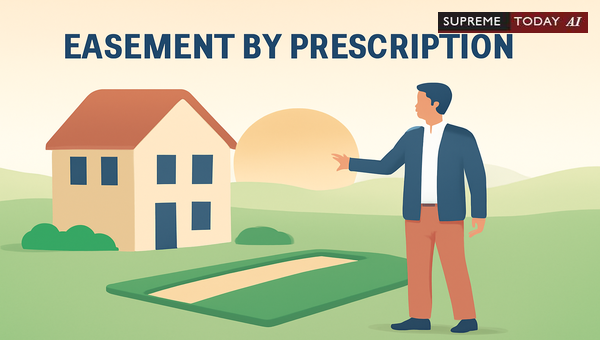
In property disputes, few issues spark as much contention as over neighboring land. Homeowners, farmers, and developers often clash over pathways, cart tracks, and access routes. A common question arises: Can of a pathway lead to an ? Recent judgments from Indian courts provide clear guidance, emphasizing strict requirements under the .
This blog delves into the legal principles, judicial trends, and practical strategies, drawing from authoritative precedents. Whether you're facing a boundary dispute or advising on property rights, understanding these nuances is crucial.
An allows someone to claim a legal right to use another's property after long-term, uninterrupted use. Governed by , it requires proving four essential elements:
Courts demand clear pleadings and categorical evidence to substantiate these claims. Vague assertions of 'many years' of use often fail 2023 0 Supreme(Ker) 988.
Intermittent or sporadic use is a frequent stumbling block. Courts consistently rule that such patterns do not meet the 'continuous and uninterrupted' threshold. For instance, in recent cases, claims were dismissed because plaintiffs couldn't prove open, peaceable use for the full statutory period 2017 0 Supreme(Ker) 1343.
One judgment highlighted: the plaintiff did not prove the pathway was used openly, peaceably, and without interruption for the statutory period, leading to dismissal of the easement claim 2017 0 Supreme(Ker) 1343. Similarly, where use was not 'continuous or as of right,' prescription rights were negated 2017 0 Supreme(Ker) 1343.
This trend underscores judicial scrutiny: , unless proven as-of-right and uninterrupted for , falls short2023 0 Supreme(Ker) 988.
Recent rulings reinforce these principles. Courts are dismissing claims reliant on sporadic access, prioritizing evidence of consistent enjoyment. In a notable appellate decision, the court rejected due to lack of proof of hostile, 2011 0 Supreme(Ker) 1009. It noted: the right of way by is the result of continuous and hostile use to the knowledge of the other person 2011 0 Supreme(Ker) 1009.
Another appeal allowed, overturning lower courts' findings on necessity and prescription. The reasoning? Precise and clear pleadings are mandatory for easement claims, as they are ''
Kallen Devi VS Raghavan
. The court stressed: Easement being a precarious right, the pleadings should be precise and definiteKallen Devi VS Raghavan
. Even assuming a pathway was the only access, missing ingredients like specific evidence doomed the claim.In , similar outcomes prevail. Plaintiffs claiming over tracks used 'for many years openly and uninterruptedly' succeeded only with robust evidence, unaffected by provisions where the Easements Act applies 1998 0 Supreme(Mad) 956.
Not all hope is lost if prescription fails. arises when a property lacks alternative access, rooted in equity rather than time 1964 0 Supreme(Ker) 347. Unlike prescription, it doesn't require of use—necessity at the time of property division suffices.
However, courts distinguish sharply. Mere inconvenience doesn't qualify; there must be no other viable 1997 0 Supreme(Mad) 589. Claims blending prescription and necessity can appear inconsistent, as one demands long use and the other absolute need 1997 0 Supreme(Mad) 589. In one case, lower courts favored both, but higher scrutiny revealed flawed pleadings, leading to reversal 2011 0 Supreme(Ker) 1009.
For example: Only on the ground of inconvenience an cannot be claimed when there are other ways of ingress and egress 1997 0 Supreme(Mad) 589.
Success hinges on meticulous preparation:
Kallen Devi VS Raghavan
.In a cart track , defendants countered successfully by proving prescriptive use, with courts upholding findings based on 1998 0 Supreme(Mad) 956.
To navigate these claims effectively:
Latest trends show courts favoring clear, consistent use over sporadic patterns2017 0 Supreme(Ker) 1343.
rarely secures —courts demand unbroken, open enjoyment for . Recent judgments, like those dismissing vague claims 2017 0 Supreme(Ker) 1343 2023 0 Supreme(Ker) 988, signal stricter enforcement. Where necessity applies, focus on absolute lack of access, not mere convenience 1997 0 Supreme(Mad) 589.
Key Takeaways:- insufficient without continuity proof.- Precise pleadings and evidence are non-negotiable.- Consider necessity as a fallback.
This article provides general insights based on public judgments and is not legal advice. Consult a qualified lawyer for your specific situation.
#EasementByPrescription #IndianPropertyLaw #LegalJudgments


Therefore, the use of the way is an impossibility and hence it could not be pleaded that the plaintiff used the said way and perfected easement by prescription. ... , and for twenty years, the right to such access and use of light or air, support or other easement shall be absolute. ... According to the plaintiff, plaint B schedule is the only way available to plaint A schedule property, on which the plai....

So, the use of plaint B schedule way to perfect right of easement by prescription i.e. 20 years is a matter to be proved by examining somebody, who is capable of deposing about its use, to hold that the same ripened into right of easement by prescription. 13. ... It was also found by the trial court that the plaintiff not established the use of plaint B schedule with e....

So, the use of plaint B schedule way to perfect right of easement by prescription i.e. 20 years is a matter to be proved by examining somebody, who is capable of deposing about its use, to hold that the same ripened into right of easement by prescription. 13. ... It was also found by the trial court that the plaintiff not established the use of plaint B schedule with es....

With regard to an easement by prescription, the defendant is required to prove that he was in peaceful, open and uninterrupted enjoyment of the right for a period of 20 years. Hence, the defendants failed to establish that they are entitled to use the passage by easement by prescription. ... Therefore, easement by prescription develop over time through continuous and op....

Further, once they had obtained a right to use the pathway through the lease deed their use after the expiry of the period will not convert into an easement by prescription. ... Anandavally Amma and Others] and contended that “Implied grant and the concept easement by prescription are quite antithetical to each other. ... They have also pleaded easement by pre....

Such permissive use could not be turned as easement by prescription. The learned counsel for the appellant cited the decision of this court in Cherootty Balan v. ... or prescription under S.15 of the Indian Easement Act?” ... The Regular Second Appeal is allowed in part, modifying the judgment and decree passed by the First Appellate Court by declaring that the additional plaintiffs are ....

According to defendant that pathway was for his exclusive use and plaintiff had no right over the same. Whereas plaintiff claimed easement by prescription, necessity as well as mamul right over that pathway. 17. ... Easements can be acquired by different ways and are of different kinds, that is, easement by grant, easement of necessity, easement by prescription, etc. ......

Easements can be acquired in different ways and are of different kinds, that is, easement by grant, easement of necessity, easement by prescription, etc. ... As observed above, the plaintiff failed to plead, and prove the right of easement by prescription. The first Appellate Court, without considering the said aspect, has passed an impugned judgment. ... The pleadings ....
The plaintiff sought for declaration of easementary right and other consequential relief by raising a plea of easement by necessity and easement by prescription. ... The point for determination framed by the first appellate Court is only with regard to the easement of prescription pleaded by the plaintiff. ... In such circumstances, based on the evidence of plaintiff's vendor alone, we cannot come to the ....

Assailing the impugned judgment and decree, learned Senior Counsel for the appellants submitted that the plaint is bereft of the necessary ingredients to constitute an easementary right by prescription as prescribed under Section 15 of the Indian Easement Act, 1882. ... The first submission made by the learned senior counsel for the appellants with regard to absence of necessary ingredients in the plaint to constitute easement#HL_....

2. Plaintiff filed suit for declaration of easement by prescriptionover C schedule pathway and consequential injunction. On account of the objection of non-joinder of parties, the 3rd defendant who is the wife of the 2nd defendant was impleaded in the suit. The 3rd defendant remained exparte. Easement by prescription requires proof of continuous use for the statutory period; mere permissive use does not establish a right. M.A.ABDUL HAKHIM, J. 1.The appellants are the defend....
The lower Appellate Court found in favour of easement of necessity and also by prescription. While easement of necessity has its origin in a statute, the right of way by easement by prescription is the result of continuous and hostile use to the knowledge of the other person. Both the Courts have found that the plaintiff cannot succeed on the claim of easement by necessity. That is the reason why the courts have always insisted that whenever a right of easement is claimed, th....
The lower Appellate Court found in favour of easement of necessity and also by prescription. That is the reason why the courts have always insisted that whenever a right of easement is claimed, the pleadings should be precise and clear and not vague. The lower Appellate Court found customary easement and easement by prescription. While easement of necessity has its origin in a statute, the right of way by easement by prescription is the result of continuous and host....

The plaintiffs and their predecessors in title have been using the said cart track for many years openly and uninterruptedly. The plaintiffs had perfected easement by prescription. After the advent of the Lower Bhavani Project in view of the stagnation of water and poor maintenance the said fences had fallen. According to the plaintiffs originally an old fence existed on both sides of the suit cart track.
He claims easement both by prescription and necessity. The sale deed was obtained in 1970, and the suit was filed in 1975. In this connection, we have already extracted the claim of the plaintiff over the cart track. The very claim by prescription and necessity is inconsistent.


An indispensable Tool for Legal Professionals, Endorsed by Various High Court and Judicial Officers
Please visit our Training & Support
Center or Contact Us for assistance

Scan Me!
India’s Legal research and Law Firm App, Download now!


For Daily Legal Updates, Join us on :



 Back to top


