


Cannot Retract a Promise: Key Case Laws Explained
In the world of contracts and agreements, a simple promise can carry significant legal weight. But what happens when someone wants to back out after the other party has relied on it? Many people ask: Find me Case Laws that a Person Could Not Turn Back on his Promise or Instruction to Another Person. This question strikes at the heart of and contract law principles, where often becomes impossible once acceptance or action occurs. This blog post dives into relevant case laws and legal doctrines, drawing from established sources to explain when promises bind parties—generally speaking, of course.
Whether you're a business owner sealing a deal or an individual acting on a verbal assurance, understanding these rules can prevent costly disputes. We'll explore core findings, key cases, and practical insights while emphasizing that this is general information, not specific legal advice. Consult a qualified attorney for your situation.
Main Legal Finding: Promises Once Accepted Are Hard to Retract
Generally, a person cannot unilaterally turn back on a promise or instruction once it has been accepted or acted upon, particularly when the other party has communicated reliance or changed their position. This stems from contract law principles like those in , where acceptance of performance from a third person can discharge the original promisor from liability, preventing subsequent enforcement of the promise .
Key points include:- Binding Acceptance: Once a promisee accepts performance or an instruction, the promisor may be estopped from denying or retracting it, especially if reliance occurred .- Silence Isn't Enough: In business contexts, mere silence or failure to respond to letters doesn't negate a promise; disputing it requires explicit action .- Actions Speak Louder: Proposals become upon acceptance, and subsequent actions (like approving a loan before valuation) create obligations that courts view as hard to rescind .
These principles ensure fairness, preventing one party from luring another into action only to pull the rug out later.
Principles from Contract Law
Under traditional contract formation, a proposal turns into a promise when accepted, binding the promisor. The documents highlight that when a proposal is accepted, it becomes a promise, and the promisor is bound . Courts have reinforced this by noting unethical practices—like approving loans pre-valuation—still create enforceable ties if acted upon.
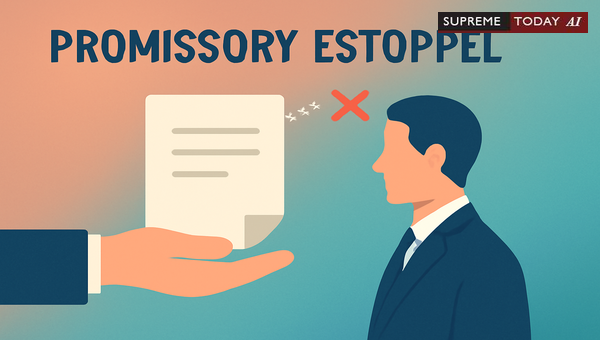
amplifies this: if a promise induces , the promisor typically cannot retract it. For instance, It is axiomatic that after holding out a promise, say a permission, the State, with its subsequent acts, cannot turn the situation adverse to the person who acted on the promise, much to his prejudice 2015 0 Supreme(Ker) 178. This doctrine protects those who alter their position based on the assurance.
Landmark Case Laws on Non-Retractable Promises
Several cases illustrate this unyielding stance:
and Silence as Non-Denial
In , the court held that the mere failure to answer letters does not serve as evidence corroborating a promise of marriage . Extended to business, if a letter states agreement terms, the recipient must respond to dispute it—silence implies acceptance, making retraction tough. Similarly, in , the absence of response to letters does not corroborate a promise of marriage, but in , written promises demand rebuttal .
State Promises and Estoppel
Against government entities, applies strictly. A plea of can be set up by a person against the State only when he is able to prove with adequate evidence that the State has promised him in writing in express terms to grant specific benefit and acting upon such promise he has altered his position. In such situation, the State cannot be allowed to go back to the promise made to such person 2015 2 Supreme 617. Here, a letter prescribing qualifications wasn't a direct promise, so estoppel failed—but the principle holds when reliance is proven.
In another municipal case, after accepting a tender and deposits, the couldn't resile: If representation or promise is made by State, if individual alters his position in pursuance of such representation or promise State can not be allowed to resile from its promise... MCH is bound by principles of 1999 0 Supreme(AP) 173. The petitioner, having paid deposits and displayed ads, enforced the three-year lease.
Building Permits and Supervening Events
A poignant example: After issuing a building permit, a municipality couldn't penalize construction when land acquisition followed. If a person's action becomes illegal owing to subsequent events, especially not at his own behest, but at the behest of the person or authority who calls it illegal, the person that acted bona fide... cannot... be penalised 2015 0 Supreme(Ker) 178. The wasn't irrevocable, but the authority's silence prejudiced the builder, invoking estoppel-like protection.
These cases show courts scrutinize reliance: Did the promisee act to their detriment? If yes, retraction is generally barred.
Exceptions and Limitations
Not all promises are ironclad. Exceptions may arise for fraud, misrepresentation, or lack of intent to bind—though not detailed in the sources . Silence alone rarely binds in non-business contexts, and promises must often be in writing against states 2015 2 Supreme 617. Always document agreements clearly.
Practical Recommendations
To navigate these waters:- Communicate Clearly: Use written terms to define promises and instructions.- Respond Promptly: Dispute disagreements explicitly to avoid implied acceptance .- Act Cautiously on Reliance: Before investing based on a promise, confirm in writing.- Invoke Estoppel Wisely: Prove written promises and detrimental changes, as in municipal tender cases 1999 0 Supreme(AP) 173.
Parties should recognize that once a promise or instruction is acted upon, it cannot be easily rescinded .
Conclusion: Honor Your Word, Legally Speaking
Case laws consistently affirm that retracting a promise after acceptance or reliance invites legal hurdles via and contract doctrines. From to modern estoppel against authorities 2015 0 Supreme(Ker) 178 2015 2 Supreme 617, the message is clear: Think twice before promising, as courts may hold you to it.
Key Takeaways:- Promises bind upon acceptance or action .- Silence doesn't negate in business; respond to dispute .- Estoppel protects reliance, even against states if proven 1999 0 Supreme(AP) 173.
This overview draws solely from cited documents for educational purposes. Legal outcomes vary by jurisdiction and facts—seek professional advice tailored to your case.
References:1. – Core contract principles and cases like .2. 2015 0 Supreme(Ker) 178 – State promises and building permits.3. 2015 2 Supreme 617 – against State.4. 1999 0 Supreme(AP) 173 – Municipal tender estoppel.
#PromissoryEstoppel, #ContractLaw, #BindingPromises















