


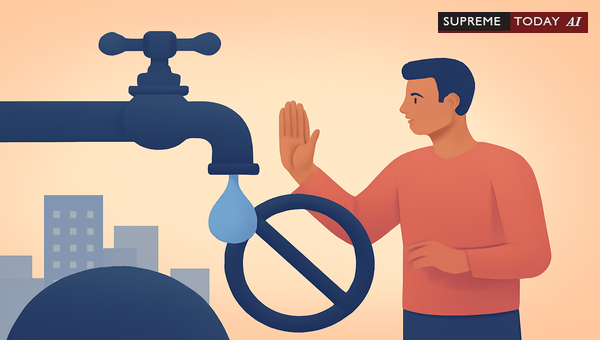
IPC Sections for Stopping Someone from Taking Water: A Comprehensive Guide
In rural and urban India alike, disputes over water access are common, especially in areas where shared resources like wells, canals, or reservoirs are involved. Imagine trying to irrigate your crops or quench your family's thirst, only to be stopped by a neighbor or authority. What IPC section applies to stopping someone from taking water? This question arises frequently in water-scarce regions, and understanding the legal framework can help protect your rights.
This blog post breaks down the relevant provisions of the , drawing from key legal precedents and statutes. Note: This is general information based on legal principles and is not a substitute for professional legal advice. Consult a lawyer for your specific situation.
Understanding the Legal Issue
Water is a vital resource, and interfering with someone's rightful access to it can constitute a criminal offense. The query Stopping Someone to Take Water which Section of IPC typically involves acts like blocking a flow, physically preventing access, or diverting supply, often leading to charges of . Courts examine intent, the nature of the water source (agricultural, drinking, etc.), and resulting harm.
Key offenses fall under provisions, but depending on circumstances, other sections like or endangering life may apply. Let's explore the primary sections.
Core IPC Provisions: Sections 425 and 430
: Definition of
defines as whoever with intent to cause, or knowing that he is likely to cause, or damage to the public or to any person, destroys or moves any property to such an extent that it causes alteration in its value or quantity, or denies its lawful owner use or possession.
- Applying to water disputes: If someone stops the flow of water to which another has a right, it can be considered under this section1965 0 Supreme(AP) 170. For instance, blocking a shared channel or tap constitutes damage to property rights in water.
- Punishment: Up to 3 months imprisonment, fine, or both (enhanced if value exceeds ₹50).
- Insight from case law: Water has to be utilised in a proper manner and wastage of water is also an offence under Section 425 of IPC. Therefore, without getting permission, water cannot be tapped or taken away and such act amounts to an offence of under .2022 0 Supreme(Mad) 17
: Causing Diminution of Water Supply
This is the most directly applicable section for water-related . punishes whoever commits by doing any act which causes, or is likely to cause, a for agricultural purposes, or for food or drink for human beings or animals, or for purity of water for the purposes aforementioned.
Essential ingredients:- The act must cause or be likely to cause a reduction in water supply1969 0 Supreme(Ori) 246 1969 0 Supreme(Ori) 246.- Water must be for essential purposes (agriculture, drinking, etc.).- Done with knowledge of consequences.
- Punishment: Up to 5 years imprisonment and/or fine.
- Application: Stopping someone from taking water, if intentional and causing , falls here. For example, diverting a stream or closing a valve affecting a field's irrigation.
Additional IPC Sections in Water Obstruction Cases
Water disputes often involve more than . Courts invoke these based on facts:
:
If stopping someone physically prevents them from proceeding in a direction they have a right to, it's . Stopping someone from accessing water or obstructing their movement can be considered if it causes unlawful restriction2022 0 Supreme(SC) 1243.- Punishment: Up to 1 month imprisonment, fine up to ₹500, or both.
: Act Endangering Life or Personal Safety
Actions like stopping water flow or obstructing water access may fall under this if they threaten safety. Courts have considered actions like stopping water near a reservoir as potentially falling under Section 336, especially if it posed danger to others2025 Supreme(Online)(HP) 6782.
:
If obstruction leads to death (e.g., dehydration or crop failure indirectly), negligence charges apply. Courts have invoked this when water obstruction results in death due to negligence, even without direct physical injury2025 Supreme(Online)(HP) 6782.
: Acts Done by Several Persons in Furtherance of
When multiple people act together to stop water, Section 34 applies for 2025 Supreme(Online)(HP) 6782.
Other mentions:- (): Unauthorized tapping or taking water without permission 2022 0 Supreme(Mad) 17.- : , rendering it less fit for use 2012 0 Supreme(Ker) 16. For the purpose of , it is sufficient, if a person voluntarily corrupts or fouls the water to render it less fit for the purpose for which it is ordinarily used.
Insights from Case Law and Other Sources
Real-world cases illustrate applications:- In a dispute, when a person objected to another taking water as per turn, it led to violence, highlighting turns in shared supplies 2010 0 Supreme(Mad) 4405. When he was about to take water, both the accused objected to the same, and P.W.1 made a request that he could be allowed to take water at least for half an hour.- Stopping the flow of water prompted FIRs, with counter-claims of assault
. It is further submitted that on stopping the flow of water, the opposite party no.3 had beaten the applicants...- Unauthorized drains stopping water near reservoirs invoked charges
. The charge... by 'forming out a drain and stopping the same few yards away from the Hiyare Reservoir road, an offence punishable under ...
Municipal and water laws add layers:- Municipal by-laws prohibit unauthorized cutoffs
RAMEN CHETTY v. THE KANDY
.- : Interference requires authorized complaints 2024 0 Supreme(P&H) 255 2025 0 Supreme(Telangana) 38.Practical Application and Evidence Gathering
To prosecute:1. Prove right to water (e.g., via panchayat records, turns).2. Document intent and harm (photos, witnesses).3. File FIR under relevant IPC sections.
If intentional harm to supply, prioritize Section 430; for general damage, Section 4251969 0 Supreme(Ori) 246 1965 0 Supreme(AP) 170. Courts quash weak FIRs lacking procedure 2024 0 Supreme(P&H) 255.
Conclusion and Key Takeaways
Stopping someone from taking water may constitute under Sections 425 or 430 IPC, with additional charges like 341, 336, or 304-A depending on harm and intent. Always gather evidence of rights and malice.
Key Takeaways:- Primary sections: 425 (general ), 430 (water diminution).- Context matters: Physical restraint (341), group acts (34), negligence (304-A).- Seek amicable resolution first, but know your legal options.- Equal distribution is key; wastage or unauthorized diversion is punishable 2022 0 Supreme(Mad) 17.
For tailored advice, contact a local lawyer. Stay informed on water rights to avoid disputes.
References:- 1969 0 Supreme(Ori) 246 1965 0 Supreme(AP) 170 2022 0 Supreme(Mad) 17
2010 0 Supreme(Mad) 4405
2025 Supreme(Online)(HP) 6782 2022 0 Supreme(SC) 1243 2012 0 Supreme(Ker) 16 #IPCLaw, #WaterRightsIndia, #LegalDisputes


![Minister of Water and Sanitation and Others vs Lotter NO and Others ; Minister of Water and Sanitation and Another vs Wiid and Others ; Minister of Water and Sanitation and Others vs South African Association for Water User Associations and Others [2023] ZACC 9 - 2023 Supreme(SA)(ZACC) 12](https://cdn.supremetoday.ai/static/img/news-place-holder.png)












