


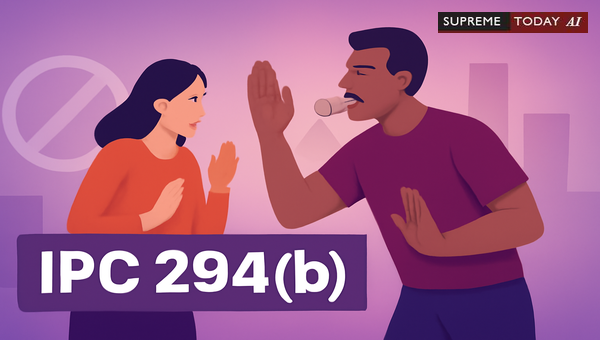
Essential Ingredients to Attract IPC Section 294(b) Explained
In today's bustling public spaces, incidents involving offensive language or behavior often lead to police complaints under various sections of the (IPC). One commonly invoked provision is , which targets and songs that annoy others in or near public places. But what exactly are the essential ingredients to attract Section 294(b) in IPC? Not every abusive outburst qualifies—courts demand specific elements to be proven.
This blog post breaks down the statutory requirements, judicial interpretations, and real-world applications, drawing from key case laws. Whether you're facing such charges or simply seeking legal clarity, understanding these ingredients can prevent misuse of the law. Note: This is general information and not specific legal advice. Consult a qualified lawyer for your situation.
What is Section 294(b) of the IPC?
criminalizes or utterances in public to protect . The provision states: Whoever, to the annoyance of others, does any obscene act in any or sings, recites or utters any obscene song, ballad or words in or near any , shall be punished.2024 0 Supreme(Ker) 798
This section balances maintaining social order with protecting free speech, requiring prosecutors to establish three core ingredients:
1. Obscene Act, Song, or Words
The act or words must be obscene, meaning , , or appealing to —typically with a sexual connotation that tends to deprave or corrupt those who encounter it. Mere abusive or vulgar language doesn't suffice unless it arouses sexually impure thoughts.
For instance, courts have clarified: It may be merely abusive, humiliating or defamative words which would not attract the under section 294 of IPC.
The statements of witnesses must disclose ingredients like obscenity, not just general abuse.
In another ruling: However, in order to attract the under , the words uttered by a person should have annoyed others. Mere abusive, humiliating or defamative words cannot attract an under .2024 Supreme(Online)(MAD) 13730
2. In or Near a
The offense must occur in any or near one. is interpreted broadly to include streets, markets, parks, or areas accessible to the public, even adjacent spaces. The judiciary has emphasized that should be interpreted liberally to include areas near public places.2024 0 Supreme(Ker) 798
3. Causing Annoyance to Others
Crucially, the obscene act must cause annoyance—discomfort, irritation, or disturbance—to others present. This is subjective but requires evidence of actual impact, not mere potential. The essential ingredient to attract the provision under Section 294(b) of I.P.C., the essential ingredient is an obscene act must have been done... to the annoyance of others.
Balu vs The Inspector of Police
Even, for attracting the under , there must be a sufficient proof to establish that the words uttered by the accused person annoyed others.2024 Supreme(Online)(MAD) 13730
Judicial Interpretations and Landmark Cases
Indian courts adopt a cautious approach, quashing frivolous cases where these ingredients aren't met. Let's examine key precedents:
Case Highlight: Mere Abuse Doesn't Equal Obscenity
In a pivotal ruling, proceedings were quashed because the words used, although abusive, did not meet the threshold of obscenity because they did not arouse sexually impure thoughts.2024 0 Supreme(Ker) 798 The court stressed context and lack of sexual connotation. 2024 0 Supreme(Ker) 798
Similarly: Section 294(b) of IPC is made out. Therefore, no case is made out as against the petitioner to attract the under Section 294(b) of IPC. Section 294(b) of IPC, there must be an uttering of words to affect the person who lodged the complaint.2025 Supreme(Online)(MAD) 12658 The absence of evidence and witnesses led to , as mere abusive words do not constitute an under Section 294(b) of IPC.2025 Supreme(Online)(MAD) 12658
Broader Applications and Quashing Trends
In cases involving alleged during disputes: There is absolutely no filthy language mentioned in the complaint to attract the under Section 294(b) of IPC.2021 0 Supreme(Mad) 2998 Courts refuse to interfere only if blatant non-sustainability is evident, but here, lack of obscene specifics doomed the charge. 2021 0 Supreme(Mad) 2998
Another instance quashed charges under , etc., noting no obscene words were uttered to annoy others, thus failing to establish the offences under Sections 294(b) due to lack of evidence and no lake (contextual mismatch). Mere abuse wasn't obscenity. 2025 Supreme(Online)(MAD) 12658
In a corporate dispute turned criminal: Proceedings under 294(b) were quashed for lack of evidence showing that the petitioner used words that annoyed the complainant.2024 Supreme(Online)(MAD) 13730
These cases illustrate courts' insistence on proof: The statements of the witnesses recorded under does not disclose any ingredient which may attract the under section 294 of IPC.
Strengths, Limitations, and Balancing Free Speech
Strengths of Section 294(b)
- Protects from conduct.
- Broad definition covers diverse scenarios. 2024 0 Supreme(Ker) 798
- Judicial scrutiny prevents abuse.
Challenges
- Subjectivity: Obscenity and annoyance can vary culturally, risking misuse.
- Abuse vs. Obscenity Gap: Mere abusive language alone does not fulfill the obscenity requirement.2024 0 Supreme(Ker) 798
- Free Speech Tension: Must align with .
Recent trends favor restriction: Clear evidence of lewdness and annoyance is mandatory, curbing malicious FIRs.
Key Takeaways for Avoiding or Defending Charges
- Ingredient Checklist:
- Prove obscenity (sexual/lewds, not just abuse).
- Confirm public/near-public location.
Show actual annoyance via witnesses.
If facing charges, highlight lacks like no filthy language... to attract Section 294(b).2021 0 Supreme(Mad) 2998
Prosecution tip: Witness statements under CrPC 161 must specify obscene content and impact.
Conclusion
To attract , all three ingredients—obscene act/words, public setting, and annoyance—must align. Courts consistently quash cases reliant on mere abuse, as seen in rulings like 2024 0 Supreme(Ker) 798, 2025 Supreme(Online)(MAD) 12658, and others. This safeguards rights while upholding decency.
Stay informed, but for personalized guidance, reach out to a legal expert. Understanding these nuances empowers better navigation of India's legal landscape.
References: Integrated case IDs above represent judicial excerpts on elements.
#IPC294b, #ObsceneActsIPC, #IndianPenalCode












