


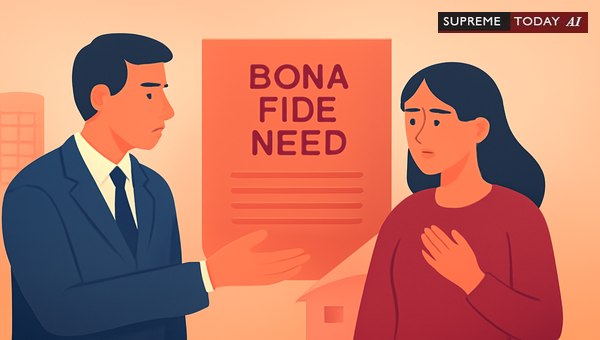
Understanding in Eviction Cases: Testing Relevancy
Eviction disputes between landlords and tenants often hinge on the landlord's claim of —a genuine, sincere requirement for the property. But how do courts determine if this need is real or merely a pretext? The question of Relevancy Pn arises frequently, probing whether a witness's testimony truly supports the landlord's case. In rent control jurisdictions across India, such as under the or , proving this need is crucial for eviction orders.
This post breaks down the legal principles, key strategies to test relevancy, and insights from landmark cases. Note: This is general information and not specific legal advice. Consult a qualified attorney for your situation.
What Constitutes ?
refers to a landlord's honest, present requirement for the premises, either for personal use, family occupation, or business expansion. Courts emphasize it must be natural, real, sincere, and honest, not whimsical or fanciful. As held, The bona fide requirement must be and must be manifested in actual need which would evidence the court that it is not a mere fanciful or whimsical desire. 2024 0 Supreme(Pat) 203
Key elements typically include:- Present necessity: The need should exist at the time of filing, not speculative. For instance, a Non-Resident Indian's desire to return and start a business may qualify if genuine 2017 0 Supreme(Ker) 1392.- No suitable alternatives: Landlords must show lack of other accommodations 2023 0 Supreme(Del) 839.- Liberal construction for family: Requirements for family members are often covered 2025 4 Supreme 565.
Failure to prove these can doom an , as seen where a landlady's conduct—installing a water tank without prior mention of need—undermined her claim 2024 0 Supreme(Pat) 203.
Relevancy in Proving : Strategies
To challenge or affirm relevancy, courts scrutinize witness testimony through targeted questions. These probe credibility, bias, timeline consistency, and supporting evidence. Here are 10 essential questions commonly used to test a witness's account of :
Clarify circumstances: Can you clarify the specific circumstances under which you claim the arose? Were there any other alternatives available at that time? This checks if the need is immediate and without options.
Timeline alignment: You mentioned in your statement that you were present during the events in question. Can you explain how your recollection of those events aligns with the timeline provided by other witnesses? Inconsistencies can discredit claims 2025 4 Supreme 565.
Personal relationships: Is it correct that you have a personal relationship with the party involved in this case? How might that relationship influence your testimony? Bias is a red flag.
Source of knowledge: You stated that you had firsthand knowledge of the situation. Can you detail how you came to acquire that knowledge, and were there any factors that might have affected your perception at the time?
Prior discussions: Have you ever discussed your testimony with anyone prior to today? If so, who were you speaking with, and what was the nature of those discussions? Coaching can undermine relevancy.
Documentary support: In your testimony, you indicated that certain documents support your claims. Can you provide those documents, and are there any discrepancies between what you claim and what those documents show?
Determination of need: You mentioned that you were aware of the for the transaction. Can you explain how you determined that need and whether you consulted with anyone else regarding it? Experience isn't required, but reasoning must be sound 2024 0 Supreme(Pat) 203.
Reconciling contradictions: Are you aware of any other witnesses who have provided a different account of the events? How do you reconcile those differences with your own testimony?
Qualifications: What qualifications do you have that lend credibility to your understanding of the in this context? Have you received any formal training or education related to this matter? 2015 0 Supreme(Del) 4028
Acknowledging biases: Can you acknowledge any potential biases that may affect your testimony, particularly regarding your interests in the outcome of this case?
These questions ensure testimony is relevant by linking it directly to proven facts, avoiding extraneous details.
Insights from Key Case Laws
adopt a practical approach to , asking: whether in the given facts proved by the material on record the need to occupy the premises can be said to be natural, real, sincere, honest. If the answer be in the positive the need is bona fide. 2015 0 Supreme(Del) 4028 2014 0 Supreme(Del) 1968 2015 0 Supreme(P&H) 443
Bihar Case: A landlady failed to prove need as notices omitted personal necessity initially, and her son's statement was incorrect 2024 0 Supreme(Pat) 203.
: Even low-income landlords with family needs prevail if genuine, especially against long-term tenants without alternatives 2025 4 Supreme 565. Tenants clinging for 63 years post-lease expiry lost.
: Landlord-tenant relationship, no alternatives, and genuine business need (e.g., storage) upheld eviction 2023 0 Supreme(Del) 839 2014 0 Supreme(Del) 1968. A shop for readymade garments was deemed bona fide for an elderly owner.
Kerala Act: Prospective needs like reconstruction or NRI return can qualify if sincere 2017 0 Supreme(Ker) 1392.
Sub-letting and Personal Use: Courts uphold eviction if need is honest, distinguishing from pretext 2015 0 Supreme(P&H) 443 2014 0 Supreme(Sikk) 91.
In one instance, a landlord's requirement for a nursing home, backed by qualified family doctors, was affirmed 2014 0 Supreme(Sikk) 91. Conversely, negative wealth or low income strengthens claims if documented 2025 4 Supreme 565.
Challenges and Tenant Defenses
Tenants often counter by proving:- Alternate accommodations exist.- Need is not or pretextual.- Witness biases or inconsistencies.
Courts guard against pedantic views, favoring realities of life 2015 0 Supreme(Del) 4028. Long-term tenancies (e.g., 73 years) don't automatically prevail if need is proven 2025 4 Supreme 565.
Key Takeaways
- Prove sincerity: demands current, honest intent, tested via evidence and .
- Use cross-questions wisely: The 10 questions above target relevancy, credibility, and biases.
- Learn from cases: Notices, documents, and lack of alternatives are pivotal 2024 0 Supreme(Pat) 203 2023 0 Supreme(Del) 839.
Landlords should document needs early; tenants, seek alternatives. For tailored guidance, reach out to a local expert. Stay informed on evolving rent laws to protect your rights.
Word of caution: Laws vary by state—e.g., Delhi vs. Bihar. This overview draws from precedents but isn't exhaustive.
#BonaFideNeed, #EvictionLaw, #RentControl












