


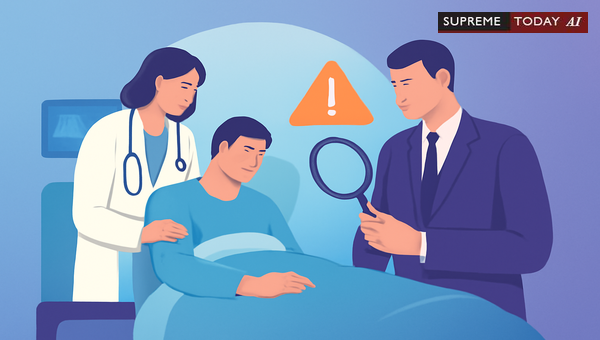
Proving : The Crucial Role of Expert Opinion
In the realm of consumer protection law, particularly in cases involving , one persistent question arises: Complainant to Prove Deficiency of Service by Expert Opinion. Can allegations of substandard medical care or service deficiency stand without robust evidence? Courts in India, under the , have repeatedly emphasized that mere claims are insufficient. This blog post delves into the legal requirements, landmark case insights, and practical recommendations to help you understand this vital principle.
Whether you're a patient facing alleged malpractice or a legal professional building a case, grasping the is essential. Note that this article provides general information based on judicial precedents and is not specific legal advice—always consult a qualified attorney for your situation.
Understanding the in Deficiency Cases
The foundation of any successful consumer complaint alleging , especially , rests with the complainant. Courts consistently hold that the complainant holds the to establish claims of and . Without sufficient evidence, particularly expert opinion, allegations cannot be substantiated
.
This principle ensures that subjective accusations do not override professional standards. As one ruling states, Mere allegation of negligence will be of no help to the complainant. It is settled law that it is for the complainant to prove the negligence or by adducing or opinion and this fact is to be proved
.
In practice, this means complainants must demonstrate:- A deviation from the accepted .- linking the deficiency to harm.- Quantum of damages, if applicable.
Failure to meet this threshold often leads to dismissal, as seen in multiple decisions.
Why Expert Opinion is Indispensable
is not optional—it's deemed crucial in cases of . Courts require it to evaluate complex medical standards that laypersons cannot assess. Allegations must be supported by proving the and any deviations
.
The absence of such evidence has doomed many complaints. For instance, The complainant has failed to produce any expert opinion. If that be the position, we are of considered opinion that the principles laid down in the above-mentioned decisions are very much applicable to the instant case
. Similarly, in a case involving orthopedic surgery, the court dismissed the complaint because without , the complainant could not prove or
.
From other precedents:- There is virtually no evidence of expert adduced by the complainant/Company. It was duty of the respondent/complainant-Company to get the car inspected from expert from the field
. Though not medical, this underscores the broader application to service deficiencies.- The respondent No.1 / complainant was largely responsible to prove her allegations and was required to produce some cogent evidence either by way of expert opinion or any medical literature
.
These cases illustrate a pattern: courts demand objective validation over personal narratives.
Key Case Studies Highlighting the Requirement
Defective Shoe and Allegation
In a notable instance, a complainant alleged due to a defective shoe, but the court dismissed the appeal due to lack of expert opinion, reinforcing the necessity of
.
Orthopedic Surgery Mishap
Another case involved post-surgery complications where, absent , claims of negligence failed outright
.
Gynecological Treatment Dispute
Considering the entirety of the case, the is qualified gynecologist, who treated the patient as per reasonable and . There is no merit in the instant . I do not find any negligence on the part of doctor. The complainant has not produced any expert opinion to prove its case
. Here, the was dismissed.
Eye Surgery and Failed Proof
In an eye surgery negligence claim, the court held: the complainant failed to prove negligence in the surgery by providing . It emphasized the need for expert opinion to establish
. The appeal succeeded for the doctor.
Pregnancy and Delivery Tragedy
Contrastingly, where expert opinions were present, liability was apportioned. Hospitals were held negligent for failing tests and timely care, backed by medical records, testimonies, and expert opinions
. This shows expert input can sway outcomes positively.
These examples span and highlight consistency across jurisdictions.
Qualifications of the Expert: A Critical Factor
Not just any opinion suffices. It is essential that the expert providing the opinion is qualified in the relevant specialty. An expert in forensic medicine, for example, may not opine on unrelated fields, leading to rejection
.
Courts scrutinize credentials to ensure reliability. The complainant has not filed any expert opinion, therefore, for want of expert opinion, merely on the basis of averments made by the complainant in the complaint, it is not sufficient
.
Broader Implications from Additional Precedents
Even in non-medical service disputes, like insurance schemes, proof burdens apply. Complainant miserably fails to prove that Dr.Jalil Muzawar’s Hospital is included in . Secondly, complainant fails to prove that there is deficiency of service by the respondent side
.
In tooth treatment cases, absence of led to dismissal: Petitioner has failed to establish that RCT was responsible for bone injury or breaking enamel
.
These reinforce that across consumer law, expert validation is key for technical deficiencies.
Practical Recommendations for Complainants
To strengthen your position:- Obtain expert opinions early from specialists in the relevant field.- Ensure the opinion directly addresses the claims, including , breach, and .- Corroborate with medical records, literature, or tests.- Prepare comprehensively, as the has to be distinguished from the tortuous acts of the respondent
.
Conclusion and Key Takeaways
Proving deficiency of service, particularly in , hinges on expert opinion. Courts dismiss unsubstantiated claims to protect professionals while upholding consumer rights 2004 0 Supreme(Cal) 715
. Key takeaways:- Burden lies with the complainant.- from qualified specialists is mandatory.- Absence weakens cases fatally.
By heeding these principles, complainants can better navigate . References include
,
,
,
,
,
,
,
,
,
,
,
.
For personalized guidance, reach out to a legal expert. Stay informed, stay protected.
#MedicalNegligence #ExpertOpinion #ConsumerRights















