


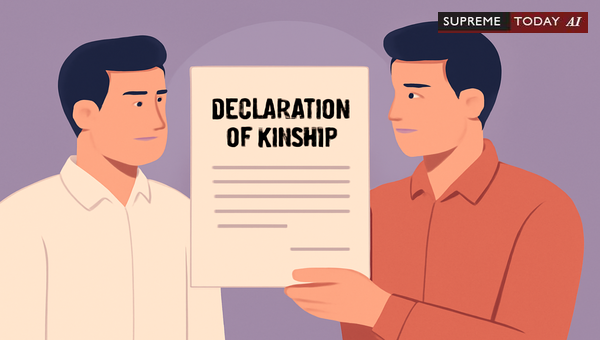
Declaring Kinship: Can a Person Prove They Are a Deceased Brother Despite Different Surnames?
In family disputes, inheritance claims, or succession matters, proving blood relations can be crucial. But what happens when surnames differ? Can you still seek a court declaration that a person is the brother of a deceased individual? This question arises frequently in Indian legal contexts, especially involving property rights or heirship. While surnames often signal lineage, they aren't absolute barriers to establishing kinship. This post explores the legal pathways, principles, and evidence required, drawing from established case law and statutes.
Important Disclaimer: This article provides general information based on legal principles and precedents. It is not legal advice. Consult a qualified lawyer for advice tailored to your situation.
The Core Legal Question
Whether a declaration can be sought that a person is the brother of a dead person with a different surname? The short answer is yes, it is possible, but success hinges on robust evidence. Courts recognize that surnames can vary due to adoption, marriage, personal choice, or regional customs, without severing familial ties. 2022 6 Supreme 675
Key Legal Principles Governing Kinship Declarations
Surname vs. Actual Kinship
A surname typically indicates lineage and family identity, reflecting social and cultural realities. However, the law doesn't treat it as conclusive proof. Courts have held that differences in surnames do not inherently negate brotherhood or other relations, provided other evidence substantiates the claim. 2022 6 Supreme 675 1971 0 Supreme(SC) 234
For instance, in succession or heirship disputes, plaintiffs must demonstrate biological or legal ties through documents like birth certificates, school records, or family testimonies, even if names diverge.
Role of in Proving Relationships
play a pivotal role under . These statements, made by a deceased person regarding the cause of their death or related circumstances, are admissible if voluntary and made in a fit mental state. 2001 5 Supreme 26 2013 4 Supreme 595
Courts scrutinize such declarations for credibility, considering factors like the declarant's mental condition and witness presence. In one case, the prosecution introduced from a younger brother and his wife, emphasizing voluntariness and truthfulness as the ultimate test. 2024 0 Supreme(Cal) 470
Oral , while admissible, are weaker and demand corroboration. As noted, oral are weak evidence and require corroboration, particularly in the absence of direct evidence and clear motive. 2023 0 Supreme(Bom) 2114
Another ruling clarified: It is not necessary that the dying declaration must be recorded by a Magistrate or a police officer or a doctor. A dying declaration can be made to any person including a close relative of the deceased. 2015 0 Supreme(Ker) 562
Establishing Kinship Through Evidence
To succeed in a declaration suit, gather:- Documentary proof: Birth records, ration cards, voter lists showing family links.- Testimonies: From relatives or neighbors confirming the relationship.- Corroborative evidence: Photos, school admissions, or property documents listing siblings. 1966 0 Supreme(SC) 173 2024 1 Supreme 269
Courts require this to overcome surname discrepancies. In a case involving identity disputes, liberty was granted to file a civil suit for declaration that two persons with similar but disputed names were the same, highlighting the need for intervention when claims are contested. 2024 Supreme(Online)(MP) 42446
Relevant Case Law Insights
Indian courts have addressed surname variances in kinship claims multiple times:
Dying Declaration Reliability: In a murder conviction under , the court relied on a dying declaration by the wife of the deceased's younger brother, corroborated by forensics. This underscores how family-related can establish relations and facts. 2024 0 Supreme(Cal) 470
Evidentiary Caution: Convictions based solely on statements treated as were overturned if unclear, e.g., ambiguity in identifying a brother-in-law. 2022 0 Supreme(Chh) 475 The court noted: it is not clear as to which brother-in-law deceased was pointing out.
and Succession: In heirship matters, courts allow under without formal presumed death decrees, facilitating kinship proofs in property claims. 2024 0 Supreme(Bom) 762
Oral Declarations' Weakness: A murder appeal was allowed due to inconsistent oral lacking corroboration: There is no evidence in that respect, as to whether any other person was accompanying the accused. This also shows that there is contradiction between the alleged oral . 2023 0 Supreme(Bom) 2114
Identity Declarations: When co-sharers dispute identity (e.g., Ramakant and Anand Singh Tomar), civil suits for declaration are recommended. 2024 Supreme(Online)(MP) 42446
These cases illustrate courts' openness to kinship declarations despite surname differences, but only with credible backing. 2020 0 Supreme(MP) 269 1961 0 Supreme(SC) 345
Practical Steps to Seek a Declaration
- File a Civil Suit: Approach a under the for a .
- Collect Evidence: Prioritize , if available, alongside other proofs.
- Anticipate Challenges: Defendants may contest based on surnames; counter with genealogical evidence.
- Seek Interim Relief: For urgent inheritance matters.
In trademark contexts, even surnames gain protection if distinctive, but this doesn't apply to personal kinship claims—common surnames can't be monopolized. 2018 0 Supreme(Del) 2001 2010 0 Supreme(Guj) 141
Challenges and Considerations
- : Lies on the claimant; mere assertions fail.
- Surname Commonality: Courts note no proprietary right in common surnames. 2010 0 Supreme(Guj) 141
- Procedural Issues: Suits against deceased persons require legal heirs on record, but decrees stand if no prejudice shown. 2010 0 Supreme(P&H) 294
Conclusion and Key Takeaways
Yes, a declaration can generally be sought to establish brotherhood despite different surnames, supported by Section 32 Evidence Act and corroborative evidence. Courts prioritize substance over form, recognizing surnames' fluidity. Key findings:- Different surnames do not negate familial ties. 1971 0 Supreme(SC) 234- support claims but need corroboration. 2001 5 Supreme 26- Gather comprehensive evidence for success. 1966 0 Supreme(SC) 173
For inheritance or disputes, act promptly with professional guidance. This approach ensures justice in complex family matters.
References- 2022 6 Supreme 675 2024 1 Supreme 269 2023 0 Supreme(MP) 823 1966 0 Supreme(SC) 173 2001 5 Supreme 26 2013 4 Supreme 595 1971 0 Supreme(SC) 234 1961 0 Supreme(SC) 345 2016 5 Supreme 201- 2024 0 Supreme(Cal) 470 2024 Supreme(Online)(MP) 42446 2022 0 Supreme(Chh) 475 2024 0 Supreme(Bom) 762 2023 0 Supreme(Bom) 2114 2015 0 Supreme(Ker) 562
#FamilyLaw #KinshipDeclaration #DyingDeclaration


















