


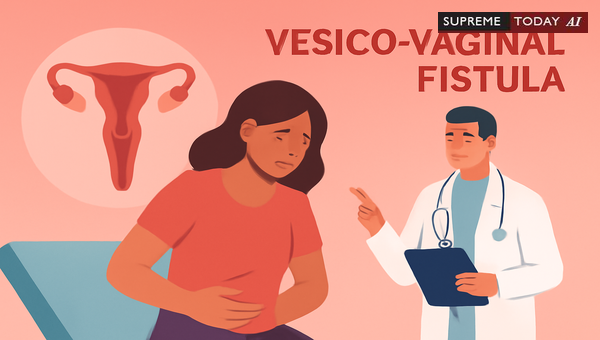
Vesico-Vaginal : Proving Doctor Negligence
Vesico-vaginal (VVF) is a distressing medical condition where an abnormal opening forms between the bladder and vagina, causing continuous urine leakage. Often linked to surgical procedures like hysterectomies, it raises critical questions about . Many patients wonder: Vasico Vaginal Negligency by Doctor – can a doctor be held liable, and how?
This blog post breaks down the legal framework in India, drawing from court precedents and expert analyses. While complications can occur without fault, proving negligence requires specific evidence. Note: This is general information, not legal advice. Consult a qualified lawyer for your case.
Understanding Vesico-Vaginal (VVF)
VVF typically arises post-surgery, prolonged labor, or infections. In surgical contexts, it's often a post-hysterectomy complication. As noted in one case, The is usually found in the vaginal vault (as in the complainant’s case)
. Another source highlights, It was found Vasico Vaginal (VVF) a post-hysterectomy complication 2025 Supreme(Online)(SCDRC) 2273.
Medical literature referenced in judgments explains: patient who have a post-operative vasico-vaginal develop a watery vaginal discharge after surgery
. Causes include bladder injury during suturing, but not all instances imply negligence.
Establishing in VVF Cases
To succeed in a negligence claim, plaintiffs must demonstrate the doctor's actions fell below the for a reasonable professional. Key principles include:
- : To prove , the plaintiff must show that the doctor's actions (or inactions) fell below the expected of a reasonable medical professional in similar circumstances 2022 0 Supreme(SC) 727 2022 7 Supreme 158.
- Not Every Complication Equals Negligence: Mere occurrence of a complication or adverse outcome during medical treatment does not automatically imply negligence. The doctor may not be liable if the complication was not reasonably foreseeable or preventable 2022 0 Supreme(SC) 727 2022 7 Supreme 158.
Courts emphasize genuine differences in medical opinion: There is scope for genuine difference of opinion and one professional doctor is clearly not negligent merely because his conclusion differs from that of other professional doctor 2025 Supreme(Online)(SCDRC) 2273.
Evaluating the Doctor's Response
Doctors aren't expected to operate impulsively. A measured approach can be defensible:
- The initial response of the doctor to not operate immediately and instead evaluate the nature of the leak and attempt to control the may be considered reasonable, provided it was medically advised 2022 0 Supreme(SC) 727 2022 7 Supreme 158.
- Conducting the operation at a later stage to tackle the perforation in the large bowel could also be justified if it was the medically appropriate course of action 2022 0 Supreme(SC) 727 2022 7 Supreme 158.
In one case, a urologist opined, the Appellant’s urinary bladder had got punctured on account of negligence of the Respondent while suturing the upper portion of the vagina during the hysterectomy
S. Girija VS A. Tulasi
, leading to compensation enhancement to Rs. 2,50,000 for medical expenses and agony.However, defenses succeed when evidence lacks: The complainant had developed Vasico Vaginal as a post operative complication and she did not have ureter vaginal . The complainant had not produced any to show that the first opposite party stitched ureter with vaginal flesh
GURUVAMMAL VS G. NAVANEETHAN (DR. )
. Courts ruled, Surgical complications may not always indicate , and a doctor cannot be held liable for following an acceptable medical practice.and Evidence Requirements
The onus lies on the plaintiff:
- The burden is on the plaintiff to prove, through credible medical evidence, that the doctor's actions or omissions amounted to negligence that caused the injury 2022 0 Supreme(SC) 727 2022 7 Supreme 158.
- Expert testimony is crucial to link negligence to the .
Corroboration isn't always mandatory: Corroboration of the plaintiff's testimony by medical evidence is not an absolute legal requirement, but rather a guidance of prudence 2006 5 Supreme 204 2012 0 Supreme(SC) 424. Courts may rely on plaintiff testimony alone absent compelling reasons.
The mere absence of evidence of active or abscess does not necessarily negate a claim of negligence 2021 0 Supreme(Raj) 443. In a hysterectomy case, absent discharge proof or post-op advice, the court inferred , awarding Rs. 50,000
.
Insights from Real Court Cases
Indian consumer courts have varied rulings:
- Negligence Found: In a tumor removal surgery, stitching the ureter to vaginal flesh caused leakage; though dismissed initially, appeals highlighted proof burdens
GURUVAMMAL VS G. NAVANEETHAN (DR. )
. Another awarded compensation for bladder puncture during hysterectomyS. Girija VS A. Tulasi
. - No Negligence: Post-hysterectomy VVF dismissed as inherent risk, lacking expert proof
GURUVAMMAL VS G. NAVANEETHAN (DR. )
. In a PID treatment case, delayed VVF attributed to , not surgery; repairs were deemed proper.
- Complications in Delivery: as a rare but known complication of birth injury
, not always negligent.
- Diagnosis Issues: Initial misdiagnosis of corrected later, questioning initial care 2025 Supreme(Online)(SCDRC) 19999.
Vacuum delivery led to , deemed rare but possible without fault 2025 Supreme(Online)(SCDRC) 6121.
These cases underscore: Expert evidence and are pivotal.
Building a Strong Claim: Recommendations
To pursue a VVF negligence claim:1. Gather medical records, including pre/post-op notes.2. Secure independent expert opinions on breaches.3. Prove between doctor's acts and .4. File in under the .
Overcome defenses like unforeseeable risks or patient factors (e.g., intercourse claims, often unproven without evidence).
Key Takeaways
- VVF post-surgery may indicate negligence but requires proof of substandard care and 2022 0 Supreme(SC) 727 2022 7 Supreme 158.
- Courts balance patient rights with medical realities, favoring evidence-based claims.
- Compensation, when awarded, covers expenses, agony, and costs – e.g., enhanced to Rs. 2.5 lakhs
S. Girija VS A. Tulasi
.
If facing VVF after treatment, document everything and seek legal/medical advice promptly. Justice hinges on robust evidence, not mere outcomes.
Disclaimer: This article provides general insights based on precedents. Laws evolve, and outcomes vary. Always consult a legal professional for personalized guidance.
#MedicalNegligence, #VVF, #PatientRights














